
Fir mite
Dendrolaelaps abietis
Description
How to identify
The fir mite (Dendrolaelaps abietis) belongs to the order Mesostigmata and the family Digamasellidae. These are small predatory or mycophagous gamasid mites closely associated with subcortical insects.
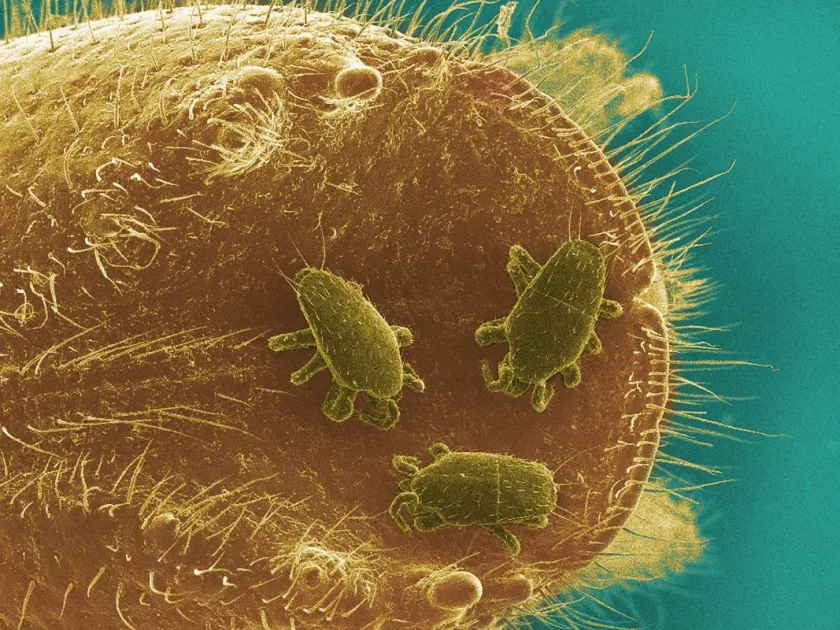
Adult specimens exhibit a typical gamasid body structure: oval, flattened, and equipped with a well-developed dorsal shield. Their coloration ranges from pale yellow to brown depending on age and diet.
These mites lead a mostly hidden lifestyle, inhabiting the space under tree bark, within the galleries of stem-boring insects, and in the forest floor litter. Their morphology is highly adapted for crawling through narrow crevices between wood and bark.
Specific identification usually requires microscopic analysis, as distinguishing Dendrolaelaps abietis from related species involves examining the structure of the chelicerae and the arrangement of setae on the dorsal shield.
The life cycle includes egg, larva, protonymph, deutonymph, and adult stages. Unlike many other mites, the deutonymph stage often serves as a phoretic stage, hitchhiking on host insects to move between trees.
What it damages
This species is linked to damage in various conifer species, primarily fir (Abies), and occasionally spruce and pine. The primary damage occurs in weakened trees within forest stands.
Mites often act as phoretics (hitchhikers) on bark beetles, particularly species of the genera Ips and Pityogenes. They migrate into the galleries excavated by these insects under the bark.
The presence of these mites exacerbates the pathological impact on the tree, as they can serve as vectors for fungal spores that cause wood rot and vascular diseases.
The primary harmful effect is that the accumulation of mites in galleries degrades the physiological state of the cambium, which hinders the tree's ability to heal wounds caused by stem-boring insects.
During bark beetle outbreaks, the mite population density can reach critical levels, accelerating the decline and death of trees already under attack by phytophagous insects.
When it appears
The activity of Dendrolaelaps abietis is directly dependent on the phenology of its host insects. The first peak of activity occurs in spring when bark temperatures rise above freezing.
The summer period is characterized by peak population densities, as this coincides with the flight and reproductive phase of bark beetles, which provide transport and habitat for the mites.
In autumn, as average daily temperatures decline, the mites begin migrating into deeper bark layers or the leaf litter to enter a state of diapause for the winter.
The life cycle of this species is relatively short, allowing the mite to produce multiple generations within a single growing season under favorable climatic conditions.
The lifespan of each generation depends on the humidity of the subcortical space; excessive dryness inhibits development, while high humidity promotes rapid population growth.
Signs of infestation
External signs of mite presence are often obscured by the activities of bark beetles, necessitating a detailed inspection of the wood in areas with bark necrosis.
The presence of "boring dust" (frass) on the trunk or at the base of the tree is an indirect sign of a complex of insects and mites developing under the bark.
When removing sections of bark in affected areas, one can often find colonies of small, mobile mites moving across the wood surface or on the bodies of bark beetles.
A characteristic sign is the darkening of the phloem and the presence of fungal infection spots, the spread of which is facilitated by this mite species.
The wilting of individual branches or discoloration of needles at the tree crown is often a consequence of a pest infestation complex, including Dendrolaelaps abietis, forming under the bark of the trunk.
Control measures
Sanitary logging is the primary method for controlling pest populations. Removing trees infested with bark beetles effectively disrupts the mite's developmental cycle.
Cleaning forest stands of logging residues eliminates breeding and overwintering sites for the mites, significantly lowering the infection pressure in the forest.
The use of pheromone traps to capture stem-boring insects indirectly affects mite populations by limiting their opportunities to disperse to new, healthy trees.
Biological control methods involve preserving natural entomophagous predators that help regulate the numbers of both bark beetles and specialized gamasid mites in the forest ecosystem.
In forest nurseries or ornamental plantings, systemic insecticides (subject to local regulations) may be used for trunk treatment to prevent the initial colonization of trees by bark beetles.
Taxonomy
- Latin name
- Dendrolaelaps abietis
- Order
- Mites
- Family
- Digamasellidae
- EPPO code
- DDRLAB
Discussion
No discussions yet — be the first.