
Pine bark beetle (vitei)
Dendroctonus vitei
Description
How to identify
Dendroctonus vitei is a species of bark beetle belonging to the Curculionidae family. It is a specialist pest that targets various pine species, playing a significant role in forest ecology and management.
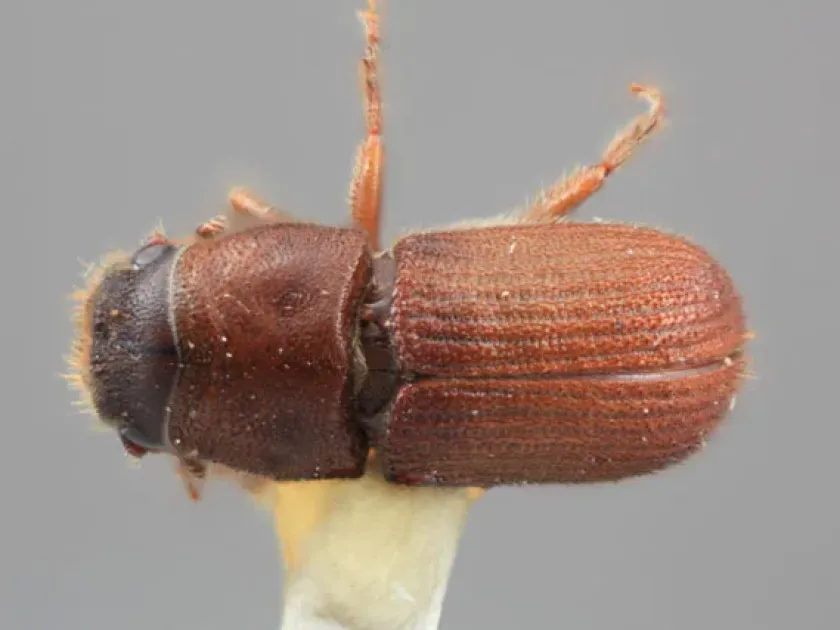
The adult beetle is typically 5-7 mm long, characterized by a cylindrical body shape and a dark brown to black coloration. The body is covered with setae, providing protection while tunneling.
Larvae are legless, white, and possess a robust head with powerful mandibles. They spend their entire developmental cycle within the bark and cambium layers of the host tree.
Taxonomically, the species is closely related to other Dendroctonus members, sharing similar biological characteristics, but it is distinct in its host preference and habitat selection near the root collar.
Identification often requires careful inspection of the galleries under the bark, which exhibit specific patterns distinctive to this species compared to common pine weevils or other beetles.
What it damages
The primary damage is caused by the boring activities of the beetles and their larvae. By excavating tunnels under the bark at the root collar, they disrupt the phloem and cambium tissue.
This disruption prevents the flow of nutrients and water throughout the tree, leading to decline, chlorosis of the needles, and eventual mortality of the infested specimen.
Young plantations and stressed stands are particularly susceptible. In epidemic years, even seemingly healthy mature trees can succumb to massive attacks by the beetle population.
Infestation sites often serve as breeding grounds for secondary pests and pathogens, accelerating the death of the tree and increasing the economic loss for forestry operators.
The damage is especially critical because it often affects the lower trunk and root zone, which are the most vital areas for tree stability and resource uptake.
When it appears
The emergence of Dendroctonus vitei is highly temperature-dependent. Adults usually begin their activity in the spring, once temperatures are consistently high enough for flight.
Depending on the climatic zone, the beetle may complete one or two generations per year. Warm, extended summers often lead to increased population densities and severe damage.
Winter is typically spent in the adult stage, hiding in the soil or protected sections of the bark at the base of the tree, remaining inactive until the following spring.
The mating and egg-laying process occurs during the active season, requiring constant vigilance from foresters during the warm months when the beetles are most mobile.
Understanding the life cycle is crucial for scheduling preventive measures, such as bark treatments or trap tree placement, to minimize the impact of the next generation.
Signs of infestation
The presence of fine wood dust, often called "frass," at the base of the trunk is one of the most reliable indicators of recent boring activity by the beetles.
As the tree's vascular system fails, the needles begin to fade from green to yellow and eventually turn reddish-brown, marking the advanced stages of the infestation.
Entry holes on the trunk or near the roots are visible upon close inspection, sometimes accompanied by resin pitch tubes if the tree has attempted a defensive response.
Bark loosening is a significant sign of severe damage, indicating that the galleries have extensively undermined the protective outer layer of the tree.
If a tree shows localized wilting or crown thinning without obvious mechanical damage, it should be checked for underlying bark beetle activity at the root collar.
Control measures
Sanitation cutting is the primary method of control. Removing and properly disposing of infested trees helps disrupt the beetle's life cycle and prevents it from spreading to healthy trees.
Trap trees and pheromone-baited traps are effective tools for monitoring population trends and suppressing beetle numbers in localized high-risk areas.
In nurseries or high-value forest plots, targeted insecticide applications may be used during the beetle flight period to prevent colonization, provided they are environmentally regulated.
Promoting forest health through proper silvicultural practices, such as maintaining appropriate tree density and thinning, helps trees remain resilient against attacks.
- Conduct regular forest inventory and monitoring.
- Ensure rapid removal of windthrown or damaged timber.
- Foster natural predators such as woodpeckers and parasitic wasps.
Taxonomy
- Latin name
- Dendroctonus vitei
- Order
- Coleoptera (beetles)
- Family
- Curculionidae
- EPPO code
- DENCVI
Discussion
No discussions yet — be the first.