
Red turpentine beetle
Dendroctonus valens
Description
How to identify
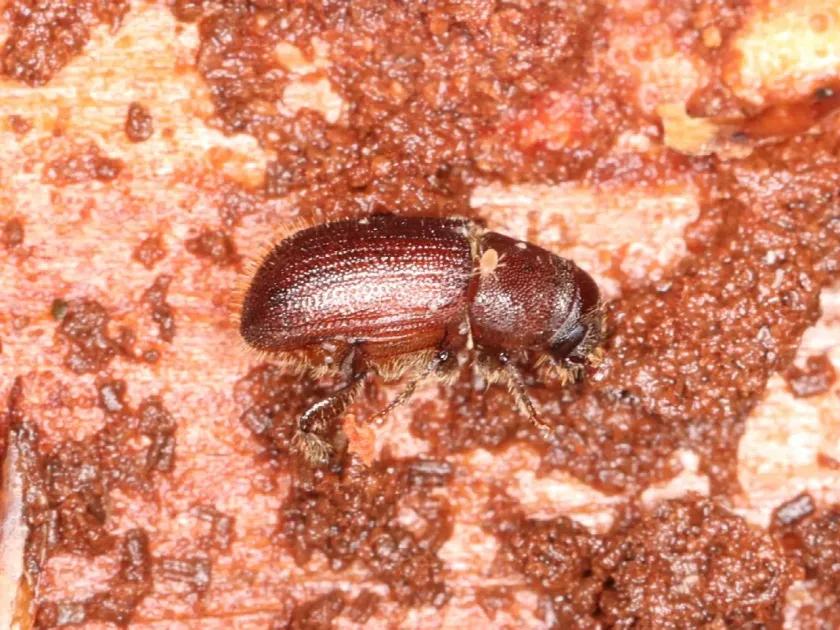
The red turpentine beetle is a member of the Curculionidae family, subfamily Scolytinae. Adult beetles are large for bark beetles, measuring up to 10 millimeters in length, with a reddish-brown to dark brown coloration.
The body is cylindrical and covered with fine, dense hairs, which is a key identification feature. The pronotum is noticeably narrower than the elytra, and the elytra have distinct rows of punctures along their surface.
Larvae are white, crescent-shaped, and possess a dark brown head capsule. They undergo several developmental stages, feeding and growing within the inner bark of the host tree.
Pupation occurs in specialized chambers created by larvae near the base of the tree. The pupa resembles the adult beetle in form but is white and inactive during this metamorphosis phase.
This beetle is distinct from other species due to its specific habit of attacking the lower portion of the trunk and the root collar, rather than the upper canopy or branches.
What it damages
The primary hosts of the red turpentine beetle are various pine species. In cases of high population density or stress, it can also infest spruces, firs, and other conifers found within the landscape.
Both adult beetles and larvae cause damage by tunneling through the bark and the cambium layer. These galleries disrupt the tree's vascular system, preventing the transport of water and nutrients.
The infestation weakens the tree significantly. Massive attacks on stressed trees, often caused by drought, fire, or previous injury, can lead to the rapid decline and death of the host plant.
The beetle acts as a vector for various pathogenic fungi. As the insects burrow into the tree, they introduce fungal spores, which cause sapwood decay and further accelerate the tree's decline.
Damage to the root collar is particularly dangerous because this area is essential for the tree's structural integrity and overall physiological health, making it a critical point of attack.
When it appears
Adult beetles emerge from overwintering sites in early spring, once the average daily temperature reaches approximately 10–12 degrees Celsius. They immediately begin searching for suitable host trees.
The peak flight period coincides with the start of the sap flow season, as stressed trees become highly attractive due to the release of resin and volatile organic compounds.
Depending on the climatic region, the beetle may complete one to two generations per year. Warmer southern climates allow for a faster life cycle and more frequent brood development throughout the summer.
As autumn approaches, activity levels decrease significantly. Adult beetles prepare for winter by moving into the forest floor or deeper into the bark near the base of the tree for protection.
Overwintering as adults provides a survival advantage, allowing the beetles to endure cold temperatures and resume activity promptly when favorable conditions return in the following spring.
Signs of infestation
The presence of boring dust, often called "frass," at the base of the tree is the most reliable early indicator of an active infestation. This debris is pushed out of the galleries by the beetles.
Pitch tubes—masses of resin mixed with boring dust—often form on the outer bark at the entry holes. This is the tree's natural defense mechanism, attempting to "pitch out" the invading insects.
Yellowing or browning of the needles, starting from the lower branches and moving upwards, indicates severe vascular damage. The canopy gradually thins as the tree fails to maintain its foliage.
Peeling back a section of the bark reveals the complex gallery network created by the larvae. The presence of these galleries is a diagnostic confirmation of beetle activity.
- Accumulation of boring dust at the base
- Pitch tubes on the trunk bark
- Discoloration and yellowing of foliage
- Visible larval galleries beneath the bark
- Reduced tree vigor and overall decline
Control measures
Sanitation is the most effective management strategy. Removing infested or dead trees reduces the local population and prevents the spread of the beetle to healthy neighboring trees.
Silvicultural practices, such as clearing logging debris and thinning stands, help maintain tree vigor and make the forest less susceptible to mass attacks.
Trap trees can be used strategically; by felling a few trees early in the season, foresters can attract beetles to a specific site and destroy them along with the brood before the next generation emerges.
Biological control methods involve encouraging natural enemies, such as parasitic wasps and predatory beetles, which can significantly reduce bark beetle population levels.
In high-value ornamental trees or nursery settings, systemic insecticides may be applied to the trunk. Treatment must be timed carefully according to the beetle's life cycle for maximum efficacy.
Taxonomy
- Latin name
- Dendroctonus valens
- Order
- Coleoptera (beetles)
- Family
- Curculionidae
- EPPO code
- DENCVA
Discussion
No discussions yet — be the first.