
Black turpentine beetle
Dendroctonus terebrans
Description
How to identify
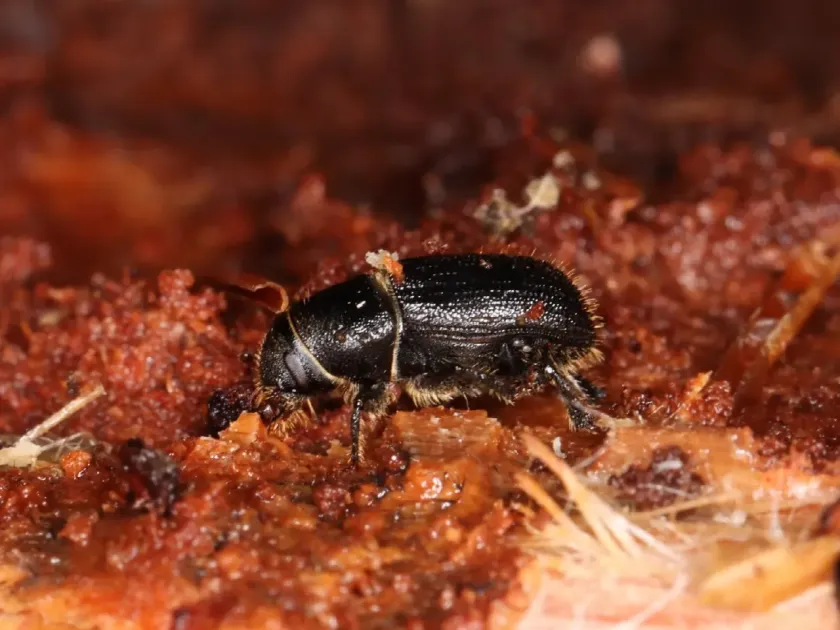
The black turpentine beetle Dendroctonus terebrans belongs to the family Curculionidae and the subfamily Scolytinae. This insect has a robust, cylindrical body ranging from 6 to 9 millimeters in length, colored reddish-brown to almost black.
The beetles possess powerful mandibles adapted for boring through the thick bark of coniferous trees. The surface of the elytra is covered with dense, short hairs, which is a distinctive morphological feature of the species.
The larvae are legless, white in color with a brown head capsule, reaching approximately 10 millimeters in length. During their development, they create broad galleries under the bark, feeding on the inner bark tissues.
Pupation occurs in specialized chambers created under the bark. The entire life cycle of the pest is closely associated with the basal area of the tree trunk and the root collars of pine species.
Unlike other bark beetles that colonize the upper canopy, this species typically attacks the lower portion of the tree, posing a severe threat to the root system integrity.
What it damages
The primary hosts of this beetle are various pine species, including loblolly, slash, and shortleaf pines in North America, where the species is endemic.
The pest targets both stressed and apparently healthy trees, showing a strong preference for areas with damaged bark or fresh stumps following logging activities.
The greatest damage occurs in young plantations and mature forest stands during drought periods when trees lose their natural resistance due to reduced oleoresin production.
Massive infestation of a tree leads to the cessation of sap flow and the subsequent death of the plant, often within one or two seasons.
In addition to direct tissue damage, the beetle often vectors fungal pathogens that accelerate wood decay and further weaken the host tree.
When it appears
Adult beetle activity begins in early spring as soon as air temperatures consistently rise above 12–15 degrees Celsius.
Females bore into the thick bark and deposit eggs in clusters, establishing large feeding sites for the future generation.
The developmental cycle from egg to adult depends on climate conditions and typically ranges from three to six months, allowing for multiple generations per year in warmer regions.
The peak of mass flight and mating occurs during the second half of summer, as adult beetles actively search for new hosts for feeding and oviposition.
The insects predominantly overwinter as adults, either in the soil near the root collar or directly under the thick bark at the base of the trunk.
Signs of infestation
The primary indicator of infestation is the presence of large, reddish-brown pitch tubes on the lower trunk, resembling solidified chunks of pine resin.
- Appearance of boring dust (frass) on the bark surface.
- Discoloration of needles to yellow or brown, typically starting at the crown.
- Presence of extensive vertical and horizontal galleries under the bark upon inspection.
- Loss of tree turgor and a noticeable decrease in resin exudation pressure.
Detecting pitch tubes within the first 1–2 meters from the ground is a critical warning sign that warrants an immediate phytosanitary inspection of the stand.
Control measures
The primary control method involves sanitation logging, aimed at removing infested and weakened trees before the new generation of pests can emerge.
Timely removal of logging residues and stumps is highly recommended, as these serve as the main breeding reservoirs for the beetle population.
The use of pheromone-baited traps allows foresters to monitor population densities and determine the optimal timing for protective interventions.
In nurseries and ornamental landscapes, the application of insecticidal treatments to the lower trunk during peak flight periods is effective.
Maintaining high forest stand vigor through proper silvicultural practices and adequate irrigation significantly reduces the likelihood of successful beetle colonization.
Taxonomy
- Latin name
- Dendroctonus terebrans
- Order
- Coleoptera (beetles)
- Family
- Curculionidae
- EPPO code
- DENCTE
Discussion
No discussions yet — be the first.