
Eastern larch beetle
Dendroctonus simplex
Description
How to identify
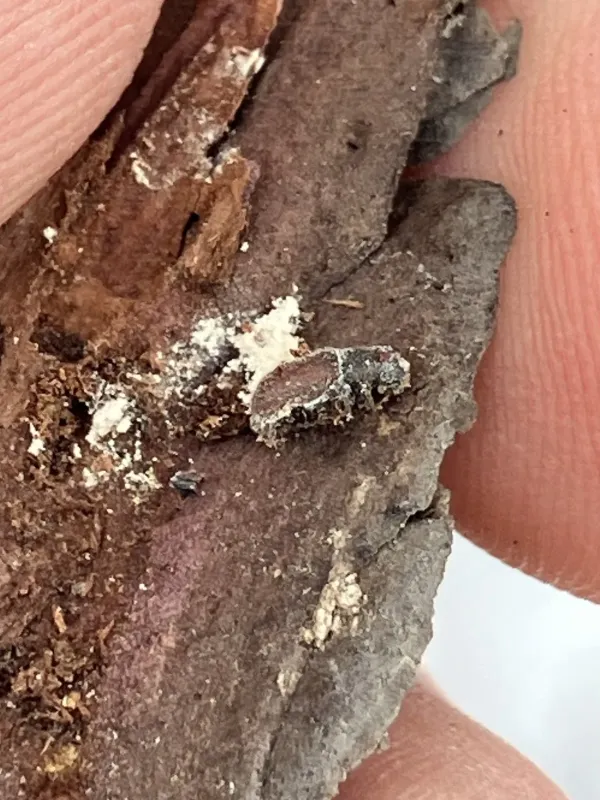
The Eastern larch beetle Dendroctonus simplex is a member of the Curculionidae family and the Scolytinae subfamily. Adult beetles are small, measuring approximately 4 to 6 millimeters in length, with a cylindrical body that varies in color from reddish-brown to dark brown or black.
This beetle is specifically adapted to feed on larch trees. The larvae are white, legless, and have a distinct yellowish head capsule, developing in the inner bark layer (phloem) of the host tree.
Eggs are deposited in galleries excavated by the female beetle. The development from egg through larval stages to pupation occurs entirely beneath the protective cover of the tree's bark.
Taxonomically, it is closely related to other Dendroctonus species. Correct identification often requires examining the gallery patterns, as these are diagnostic features for the species.
Understanding the life stages is crucial for managing infestations, as different stages have varying levels of susceptibility to environmental factors and control treatments.
What it damages
The primary host for this pest is the larch tree (Larix species). The beetle preferentially attacks mature or weakened trees, though it can also infest healthy trees during massive outbreaks.
Damage is caused by both adults and larvae feeding on the phloem and cambium. This feeding activity disrupts the tree's vascular system, preventing the transport of nutrients and water from roots to the crown.
Severe infestations result in the rapid death of the tree. The initial signs of decline are often followed by the browning of needles and significant crown thinning, leading to total mortality.
Besides killing trees, the beetle acts as a vector for various blue-stain fungi. These fungi colonize the sapwood and significantly degrade the quality of the timber, rendering it useless for most commercial purposes.
In forest stands, the presence of these beetles can lead to significant ecological shifts and economic losses, particularly in areas where larch is a commercially important species.
When it appears
The flight period for adult beetles typically occurs in late spring or early summer, depending on local temperatures. This is when the beetles disperse to find and colonize new host trees.
The lifecycle duration is variable and highly dependent on climatic conditions. In warmer southern ranges, there may be multiple generations per year, whereas in northern ranges, development can span two years.
Larvae are most active during the summer months, growing and creating extensive galleries. By the time autumn arrives, most beetles have usually reached the pupal or adult stage.
Overwintering usually takes place in the adult stage under the bark or in the leaf litter at the base of the tree. This strategy allows the species to survive harsh winter temperatures.
Outbreaks are frequently associated with periods of drought or other environmental stresses that lower the natural resistance of the larch trees.
Signs of infestation
One of the earliest signs of an infestation is the presence of boring dust, which appears as reddish-brown wood particles or frass accumulating in bark crevices or at the base of the tree.
Resin streamers or pitch tubes on the surface of the bark are classic indicators of an attempted infestation, where the tree is trying to defend itself by pushing the beetle out with sap.
Needle discoloration is a critical sign of systemic failure. As the tree's circulation system is severed, the needles turn yellow, then brown, and eventually drop off.
Peeling back a piece of bark reveals the characteristic gallery system. These galleries are typically long and vertical, with the larval galleries branching out perpendicular to the main tunnel.
Exit holes, which are small and round, indicate that the new generation of adult beetles has emerged and moved on to continue the infestation cycle.
Control measures
The primary management strategy for the Eastern larch beetle is the prompt identification and removal of infested trees (sanitation logging). This prevents the build-up of beetle populations.
Pheromone-baited traps can be used as a monitoring tool to track beetle flight times and population densities, helping forestry managers make informed decisions.
Maintaining a healthy, vigorously growing forest stand is the best long-term defense. Thinning overcrowded stands helps improve the resistance of remaining trees to beetle attacks.
Biological control efforts include the protection of natural predators, such as woodpeckers and various species of parasitic wasps, which can help keep beetle populations in check.
- Regular forest health monitoring and surveys.
- Removal and destruction of infested timber before adult emergence.
- Promoting stand diversity to increase ecosystem resilience.
- Using trap trees to aggregate and subsequently eliminate beetle populations.
Taxonomy
- Latin name
- Dendroctonus simplex
- Order
- Coleoptera (beetles)
- Family
- Curculionidae
- EPPO code
- DENCSI
Discussion
No discussions yet — be the first.