
Spruce beetle
Dendroctonus rufipennis
Description
How to identify
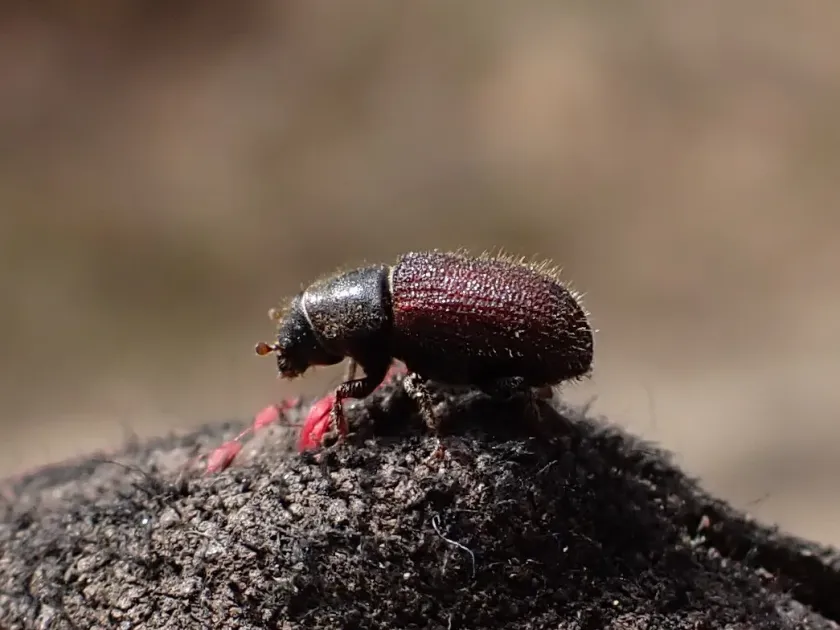
The spruce beetle (Dendroctonus rufipennis) is a member of the Curculionidae family and the Scolytinae subfamily. Adults are small, cylindrical beetles, typically measuring 5 to 7 mm in length, with a dark brown to black coloration.
Larvae are legless, white with a brown head capsule, and usually develop within the inner bark. Pupae are creamy white and are also found in galleries under the bark.
This beetle is a primary pest of spruce forests, known for its ability to attack and kill seemingly healthy, mature trees across large areas.
Taxonomically, it is classified as a significant wood-boring insect that relies on the phloem of conifers for development.
It is one of the most destructive forest pests in North America, often causing massive timber losses in boreal and temperate forests.
What it damages
The primary hosts of the spruce beetle are various spruce species, including Sitka spruce, Engelmann spruce, and white spruce.
When populations reach epidemic levels, they can devastate large stands of trees, impacting local ecosystems and timber supplies significantly.
The beetles bore through the outer bark and construct galleries in the phloem, effectively girdling the tree and interrupting nutrient flow.
Blue-stain fungi are often introduced by the beetles during the attack, which accelerates the death of the tree by clogging its vascular system.
Economic damage includes a drastic reduction in timber quality, devaluation of forest land, and an increased risk of long-term landscape changes due to mortality.
When it appears
The spruce beetle lifecycle typically spans one to three years, heavily influenced by temperature and the surrounding climate.
Adult emergence generally occurs during the summer months, often starting in early June and lasting until August, depending on the latitude.
During the flight period, beetles seek out new host trees by detecting semiochemicals released by stressed or mature trees.
The winter months are usually spent as larvae or adults under the bark, which provides insulation against extreme cold temperatures.
Because the development can be staggered, multiple cohorts may be present in a stand at the same time, complicating standard control efforts.
Signs of infestation
The most visible sign of an infestation is the presence of reddish-brown boring dust collecting in bark crevices and at the base of the tree.
Coniferous trees often attempt to push the beetles out by secreting resin, resulting in the formation of resin pitch tubes on the outer bark.
The needles on infested trees gradually transition from dark green to yellow and eventually fall off as the tree dies over several months.
Peeling back the bark will reveal the characteristic egg galleries and feeding patterns made by the larvae, which typically run parallel to the tree's grain.
- Reddish-brown boring dust at the tree base
- Resin pitch tubes on the trunk
- Fading or yellowing of the crown
- Galleries found underneath the bark
- Increased woodpecker activity on the tree
Control measures
Sanitation harvesting, which involves the rapid removal of infested and susceptible trees, remains the primary method of population suppression.
Farming management strategies like increasing stand diversity can make the forest less attractive to beetle populations over the long term.
Pheromone-based repellent traps are sometimes used in high-value areas to prevent beetle colonization by masking the scent of the host tree.
In smaller or high-value forest stands, trunk sprays with registered contact insecticides can protect individual trees from beetle attack.
Promoting natural biological control, such as protecting predatory beetles and woodpecker populations, is essential for maintaining forest resilience.
Taxonomy
- Latin name
- Dendroctonus rufipennis
- Order
- Coleoptera (beetles)
- Family
- Curculionidae
- EPPO code
- DENCRU
Discussion
No discussions yet — be the first.