
Spruce beetle
Dendroctonus punctatus
Description
How to identify
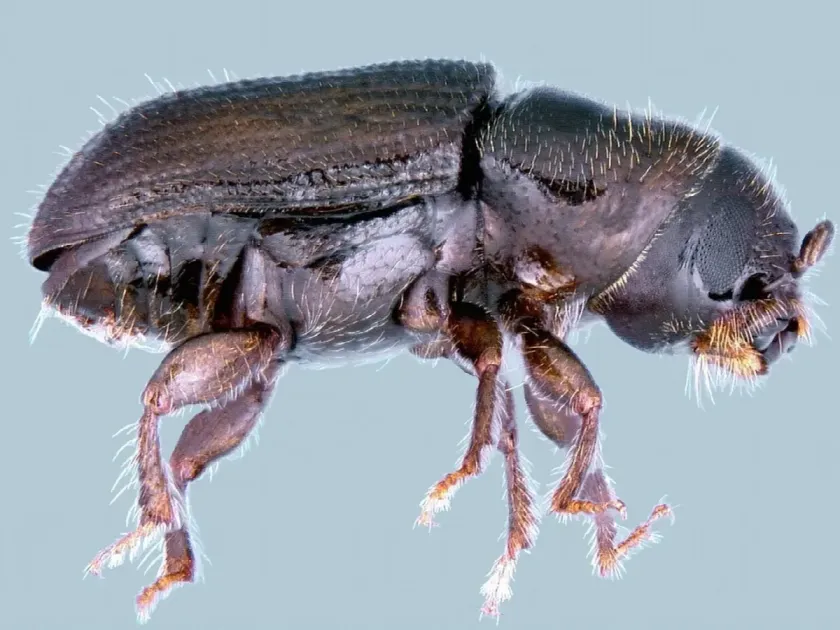
The spruce beetle (Dendroctonus punctatus) belongs to the order Coleoptera and the family Curculionidae (subfamily Scolytinae). Adults are typically 6–8 mm long with a cylindrical, robust body shape.
Their color ranges from reddish-brown to black, with distinct rows of punctures (pits) on the elytra, which is the defining characteristic of this specific species.
The larvae are legless, cream-colored grubs with a brown head capsule. They develop exclusively beneath the bark of spruce trees, tunneling through the nutrient-rich phloem.
As adults, they possess functional wings, enabling them to migrate over long distances to identify weakened or distressed host trees for colonization.
These beetles are primarily found in northern coniferous forests, thriving in dense, mature stands where tree competition or environmental stress provides suitable hosts.
What it damages
Spruce trees are the primary host for this beetle. It prefers trees that have been compromised by drought, windthrow, or previous insect and disease attacks.
Adults bore into the bark to create egg galleries, and the emerging larvae mine the inner bark (phloem), which effectively severs the tree's vascular system.
Massive infestations often lead to the rapid girdling of the tree, resulting in total nutritional failure and the subsequent death of the spruce.
The damage is often catastrophic in localized areas, especially during warm, dry years when beetle reproductive rates increase and trees are less able to produce resin to repel attackers.
Furthermore, these beetles often introduce blue-stain fungi into the tree, which further obstructs water transport and speeds up the decline of the host tree.
When it appears
Adult activity begins in the spring, typically from May to June, as temperatures reach levels that trigger flight and mating behavior.
The peak period for egg-laying occurs during the mid-summer months, during which time the beetles are most mobile and aggressive in seeking new hosts.
The lifecycle length varies by region, usually completing one generation per year, although it can take two years in cooler, high-altitude environments.
Winter is spent in the larval or adult stage, huddled beneath the bark of the host tree or within the thick bark crevices at the base of the tree.
By late autumn, the beetles enter a diapause state to survive sub-zero temperatures, preparing to resume activity as soon as the following spring season warms up.
Signs of infestation
The most immediate indicator of an infestation is the presence of "frass" (bore dust) accumulating in bark crevices or at the base of the trunk.
Visual inspections often reveal resin globs (pitch tubes) on the bark surface, where the tree has attempted to flush out the invading beetles.
Changes in canopy color are a later symptom, where the needles fade from healthy green to a sickly yellow, and eventually to a reddish-brown hue.
If the bark is carefully removed, characteristic gallery patterns specific to Dendroctonus punctatus will be visible on the inner surface of the bark.
In the final stages, the bark may begin to slough off the trunk in large sections, indicating that the tree is completely dead and the beetles have moved on.
Control measures
Sanitation harvesting is the most effective management strategy; removing and processing infested trees before the beetles emerge is critical to local control.
Pheromone-based trapping systems are used to monitor beetle population levels and can also be used as a diversionary tactic to protect high-value areas.
Maintaining forest hygiene, including the prompt removal of windthrown timber and debris, helps prevent the buildup of beetle populations in the landscape.
For ornamental or high-value urban trees, systemic insecticides or protective bark sprays can be applied as a preventive measure against adult attacks.
- Regular aerial and ground forest health surveys
- Use of "trap trees" to concentrate and destroy populations
- Prompt disposal or debarking of infested timber
- Encouraging natural predators like woodpeckers and parasitic wasps
Taxonomy
- Latin name
- Dendroctonus punctatus
- Order
- Coleoptera (beetles)
- Family
- Curculionidae
- EPPO code
- DENCPU
Discussion
No discussions yet — be the first.