
Douglas-fir beetle
Dendroctonus pseudotsugae
Description
How to identify
The Douglas-fir beetle (Dendroctonus pseudotsugae) is a species of bark beetle within the family Curculionidae. Adult beetles typically measure between 4 to 7 mm and are characterized by a dark brown to black coloration.
Their bodies are cylindrical and sturdy, an evolutionary adaptation for excavating tunnels beneath the bark of host trees. The larvae are cream-colored, legless grubs with a distinct brown head capsule.
Taxonomically, they belong to the order Coleoptera. This species is highly specialized, relying on chemical signaling (pheromones) to coordinate mass attacks on host trees.
Native to Western North America, these beetles have evolved a complex life cycle that allows them to thrive in the specific micro-environment found under the thick bark of Douglas-firs.
Their behavior is driven by the need to secure nutrient-rich phloem while overcoming the chemical defenses, such as resin, produced by the host tree.
What it damages
The primary host for this pest is the Douglas-fir (Pseudotsuga menziesii). While they prefer Douglas-fir, they may occasionally attack larch or other conifers when populations are high.
The beetle targets trees that are stressed by factors such as drought, root disease, or mechanical damage. Healthy trees are usually successful in fending off small-scale attacks.
However, during outbreak conditions, the sheer number of beetles can overwhelm even healthy trees, leading to widespread mortality across managed and wild forests.
Damage is inflicted by the gallery-building behavior of larvae, which physically disrupts the transport of sugars and water, effectively girdling the tree and causing its death.
The ecological and economic impact includes the loss of standing timber, increased fuel loads for wildfires, and a significant reduction in the aesthetic and environmental value of forest tracts.
When it appears
Adult flight and colonization typically occur in the spring, once temperatures become consistently warm, often between April and June depending on the latitude and elevation.
After finding a suitable host, the female initiates gallery construction. Egg-laying happens as the gallery progresses, with larvae feeding throughout the summer months.
The species usually has one generation per year, though development can vary based on local climatic conditions and the overall thermal environment within the tree bark.
Overwintering occurs primarily in the late larval or adult stage. These stages remain dormant under the bark until the temperatures rise the following spring.
The timing of the initial spring flight is a critical factor for forest managers, as pheromone-based monitoring must be deployed just before the first emergence of adults.
Signs of infestation
The most visible sign of an attack is the presence of reddish-brown boring dust at the base of the tree and in the crevices of the bark, produced by beetles as they bore in.
Fading of the foliage is a late-stage symptom. Needles often turn pale green, then yellow, and finally red-brown, indicating that the tree's vascular system has been compromised.
Resin streamers, or "pitch tubes," are often seen on the bark surface. These occur when the tree attempts to push the attacking beetle out of the tunnel using its sap.
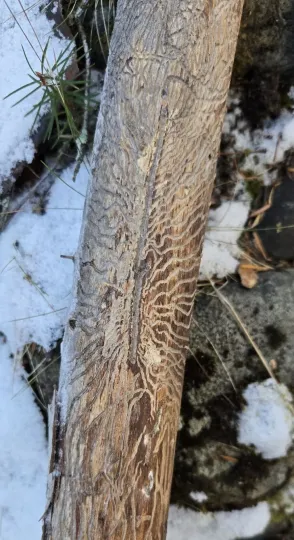
Under the bark, the diagnostic pattern consists of vertical maternal galleries with horizontal larval tunnels spreading out from the central line.
Bark sloughing or large sections of bark falling off the tree are indicators that the infestation has reached its peak and the tree is likely already dead or dying.
Control measures
Sanitation harvest is the most effective management tool. This involves identifying and removing infested trees before the next generation of beetles emerges and spreads to new hosts.
Pheromone-based repellent treatments, such as MCH (Methylcyclohexenone), can be applied to high-value trees to prevent mass attack during outbreak years.
Proper management of slash and logging debris is essential. Leaving large amounts of fresh Douglas-fir wood in the forest after harvesting can create a breeding ground for local beetle populations.
Promoting forest health through thinning and maintaining tree vigor is a long-term strategy to reduce the susceptibility of stands to beetle attacks.
- Early detection using pheromone traps;
- Prompt removal of infested timber;
- Avoidance of storing fresh logs near healthy stands;
- Encouraging bird predators like woodpeckers in forest management plans.
Taxonomy
- Latin name
- Dendroctonus pseudotsugae
- Order
- Coleoptera (beetles)
- Family
- Curculionidae
- EPPO code
- DENCPS
Discussion
No discussions yet — be the first.