
Mountain pine beetle
Dendroctonus ponderosae
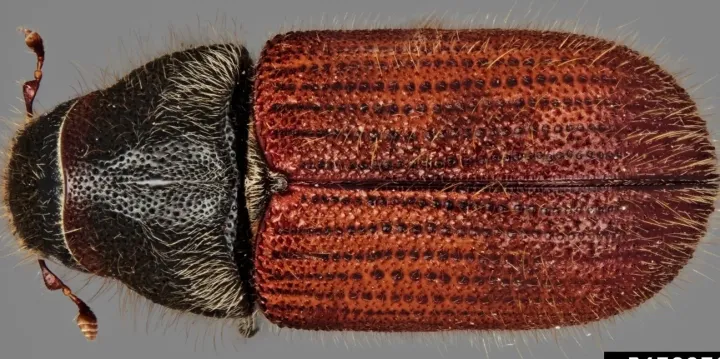
Description
How to identify
The mountain pine beetle (Dendroctonus ponderosae) is a destructive insect belonging to the Curculionidae family, subfamily Scolytinae. It is native to the forests of western North America.
The adult beetle is small, cylindrical, and black or dark brown in color, usually ranging in length from 4 to 7.5 millimeters. Its head is tucked under its pronotum.
The larvae are white, legless, and have a distinct dark-colored head. They feed on the inner bark, which is the layer between the wood and the outer bark of the pine tree.
This species is highly social in its attack behavior, using aggregation pheromones to coordinate mass attacks on healthy host trees, effectively overwhelming the tree's defenses.
The lifecycle is generally univoltine, meaning there is one generation per year, although warmer temperatures can accelerate development in certain climate zones.
What it damages
Mountain pine beetles primarily infest various pine species, including lodgepole pine, ponderosa pine, and limber pine. The infestation often leads to the death of the tree.
Adult beetles tunnel into the tree to lay eggs. These galleries interrupt the flow of nutrients and water, essentially starving the tree to death within weeks or months.
As the beetles tunnel, they introduce blue-stain fungi into the tree's sapwood, which further inhibits the tree's ability to resist the insect attack and defend itself.
Large-scale outbreaks can cause landscape-level changes in forest structure, leading to millions of hectares of dead timber, which poses a significant wildfire risk.
The economic impact of this pest is profound, affecting timber value, carbon sequestration, and the overall biodiversity of the forest ecosystem.
When it appears
Adult beetles typically emerge from infested trees during the summer months, usually between July and August, to seek new host trees.
The flight period is critical for the population expansion, as beetles must find suitable hosts before the onset of winter temperatures, which can kill off larvae.
Egg-laying happens shortly after arrival at the new host. The larvae then develop through the autumn, over-wintering inside the tree bark as larvae or pupae.
Springtime brings continued development, with the insects pupating in the bark and preparing for the next year's emergence and migration.
Temperature patterns are a major driver of the beetle's seasonal timing; mild winters often lead to higher survival rates of the developing brood.
Signs of infestation
One of the earliest signs of attack is the presence of "pitch tubes" — clumps of resin mixed with boring dust found on the outer bark of the tree.
As the tree dies, the needles turn from green to yellow, and then to a characteristic reddish-brown color, which can be seen from a distance.
The presence of fine, sawdust-like boring material at the base of the tree is a strong indicator of active colonization by the beetles.
Peeling back the bark reveals clear gallery patterns, which are vertical tunnels where the female has laid eggs and the larvae have fed.
Increased woodpecker activity on a specific tree is often an indicator that beetles are present, as the birds attempt to feed on the larvae under the bark.
Control measures
Management strategies involve the removal of infested trees during the winter months before the beetles emerge to infect new stands in the spring.
Pheromone-based repellent treatments or baiting logs can be used to manage beetle movement and protect high-value trees in parks or recreation areas.
Silvicultural practices, such as thinning forests to reduce density, create less favorable conditions for the beetles and help keep the remaining trees healthy.
Research into biological control agents and fungal pathogens shows potential for reducing local populations, though these are not yet widespread solutions.
- Sanitation harvesting of infested timber
- Deployment of pheromone traps
- Forest density management and thinning
- Regular forest health monitoring
- Public education on tree protection
Taxonomy
- Latin name
- Dendroctonus ponderosae
- Order
- Coleoptera (beetles)
- Family
- Curculionidae
- EPPO code
- DENCPO
Discussion
No discussions yet — be the first.