
Dendroctonus parallelocollis
Dendroctonus parallelocollis
Description
How to identify
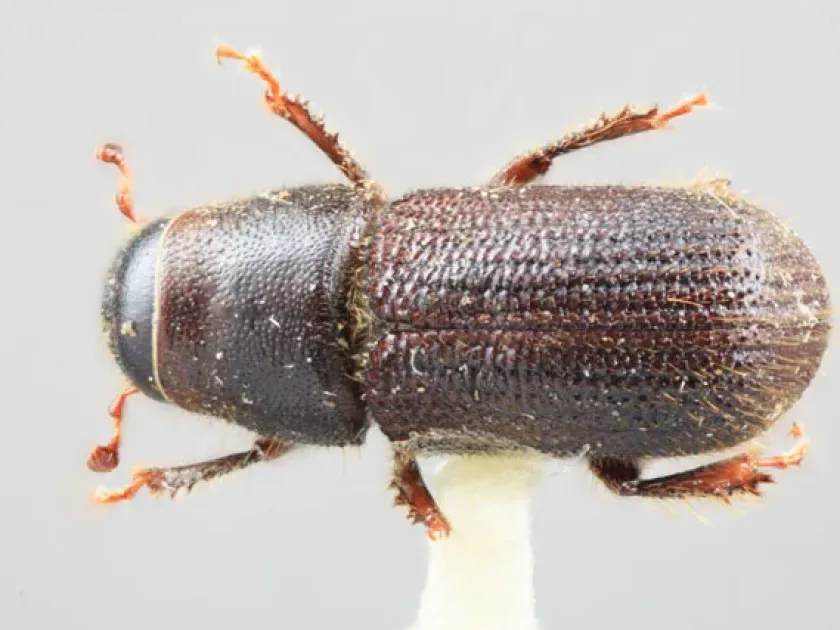
Dendroctonus parallelocollis is a species of bark beetle belonging to the order Coleoptera and the family Curculionidae (subfamily Scolytinae). Like other members of the genus Dendroctonus, it is a robust, cylindrical insect.
The adult beetle is typically dark brown or black in color. A distinguishing feature is the presence of distinct punctation on the pronotum, which serves as a key identifier for this specific species.
Adults measure approximately 4 to 6 millimeters in length. While there are subtle morphological differences between males and females, they share the same characteristic beetle anatomy required for boring into wood.
The larvae are white, legless grubs with a curved body and a well-developed, hardened head capsule, which they use to navigate through the inner bark layers.
Pupation occurs within small, oval-shaped chambers excavated by the mature larvae in the outer sapwood or the inner bark, where the insect completes its metamorphosis.
What it damages
This pest primarily infests coniferous trees, with a strong preference for various species of pine within its natural range in North and Central America.
The beetle attacks both weakened trees and relatively healthy specimens, especially when beetle populations are high, leading to rapid colonization of entire forest stands.
The damage is caused by the adults and larvae tunneling through the cambium layer. This activity severs the flow of nutrients and water, ultimately causing the tree to wilt and die.
In high densities, Dendroctonus parallelocollis can lead to significant mortality across large forest areas, causing substantial economic losses in timber management.
The presence of dead or dying trees after an infestation significantly increases the risk of wildfires in the affected ecosystem due to the accumulation of dry biomass.
When it appears
The life cycle and activity of this beetle are closely tied to the regional climate and altitude. Adults typically emerge and fly in search of host trees during the warmer months.
Overwintering usually takes place in the adult stage, often sheltering under the thick bark of host trees or in the leaf litter at the base of the tree to withstand cold temperatures.
In the spring, as temperatures rise, the beetles initiate their flight to find suitable hosts for breeding, drilling new galleries to lay their eggs.
The number of generations per year is influenced by the length of the growing season, with larval development being most aggressive during the peak of summer heat.
Emergence of the new generation can occur in late summer or autumn, depending on the developmental progress achieved during the active season.
Signs of infestation
The most reliable early sign of an infestation is the presence of "frass" (fine boring dust) around the base of the tree or caught in bark crevices.
Upon closer inspection, the surface of the bark will show numerous small entrance holes made by the beetles as they drill into the tree's vascular system.
A change in foliage color is a classic symptom, progressing from healthy green to yellow, and eventually to a reddish-brown color as the tree succumbs to the infestation.
When the bark is peeled back, distinct gallery patterns are visible. The parent galleries typically run parallel to the wood grain, with larval galleries branching off to the sides.
Sticky resin exuding from the entry holes is a sign that the tree is attempting to "pitch out" the beetles, though this defense is often overwhelmed by mass attacks.
Control measures
The primary control method involves sanitation logging, where infested trees are harvested and removed before the next generation of beetles can emerge.
Proper disposal of slash and infested wood is critical to eliminate potential breeding grounds and break the pest's reproductive cycle.
Pheromone traps are extensively used for monitoring population levels and detecting the timing of beetle flights, which aids in timely management decisions.
Biological control methods focus on protecting and encouraging native predators and parasitoids that naturally prey upon bark beetle larvae and adults.
Good silvicultural practices, such as maintaining optimal stand density and thinning, help keep trees vigorous and less susceptible to bark beetle colonization.
Taxonomy
- Latin name
- Dendroctonus parallelocollis
- Order
- Coleoptera (beetles)
- Family
- Curculionidae
- EPPO code
- DENCPA
Discussion
No discussions yet — be the first.