
Murray pine beetle
Dendroctonus murrayanae
Description
How to identify
The Murray pine beetle (Dendroctonus murrayanae) is a species of bark beetle in the family Curculionidae. It is a wood-boring insect that occupies a specific ecological niche within coniferous forest ecosystems.
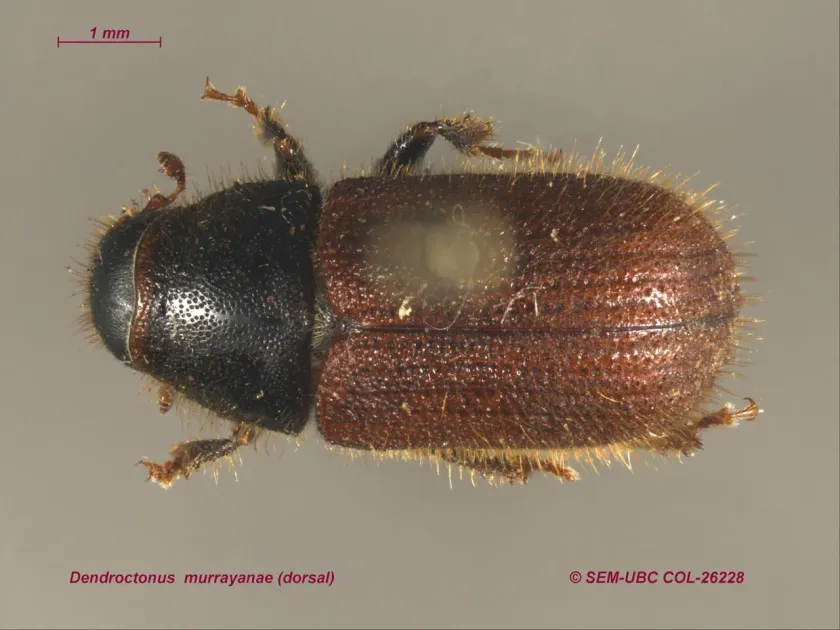
Adult beetles are small, cylindrical insects measuring approximately 5 to 7 millimeters in length. Their coloration ranges from dark reddish-brown to almost black, which provides camouflage against the pine bark.
The larvae are legless, creamy white grubs with a distinct sclerotized head capsule. They are exclusively adapted to feed on the inner bark, specifically the phloem and cambium layers of the host tree.
Taxonomically, the species is closely related to other Dendroctonus beetles, often sharing similar reproductive behaviors and host preferences within their natural range.
Identification in the field often requires examining the gallery patterns beneath the bark, as well as the adult morphology under a magnifying lens to distinguish it from other related species.
What it damages
The primary hosts for this beetle are pine species, particularly the lodgepole pine. It shows a strong preference for attacking the lower bole of the tree, often near the root collar.
By boring into the tree, the beetles create complex galleries that sever the vascular tissue, effectively girdling the tree. This disruption of nutrient and water flow leads to foliage discoloration and eventually tree death.
Furthermore, the beetles act as vectors for various blue-stain fungi. These fungi colonize the wood, accelerating the decay process and further weakening the tree's ability to defend itself against the infestation.
Trees of all ages can be attacked, but the beetle preferentially selects stressed, weakened, or windthrown individuals to establish its galleries and raise offspring.
In cases of high population density, the beetle can cause significant mortality in forest stands, impacting both commercial timber production and ecological forest structures.
When it appears
The activity of the Murray pine beetle begins in the spring when temperatures consistently rise above a specific threshold. This triggers the emergence of overwintering adults looking for new host trees.
Peak flight and host colonization typically occur during the warmer months, ranging from late spring to mid-summer depending on the local climate and elevation.
The life cycle usually spans one year. During this time, the insect completes stages including egg, larva, pupa, and adult, with the developmental rate highly dependent on ambient temperature.
Overwintering occurs primarily in the larval or adult stages beneath the bark. This allows the beetles to survive cold winter temperatures, shielded from the elements by the insulating properties of the wood.
As spring approaches, the insects resume development. The timing of this cycle is critical for management, as control measures must be implemented before the next generation of adults disperses.
Signs of infestation
The presence of fine, reddish-brown boring dust at the base of the tree is one of the most reliable indicators of a current infestation. This dust is produced as beetles tunnel through the bark.
Resin pitch tubes are often visible on the outer bark surface. These are lumps of resin mixed with boring particles, formed by the tree's defensive response to the beetles' entry attempts.
Foliage fading is a hallmark sign that the tree has been successfully colonized. The needles typically turn from green to pale yellow and finally to a reddish-brown color as the tree dies.
Removing a section of bark reveals the characteristic gallery patterns. These galleries are etched into the inner surface of the bark and the surface of the sapwood, serving as nurseries for the larvae.
Exit holes, small circular openings in the outer bark, indicate that the new generation of adult beetles has successfully matured and emerged from the tree.
Control measures
Sanitation cutting is the primary management tool. By identifying, felling, and removing infested trees, managers can significantly reduce the beetle population within a forest stand.
Pheromone-baited traps are frequently used to monitor population levels and can sometimes be used to manage localized outbreaks by attracting beetles away from healthy trees.
Improving stand vigor through proper thinning and site management reduces the likelihood of successful colonization, as healthy trees are better equipped to withstand beetle attacks.
In ornamental or high-value urban settings, systemic insecticides may be applied to the base of the tree or via trunk injection to prevent beetle entry and colonization.
Integrated pest management programs emphasize early detection and rapid response, ensuring that infested material is processed or destroyed before the next flight season begins.
Taxonomy
- Latin name
- Dendroctonus murrayanae
- Order
- Coleoptera (beetles)
- Family
- Curculionidae
- EPPO code
- DENCMU
Discussion
No discussions yet — be the first.