
Great spruce bark beetle
Dendroctonus micans
Description
How to identify
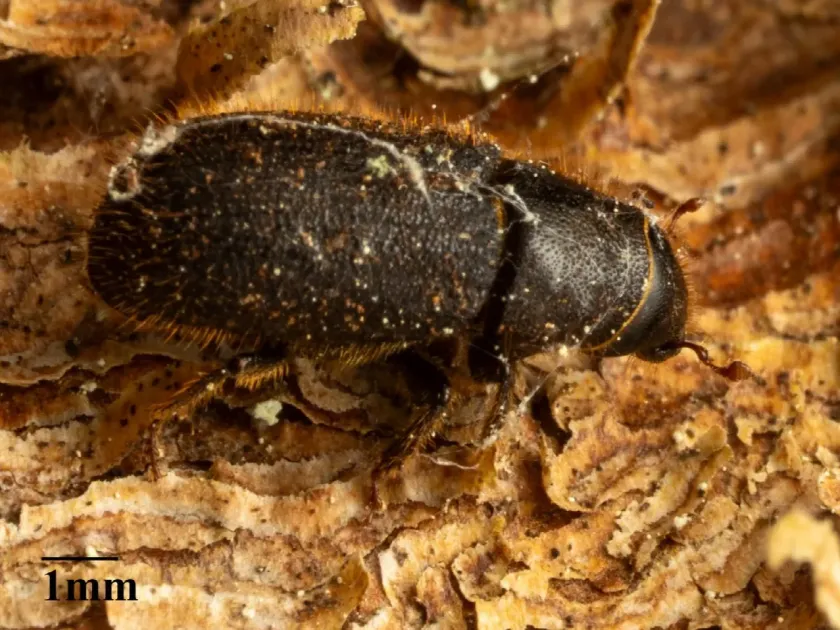
The great spruce bark beetle (Dendroctonus micans) is a significant pest species within the Scolytinae subfamily. Adult beetles typically measure 6–9 mm in length and feature a dark, brownish-black color with a dense covering of fine, yellowish hairs.
The larvae are distinct in their social behavior; they do not construct individual galleries but live together in a communal brood chamber under the bark of the host tree. This unique behavior makes them easier to identify during bark inspection.
Belonging to the order Coleoptera and the family Curculionidae, this beetle is a primary threat because it is capable of attacking healthy, vigorous trees, unlike many other bark beetle species that prefer weakened hosts.
The beetle possesses robust mouthparts that enable it to penetrate the thick bark of mature spruces. Their reproductive cycle is adapted to varying environmental conditions, allowing them to persist in different forest types.
Visual identification is often focused on the distinctive resinous tubes or "pitch tubes" found on the bark surface, which are created as the host tree attempts to defend itself against the beetle's entry.
What it damages
The primary host is the Norway spruce (Picea abies), though other species of spruce and sometimes fir are also attacked. The beetle shows a strong preference for trees that are at least 10-15 years old.
The economic damage is caused by the larvae feeding on the phloem and cambium. By creating extensive communal galleries, the larvae effectively girdle the tree, preventing the flow of nutrients and moisture, which leads to tree death.
When populations become dense, the impact on spruce stands can be devastating, resulting in widespread tree mortality and significant loss of timber value in commercial forests.
Trees damaged by this beetle become secondary hosts to other pests and opportunistic fungi, which often accelerate the decline of the infested stand.
The removal of infested trees and the long-term impact on forest structure represent substantial costs to forestry management and ecological restoration efforts.
When it appears
Adult activity typically begins in the spring, once temperatures remain consistently warm. During this period, beetles emerge from their overwintering sites to seek new hosts for reproduction.
The life cycle length is variable, depending heavily on the climate; it can range from one to two years. In warmer regions, the cycle may complete more quickly than in colder, high-altitude locations.
Summer months are characterized by peak larval feeding. This is the period when the most internal damage occurs beneath the bark, often going unnoticed by casual observers until the tree begins to show distress.
As autumn approaches and temperatures fall, the activity levels drop. Both adults and larvae enter a period of hibernation, remaining within the bark to survive the winter temperatures.
Monitoring should be most intensive during the spring and early summer when the beetles are most active and likely to colonize new trees.
Signs of infestation
The most reliable sign of an infestation is the presence of resin tubes on the trunk, which may appear as globules of sticky sap mixed with frass, the waste material of the larvae.
- Yellowing or reddening of the needles in the canopy, often beginning at the top of the tree.
- Presence of fine brown wood dust (frass) gathered in bark crevices or at the tree base.
- Bark that easily detaches from the trunk, revealing the communal larval galleries beneath.
- Visible entry holes in the bark, typically a few millimeters in diameter.
- The appearance of bleeding sap or resin streams flowing down the stem of the tree.
Advanced stages of infestation show significant crown dieback, as the tree’s water and nutrient transport systems are progressively severed by the larval feeding activity.
Careful inspection of the lower stem, particularly in shaded areas, often reveals the earliest signs of colonization before the canopy starts to show symptoms.
Control measures
Effective management relies on a combination of silvicultural practices and biological controls to maintain the population below the damage threshold.
Sanitation felling is the most critical management tool. Infested trees should be identified and removed from the stand before the next generation of beetles emerges and spreads to neighboring trees.
Biological control using the predatory beetle Rhizophagus grandis has proven highly successful. This predator is host-specific and effectively tracks and consumes the larvae of the great spruce bark beetle, significantly reducing their population density.
Chemical control is rarely viable for widespread forest use due to ecological impacts and the protected nature of the bark; however, in nurseries or high-value urban settings, localized insecticide application may be considered.
Maintaining a diverse forest ecosystem promotes the health of natural enemies, which is essential for long-term control and preventing outbreaks of Dendroctonus micans.
Taxonomy
- Latin name
- Dendroctonus micans
- Order
- Coleoptera (beetles)
- Family
- Curculionidae
- EPPO code
- DENCMI
Discussion
No discussions yet — be the first.