
Mexican pine beetle
Dendroctonus mexicanus
Description
How to identify
The Mexican pine beetle (Dendroctonus mexicanus) is a member of the Curculionidae family, subfamily Scolytinae. It is a significant wood-boring pest that primarily attacks various pine species across North and Central America.
Adult beetles are relatively small, typically measuring between 3 and 4 millimeters in length. Their bodies are cylindrical and sturdy, with colors ranging from reddish-brown to black, which helps them blend in with the bark texture.
The life cycle is inextricably linked to the host tree's phloem layer. Adults emerge to colonize new trees by detecting chemical signals, specifically monoterpenes emitted by stressed or weakened pines.
Morphologically, the species is identified by specific features on the elytra declivity and the pronotum. Precise identification often requires microscopic examination of the male and female genitalia to distinguish it from related Dendroctonus species.
Depending on the latitude and altitude, the beetle can complete several generations per year. Warm temperatures significantly accelerate the development of larvae within the inner bark, leading to rapid population growth.
What it damages
The primary host plants are various species of the genus Pinus. The beetle feeds on the cambium layer, which disrupts the transport of water and nutrients, effectively girdling the tree and causing mortality.
Once a beetle successfully penetrates the bark, it constructs egg galleries. Larvae then bore perpendicular to these galleries, feeding on the inner bark and creating a complex network of tunnels that causes severe structural damage.
Large-scale infestations can cause widespread timber loss and impact forest health significantly. Attacked trees are often unable to recover, leading to a cascade of ecological changes within the forest stand.
Weakened trees, those damaged by fire, drought, or disease, are particularly susceptible. However, when beetle populations are high, even healthy trees can be overwhelmed by mass attacks.
- Montezuma pine (Pinus montezumae).
- Mexican weeping pine (Pinus patula).
- Smooth-leaved pine (Pinus leiophylla).
- Ponderosa pine (Pinus ponderosa).
Signs of infestation
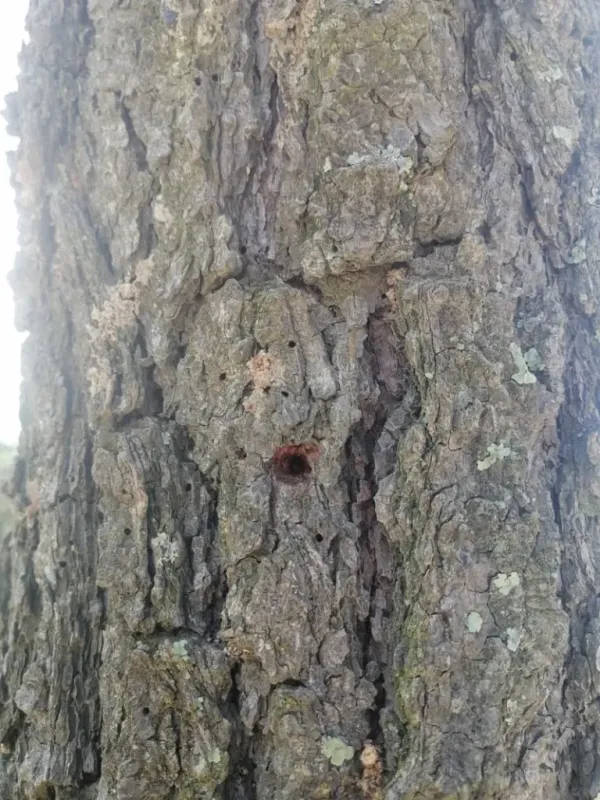
Visible resin masses, or "pitch tubes," on the bark surface are the initial sign of an attack. These are formed as the tree attempts to push the invading beetle out with resin flow.
The foliage begins to change color once the tree's vascular system is sufficiently damaged. Initial yellowing of the needles progresses to a reddish-brown color, which is a clear indicator of tree death.
Frass, which looks like fine sawdust, is often found at the base of the trunk or in bark crevices. This indicates active tunneling activities by the beetles deep within the tree's structure.
When the bark is peeled away, the distinctive galleries created by the beetles are visible. These galleries show the path of the parent beetles and the larval feeding sites.
Increased woodpecker activity on a specific tree or group of trees often points to a concentrated infestation, as birds feed on the beetle larvae found beneath the bark.
Control measures
Sanitation cutting remains the most effective management strategy. Removing infested trees promptly reduces the beetle population and prevents the spread of the next generation to adjacent healthy trees.
Pheromone traps are extensively used for monitoring population levels. These tools help forest managers determine when to implement control measures and assess the risk of potential outbreaks.
Improving forest stand vigor through thinning and proper silvicultural practices makes the trees less attractive and less vulnerable to beetle colonization in the long run.
Chemical control, while difficult to apply in vast forest areas, may be used in high-value stands. Preventive spraying of insecticides can protect individual trees during periods of high beetle activity.
Biological control research focuses on using predatory insects and parasitic wasps to reduce beetle numbers naturally, providing a sustainable alternative to chemical interventions.
Taxonomy
- Latin name
- Dendroctonus mexicanus
- Order
- Coleoptera (beetles)
- Family
- Curculionidae
- EPPO code
- DENCME
Discussion
No discussions yet — be the first.