
Mesoamerican pine beetle
Dendroctonus mesoamericanus
Description
How to identify
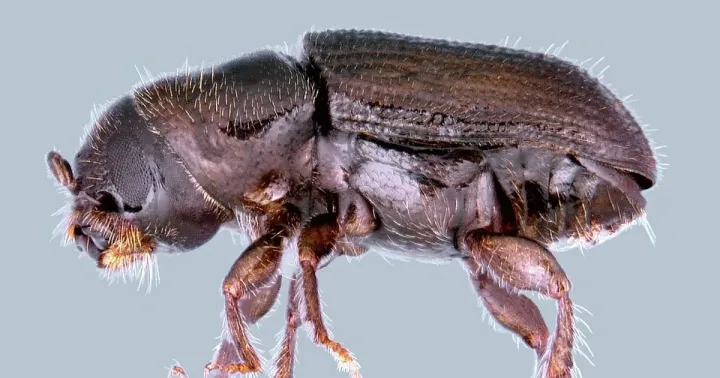
The Mesoamerican pine beetle, scientifically known as Dendroctonus mesoamericanus, is a bark beetle species belonging to the Curculionidae family. It is a small insect, typically measuring between 3 to 5 millimeters in length, with a cylindrical, dark-colored body adapted for drilling into pine bark.
Adult beetles possess a robust exoskeleton and a specialized head structure that allows them to tunnel into the phloem layer of trees. The larvae are small, legless, and white, equipped with mouthparts designed to feed on the inner bark, which is the nutrient-rich cambium layer.
These beetles are highly sophisticated in their behavior, using complex pheromone communication systems to signal the location of a host tree. This pheromone release triggers a mass attack, allowing the population to overwhelm the tree's natural defense mechanisms.
Morphologically, Dendroctonus mesoamericanus closely resembles other species within the Dendroctonus genus. Precise identification often requires an examination of the beetle's gallery patterns and, in some cases, genetic analysis to differentiate it from regional lookalikes.
The insect thrives in the unique climate of Central American pine forests. Its biological cycle is optimized for survival in high-altitude environments, where it can maintain activity throughout the year if host conditions are favorable.
What it damages
The primary host trees for this beetle are various species of pine found throughout its native range in Mesoamerica. It targets trees that are stressed, injured, or otherwise weakened, though it can attack healthy trees during large-scale population outbreaks.
Damage occurs when the beetles tunnel into the bark and feed on the phloem and cambium layers. This activity effectively severs the tree's vascular system, preventing the transport of water and nutrients between the roots and the canopy, eventually causing the tree to desiccate and die.
The economic impact of this pest is profound, as it causes massive deforestation and the loss of valuable timber resources. Large-scale infestations can destroy vast tracts of forest, leading to significant environmental degradation and biodiversity loss.
Infested trees often become hotspots for other secondary pests and pathogens, including various wood-boring insects and fungi. This secondary colonization accelerates the rate of tree decline and complicates forest rehabilitation efforts.
The virulence of the species depends heavily on the population density. During periods of drought, the trees become increasingly vulnerable, and the beetle population can explode, causing catastrophic damage to large forest areas in a relatively short timeframe.
When it appears
In the tropical and subtropical regions of its habitat, the Mesoamerican pine beetle does not experience a true dormancy period. Its life cycle is largely continuous, driven by favorable temperatures and humidity levels present throughout most of the year.
The flight period, during which adults search for new host trees, is often more intense during dry seasons. When water availability is low, the pine trees' ability to produce defensive resin is severely compromised, providing an easy entry point for the beetles.
The development time from egg to adult varies based on temperature. During warmer seasons, the cycle shortens, which leads to overlapping generations and a rapid increase in the local beetle population density.
Even during cooler periods, development continues, albeit at a slower pace, within the protected environment beneath the pine bark. The beetle's life stages remain shielded from external climate fluctuations, ensuring high survival rates.
Monitoring efforts for this pest are essential, especially during months when weather patterns stress the forest. Observing changes in the tree canopy is a key indicator of when the beetle population is actively colonizing new hosts.
Signs of infestation
One of the earliest signs of a beetle attack is the formation of resin "pitch tubes" on the surface of the bark. These are the tree’s attempts to flush out the intruders with resin, which eventually dry and harden, revealing where the beetles have entered.
Frass, or wood-boring dust, is another critical sign. It appears as reddish-brown or white sawdust around the base of the tree or in bark crevices, created by the beetles as they drill their galleries through the inner wood.
As the infestation progresses, the canopy color changes dramatically. The foliage transitions from its normal healthy green to yellow, and eventually to a dark reddish-brown, signaling that the tree's vascular system has been compromised.
Bark peeling or flaking from the trunk is a common sign in later stages, often indicating that the tree is already dead or near death. Beneath these loose sections of bark, one can usually find the intricate, characteristic gallery patterns of the beetle larvae.
- Presence of hardened resin pitch tubes.
- Accumulation of fine, granular frass at the base.
- Gradual color change of the pine needles.
- Specific gallery patterns under the bark.
- Increased activity of woodpeckers or other insect predators.
Control measures
Integrated Pest Management (IPM) is crucial for controlling the Mesoamerican pine beetle. It begins with active monitoring, using pheromone-baited traps to detect early spikes in beetle numbers and identify potential outbreaks.
Sanitation harvesting is the most direct method to curb an infestation. Removing infested trees and destroying the wood—either by burning it or mechanical chipping—prevents the next generation of beetles from emerging and spreading to healthy trees.
Promoting forest health through strategic thinning helps reduce competition for water and nutrients. A well-managed forest with a diverse age structure is generally more resilient to bark beetle attacks than a dense, overgrown stand.
Biological control, which includes the protection and encouragement of natural enemies such as predaceous beetles, ants, and parasitic wasps, plays a vital role in maintaining the natural ecological balance and suppressing beetle numbers.
Chemical control methods, such as insecticide applications, are generally reserved for high-value urban trees or small, high-risk nursery areas. These measures are rarely practical for large-scale forest protection due to costs and potential environmental impacts.
Taxonomy
- Latin name
- Dendroctonus mesoamericanus
- Order
- Coleoptera (beetles)
- Family
- Curculionidae
- EPPO code
- DENCMS
Discussion
No discussions yet — be the first.