
Jeffrey pine beetle
Dendroctonus jeffreyi
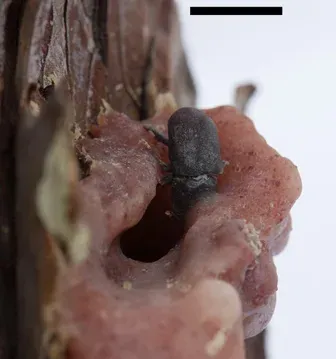
Description
How to identify
The Jeffrey pine beetle (Dendroctonus jeffreyi) is a species of bark beetle that exclusively targets certain pine species. Adults are stout, cylindrical beetles, typically measuring 6 to 8 millimeters in length with a dark brown or black body.
Morphologically, this beetle is very similar to the mountain pine beetle, making identification difficult without specialized entomological knowledge. Key features include the specific structure of the elytra and the shape of the head.
The larvae are white, legless, and possess a well-defined, darker head capsule. They spend their entire developmental period in the cambium layer of the host tree, consuming the nutrient-rich inner bark.
The life cycle involves four distinct stages: egg, larva, pupa, and adult. The entire process takes place beneath the bark, which provides the insects with constant protection from environmental changes and many predators.
Adult beetles are highly efficient at detecting suitable host trees using chemical signals, allowing them to aggregate and overwhelm the tree's natural defense mechanisms.
What it damages
The primary host for this beetle is the Jeffrey pine (Pinus jeffreyi). While the beetles prefer trees that are already stressed by drought or disease, large populations can attack and kill healthy, vigorous trees.
As the beetles feed, they excavate gallery systems in the cambium. These galleries effectively girdle the tree, cutting off the transport of water and nutrients between the roots and the needles.
The beetles introduce pathogenic fungi into the tree's vascular system. These fungi cause blue stain in the wood and further accelerate the tree's decline, making it impossible for the tree to recover.
In infested stands, the mortality rate of trees can be very high. This causes significant ecological disruption and poses a major threat to the timber industry and forest health.
The total loss of commercial timber value occurs quickly once the beetles have successfully established their colonies throughout the main trunk of the tree.
When it appears
The adult activity usually begins in late spring, as temperatures rise and the insects emerge from their overwintering sites to find new host trees for reproduction.
The peak flight and colonization period typically occurs during the summer months. During this time, mass attacks on trees are most common, and pheromones released by the beetles attract others to the same host.
The duration of the life cycle can range from one to two years, depending heavily on the altitude and the local climate conditions. Warmer regions often see faster development and more frequent generations.
Overwintering occurs either as larvae or adults beneath the bark. This allows the beetles to survive cold winters by utilizing the insulating properties of the tree trunk.
As autumn approaches, activity levels drop significantly. The beetles settle into the tree to complete their development or wait for the return of favorable temperatures in the following spring.
Signs of infestation
The presence of pitch tubes—small, reddish-brown masses of resin on the bark—is one of the most visible indicators that beetles have attempted to bore into the tree.
Boring dust, which looks like fine sawdust, accumulates in bark crevices or at the base of the tree. This material is ejected by the beetles as they tunnel into the phloem.
Needle discoloration is a late-stage sign of infestation. Needles first turn yellow, then progress to a reddish-brown color as the tree slowly dies due to the interruption of water flow.
Beneath the outer bark, the diagnostic pattern of vertical galleries and branching larval feeding tunnels can be clearly observed, indicating the beetle's life history.
Increased woodpecker activity on the tree trunk is a common secondary indicator, as birds frequently search for the larvae embedded in the bark.
Control measures
Sanitation harvesting is the most effective management tool. Removing and processing infested trees before the next generation of beetles emerges is crucial to prevent the spread of the infestation.
Pheromone-based trapping systems are used to monitor beetle population levels. These tools help foresters understand the density of the threat and time management actions effectively.
Natural biological controls, including predatory beetles and parasitic wasps, play a role in regulating populations, though they are often insufficient during large-scale outbreaks.
Chemical applications are usually restricted to high-value trees in recreational areas or nurseries, where preventive insecticide sprays can protect individual trees from successful attacks.
- Regular forest stand health assessments
- Rapid removal of dead and dying trees
- Silvicultural practices to reduce stand density
- Quarantine efforts to prevent regional spread
Taxonomy
- Latin name
- Dendroctonus jeffreyi
- Order
- Coleoptera (beetles)
- Family
- Curculionidae
- EPPO code
- DENCJE
Discussion
No discussions yet — be the first.