
Southern pine beetle
Dendroctonus frontalis
Description
How to identify
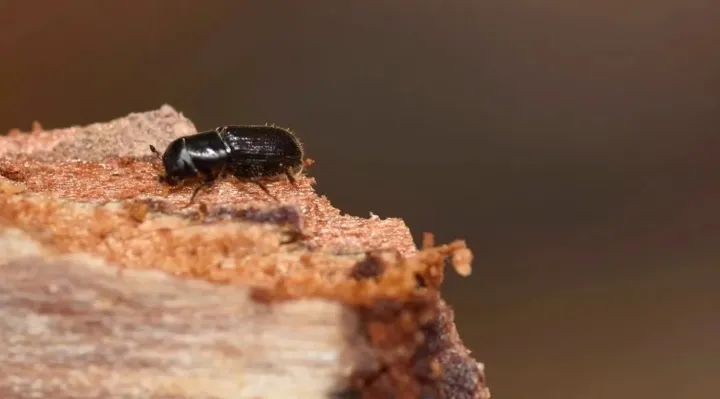
The Southern pine beetle (Dendroctonus frontalis) is a small bark beetle species in the family Curculionidae, subfamily Scolytinae, measuring 2–4 mm in length.
Adult beetles have a cylindrical shape and their color ranges from reddish-brown to black, with a rounded rear end of the elytra.
Larvae are white, legless grubs with brown heads that feed within the inner bark, specifically the phloem layer of the tree.
The species is highly aggressive and utilizes mass attacks, releasing pheromones to signal other beetles to colonize the same host tree.
It carries symbiotic fungi, specifically blue-stain fungi, which clog the tree's vascular system, accelerating death during the infestation process.
What it damages
The primary hosts are pine species, with loblolly, shortleaf, and slash pines being particularly susceptible to severe infestations.
This beetle is considered one of the most destructive forest pests, capable of killing both stressed and healthy mature pine trees.
The infestation stops the transport of water and nutrients, leading to rapid yellowing and death of the entire tree crown within weeks.
Large-scale outbreaks can result in the loss of thousands of acres of timber, causing significant economic and environmental disruption.
Damaged trees serve as hotspots that increase the pressure on surrounding healthy timber, often leading to rapid expansion of the infested area.
When it appears
Adult activity typically begins in early spring, as temperatures rise, and continues throughout the summer and into the autumn months.
In warm climates, the Southern pine beetle can complete multiple generations per year, with as many as seven overlapping cycles possible.
The peak flight and colonization periods occur during mid-summer, when environmental conditions favor the rapid reproduction of the insect.
The insect survives winter months by overwintering as larvae or pupae beneath the bark of previously infested or newly colonized trees.
Warmer winters can lead to increased survival rates, allowing for higher population levels and more intense infestations in the following spring.
Signs of infestation
The most visible early sign of infestation is the presence of white, yellow, or red pitch tubes on the surface of the bark.
As the infestation progresses, the foliage of the pine tree changes color from green to yellow, and eventually to reddish-brown.
Beneath the bark, the beetle creates complex S-shaped galleries that disrupt the vascular flow, which can be seen if a section of bark is removed.
Fine, powdery reddish-brown boring dust often accumulates at the base of the tree or in bark crevices as the beetles tunnel inside.
- Pitch tubes on the trunk.
- Yellowing and browning needles.
- Small, circular exit holes in the bark.
- Gallery patterns visible on the cambium layer.
Control measures
The most effective management strategy is sanitation harvesting, which involves removing and processing infested trees to eliminate the brood.
Pheromone traps are extensively used for monitoring population levels and tracking the movement of beetle activity within forest stands.
Chemical control, specifically the application of insecticides to the trunk, is usually reserved for high-value ornamental or landscape trees.
Promoting forest health through proper thinning and species diversity increases resistance and reduces the likelihood of massive outbreaks.
Early detection using satellite imaging and aerial surveillance is critical for managing populations before they spread to larger landscapes.
Taxonomy
- Latin name
- Dendroctonus frontalis
- Order
- Coleoptera (beetles)
- Family
- Curculionidae
- EPPO code
- DENCFR
Discussion
No discussions yet — be the first.