
Western pine beetle
Dendroctonus brevicomis
Description
How to identify
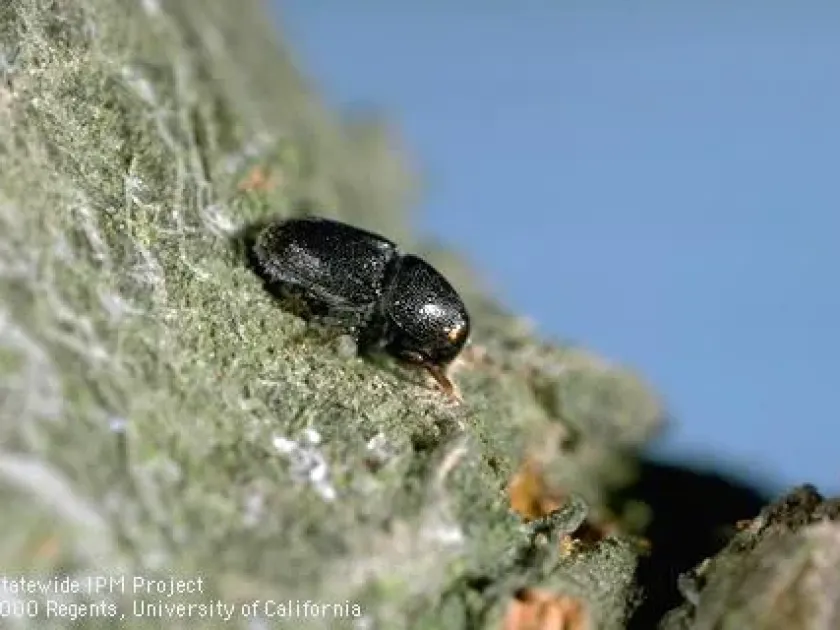
The Western pine beetle (Dendroctonus brevicomis) is a destructive species of bark beetle belonging to the family Curculionidae. Adult beetles are small, typically measuring between 3 and 5 millimeters in length.
Their bodies are cylindrical, allowing them to navigate efficiently through the phloem and cambium layers of host trees. The head is partially hidden by the pronotum, which is a key morphological feature.
Larvae are legless, white in color, with a dark head capsule, and they develop by consuming the inner bark of the host tree.
The species is known for its ability to aggregate on a single tree in large numbers, overwhelming the host tree’s natural defenses with concentrated pheromone signals.
These insects are highly mobile, using flight to locate suitable host trees based on chemical and visual cues from the forest environment.
What it damages
The primary host for this beetle is the ponderosa pine (Pinus ponderosa), though it can also infest other pine species within its geographic range.
Damage is caused by both adults and larvae as they construct extensive galleries in the inner bark, which effectively girdles and kills the tree.
By disrupting the flow of water and nutrients between the roots and needles, the infestation leads to the rapid decline and death of the host tree.
Western pine beetles also introduce various species of fungi, including blue-stain fungi, which further degrade the wood quality and hasten the tree's demise.
Widespread outbreaks result in significant mortality of pine stands, leading to altered forest structure and increased risk of wildfires due to fuel buildup.
When it appears
The activity of the Western pine beetle is highly dependent on ambient temperature, with most flight activity occurring during the warmer months of the year.
In many regions, the beetle can complete multiple generations per year, depending on the length and warmth of the growing season.
Spring and summer are the peak periods for adult beetle emergence and colonization of new host trees as they seek to establish new broods.
During the winter, the population typically survives in the bark of infested trees in the larval or pupal stages, demonstrating cold hardiness.
As the weather warms in the spring, the remaining larvae pupate and emerge as adults, initiating the cycle of infestation for the new year.
Signs of infestation
The most diagnostic sign of an active infestation is the presence of pitch tubes on the bark, which are masses of resin produced by the tree attempting to expel the beetles.
Frass, or fine boring dust, is often found in bark crevices or at the base of the tree, indicating successful entry by the adult beetles.
Needle discoloration, shifting from green to yellowish-green and finally to red-brown, is a late-stage symptom indicating the tree is dying.
- Pitch tubes visible on the outer bark
- Fine, reddish boring dust at the base of the trunk
- Gradual fading and browning of the crown
- Evidence of woodpecker activity (peeled bark)
- Gallery patterns visible under the bark
Once the foliage turns red, the beetles have usually completed their development and emerged to infest neighboring trees.
Control measures
Sanitation cutting is the primary control method, involving the removal and disposal of infested trees to reduce the population density in the stand.
Removing logging slash and fallen timber is crucial, as these materials can provide breeding grounds for the beetles if left in the forest.
Pheromone-based attractants or repellents can be used to monitor population levels or protect high-value individual trees from beetle attacks.
Biological control, such as encouraging local woodpecker populations and predatory beetles, can help mitigate beetle numbers naturally.
Preventive spraying with approved insecticides on the bark of healthy trees can be an option in ornamental or high-value urban forestry settings.
Taxonomy
- Latin name
- Dendroctonus brevicomis
- Order
- Coleoptera (beetles)
- Family
- Curculionidae
- EPPO code
- DENCBR
Discussion
No discussions yet — be the first.