
Dendroctonus
Dendroctonus
Description
How to identify
Dendroctonus is a genus of bark beetles belonging to the family Curculionidae (subfamily Scolytinae). These insects are known as some of the most aggressive forest pests globally.
Adult beetles are typically cylindrical in shape, measuring between 3 and 9 millimeters in length. Their coloration ranges from dark reddish-brown to black, helping them blend with bark crevices.
The head of the beetle is mostly concealed by the pronotum when viewed from above. The larvae are legless, white, with a brownish head capsule, and are found exclusively under the bark.
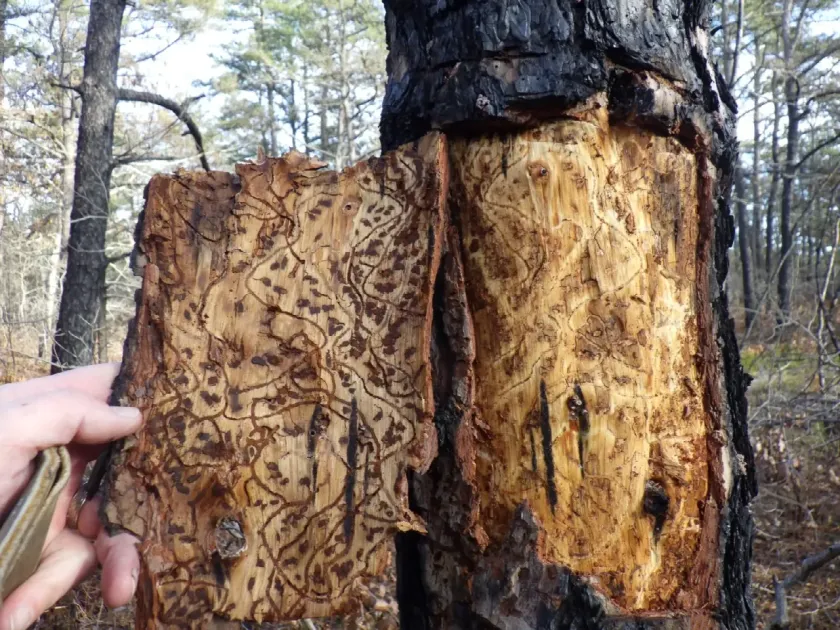
Identification often relies on the specific gallery patterns etched into the phloem and inner bark, which are unique to different species within the genus.
Because they cause massive tree mortality, these beetles are the subject of intensive entomological research focused on their chemical signaling and host-selection behavior.
What it damages
These beetles primarily attack coniferous trees, including various species of pines, spruces, and larches. Host preference is highly species-specific and depends on the geography.
The damage is caused by the adults and larvae feeding on the phloem and cambium layer, which destroys the tree's vascular system, preventing the transport of water and nutrients.
While beetles usually prefer weakened or stressed trees, during outbreak conditions, they can overwhelm healthy, vigorous stands by sheer force of numbers through mass attack.
The death of the host tree is rapid, often occurring within a single growing season once a significant population has successfully established itself under the bark.
Secondary damage occurs through the introduction of blue-stain fungi, which clog the tree's xylem, further accelerating the decline and killing the tree even if the beetle attack is unsuccessful.
When it appears
The lifecycle of Dendroctonus is heavily influenced by temperature, with development rates varying depending on the species and the regional climate.
Mass dispersal and attack flights typically occur in late spring or early summer, once temperatures are high enough to trigger the emergence of overwintering adults.
After finding a suitable host, the beetles bore into the bark, establish nuptial chambers, and begin laying eggs. The larvae hatch and begin feeding, creating distinct galleries.
Depending on the latitude and species, Dendroctonus may have one or more generations per year. Some species spend winter in the tree, while others survive in the forest floor litter.
Environmental factors like drought significantly influence the timing and success of their life cycles, often leading to synchronized emergence periods across entire forests.
Signs of infestation
The first external sign of infestation is the appearance of frass, a mixture of bark dust and excrement, accumulating in bark crevices or at the tree's base.
Resin flow, often referred to as "pitch tubes," is a common defense mechanism where the tree attempts to push the beetle out with sap, resulting in visible globs on the bark surface.
As the tree dies, the foliage will lose its healthy green color, transitioning to a yellow or reddish-brown hue, signaling the final stages of the tree's collapse.
- Visible boring holes in the tree bark.
- Pitch tubes indicating an attempt to repel the pest.
- Discoloration of needles (yellowing to red).
- Under-bark galleries visible when a piece of bark is removed.
Woodpecker activity on the tree trunk is another strong indicator, as these birds actively forage for the larvae hiding beneath the bark.
Control measures
Sanitation harvest, which involves the removal and processing of infested trees before the next generation of beetles emerges, is the primary control tactic.
Pheromone-based traps are frequently deployed to monitor populations and to act as a diversion, drawing beetles away from healthy forest stands during peak flight times.
Chemical insecticides can be used for the preventative treatment of high-value individual trees, though they are generally ineffective for managing large-scale forest outbreaks.
Maintaining forest health through thinning and stand density management reduces the likelihood of successful mass attacks by minimizing tree stress and competition.
Natural predators, including clerid beetles, parasitic wasps, and various bird species, play a critical role in regulating Dendroctonus populations in undisturbed ecosystems.
Taxonomy
- Latin name
- Dendroctonus
- Order
- Coleoptera (beetles)
- Family
- Curculionidae
- EPPO code
- DENCSP
Discussion
No discussions yet — be the first.