
Beet stem weevil
Cyphocleonus
Description
How to identify
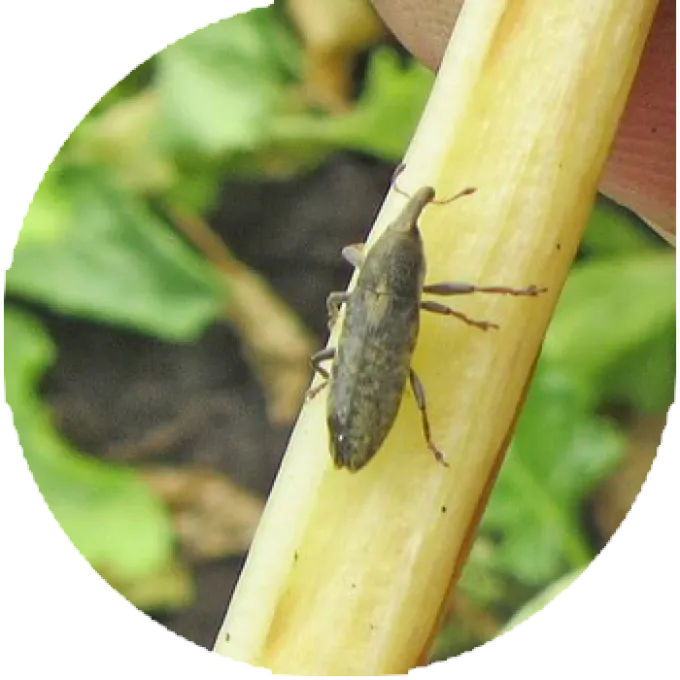
The beet stem weevil (Cyphocleonus achates) belongs to the order Coleoptera and the family Curculionidae. The adult beetle features an elongated body, typically 12–16 mm long, covered with greyish or brownish scales that form a specific camouflage pattern.
Its rostrum is relatively thick and short, which is a key diagnostic feature used by agronomists to distinguish this species from other weevils found in field crops.
The larvae, which are the primary damaging stage, are legless, C-shaped, and creamy-white in color, reaching up to 25 mm in length before they transition into the pupal stage.
These weevils are largely nocturnal or crepuscular, often hiding under soil clods or near the base of the plant during the hottest parts of the day to avoid desiccation.
The life cycle is typically univoltine, meaning one generation per year, though environmental conditions can sometimes lead to an extended larval development phase of up to two years.
What it damages
The beet stem weevil primarily affects crops in the Amaranthaceae family, most notably sugar beet, fodder beet, and red beet plants.
The most significant damage is caused by the larvae, which tunnel into the crown and the upper part of the root, creating galleries that severely impede water and nutrient transport.
Adult beetles feed on the stems and leaf petioles; while this causes visible injury, the economic impact is considerably lower than the destruction caused by larval tunneling.
Affected plants often exhibit stunted growth, malformed roots with reduced mass, and significantly lower sugar content, making them unfit for industrial processing.
In cases of high infestation, severe root destruction by larvae can lead to the wilting and eventual death of young seedlings during the early growing season.
When it appears
Overwintered adults emerge from the soil in late spring, usually correlating with the development of the first true leaves of the beet plants.
The peak period for adult activity, including mating and egg-laying, typically occurs throughout May and June as temperatures rise consistently.
Larvae hatch in mid-summer and immediately bore into the plant tissue, where they spend most of their development period feeding within the root structure.
Pupation takes place within the soil, where the larvae construct protective chambers near the damaged host plants by late summer.
Adults of the new generation emerge in late summer, feed briefly, and then descend into the soil to undergo diapause, surviving the winter months until the following spring.
Signs of infestation
Early signs of infestation include small, irregular chewing marks on the leaf petioles, which are the result of adult beetles feeding before they lay eggs.
The primary indicator of a severe infestation is the presence of small entry holes located at the crown of the root, often accompanied by dark, necrotic tissue.
Infested plants tend to wilt and turn yellow, particularly during the middle of the day, as the damaged root system fails to meet the plant's physiological water demands.
When pulling a damaged beet from the soil, it is common to find the taproot hollowed out or severely scarred, often harboring secondary fungal infections or rot.
- Yellowing and wilting of the leaf rosette.
- Visible tunneling at the crown of the beet.
- Deformed root structure.
- Secondary decay of the damaged taproot.
Control measures
Effective management begins with sound agronomic practices, such as crop rotation, which breaks the pest's cycle by removing its host plant from the field for several years.
Deep autumn plowing is crucial, as it exposes the pupae and larvae to surface conditions, significantly reducing their survival rate through mechanical damage and predation.
The elimination of weeds in the Amaranthaceae family around field margins is essential, as these weeds serve as alternative hosts and reservoirs for the pest population.
Chemical control involving systemic insecticides is applied when the pest population exceeds the economic threshold, ensuring protection during the critical stages of crop development.
Biological control, including the use of entomopathogenic fungi or nematodes, provides a sustainable approach to suppressing larval populations within the soil without chemical residues.
Taxonomy
- Latin name
- Cyphocleonus
- Order
- Coleoptera (beetles)
- Family
- Curculionidae
- EPPO code
- CYPHSP
Discussion
No discussions yet — be the first.