
Larch Tortrix
Cydia zebeana
Description
How to identify
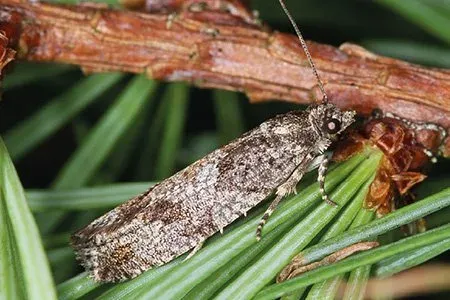
The Larch Tortrix (Cydia zebeana) is a moth belonging to the Tortricidae family. The adult moth is relatively small, with a wingspan of 15–18 mm, featuring brownish or ochreous forewings that provide excellent camouflage against the bark of host trees.
The larva (caterpillar) is about 12–14 mm long. It has a pale or reddish body with a dark head and well-developed thoracic legs, enabling it to move effectively across the surface of the tree before burrowing into the bark or wood.
The life cycle of this species is strictly synchronized with the phenology of larch trees. It undergoes a complete metamorphosis involving four stages: egg, larva, pupa, and adult. The insect typically has one generation per year throughout most of its range.
Larvae overwinter in a late instar stage inside the gall-like structures they form within the woody tissues of the host. They remain protected throughout the cold season, emerging as adults in late spring.
Pupation occurs in early spring inside the larval tunnels. After the pupal stage, adult moths emerge to mate and lay eggs, beginning the cycle anew in synchrony with the budding of the larch trees.
What it damages
The Larch Tortrix primarily attacks various species of the Larix genus. Young trees in nurseries, forest plantations, and urban landscapes are particularly susceptible to severe infestations.
Larvae damage the trees by tunneling into the cambium and xylem layers. This feeding activity disrupts the flow of nutrients and water, leading to the overall weakening of the host tree.
The most distinctive damage is the formation of galls — abnormal woody swellings on the branches or trunks. These galls weaken the structural integrity of the tree, making it prone to wind breakage or snapping under snow weight.
Heavy infestations lead to stunted growth, loss of foliage, and in cases of primary stem girdling, the death of young seedlings. It also significantly degrades the ornamental value of larch trees.
Wounds caused by larval feeding often serve as entry points for pathogens and secondary bark-boring insects, which can further aggravate the health decline of the tree.
When it appears
Adult moths usually emerge from late May to June. They are nocturnal insects, making direct observation difficult without pheromone traps or specialized equipment.
Larval activity begins immediately after hatching, typically in early summer. During this time, they feed continuously, growing and creating the characteristic tunnels and swellings on the branches.
By autumn, as temperatures begin to drop, the larvae finish their active growth and prepare for winter by securing themselves inside the host tissue, where they enter diapause.
The following spring, as temperatures rise, the larvae either resume feeding briefly before pupating or proceed directly to pupation, depending on their maturation level.
The timing of these stages is highly dependent on local climate conditions, but the overall univoltine (single-generation) cycle remains consistent in northern and central European ranges.
Signs of infestation
The primary sign of an infestation is the presence of resin flow (pitch) on the bark of trunks and branches, as the tree attempts to defend itself against the burrowing larvae.
Swollen galls on branches or at the base of lateral shoots are a clear indicator of the Larch Tortrix presence. These deformations are often easy to spot on young, thin-barked trees.
The presence of fine, sawdust-like frass (excrement) around small holes in the bark is a diagnostic sign that larvae are currently active and feeding inside the wood.
Yellowing and subsequent premature dropping of needles on specific branches indicate a disruption in the vascular transport caused by the underlying larval activity.
- Resin oozing on stems and branches.
- Galls or woody swellings on shoots.
- Deformation or bending of young trees.
- Premature needle discoloration.
- Visible frass around entry holes.
Control measures
Sanitary pruning and the removal of heavily infested branches, especially those bearing galls, is the most effective manual method for small-scale control, helping to reduce the overall population.
Maintaining vigorous tree health through proper spacing and site management is crucial, as healthier trees are more resilient to colonization by this pest.
Biological control methods, including the use of Bacillus thuringiensis or viral preparations, can be applied when larvae are in their early stages and have not yet fully burrowed into the bark.
Chemical control with systemic insecticides is sometimes required in high-value nurseries. The application timing is critical and should coincide with the peak egg-laying period or larval hatching.
The use of pheromone traps for monitoring is recommended to determine exact infestation levels and to time any chemical interventions, ensuring maximum efficacy and minimizing environmental impact.
Taxonomy
- Latin name
- Cydia zebeana
- Order
- Lepidoptera (butterflies)
- Family
- Tortricidae
- EPPO code
- LASPZE
Discussion
No discussions yet — be the first.