
Spruce seed moth
Cydia strobilella
Description
How to identify
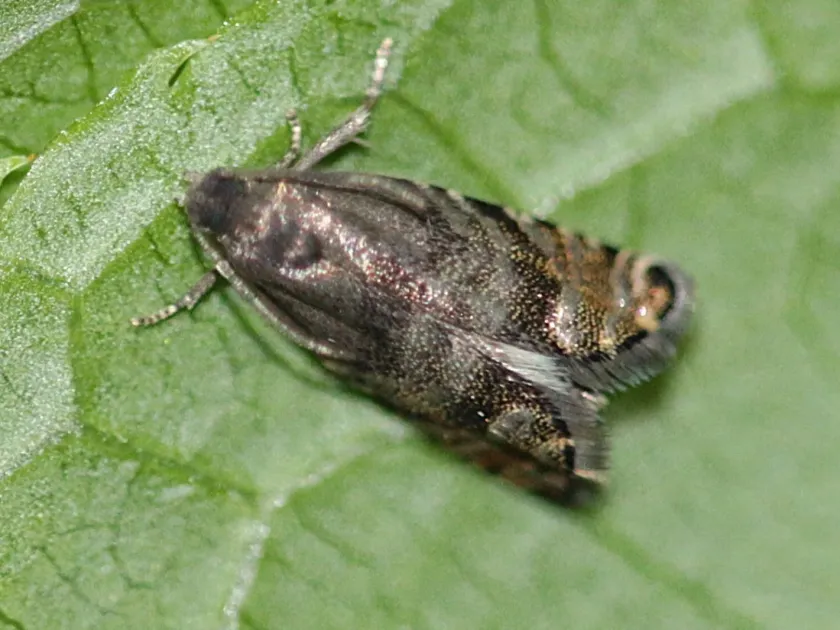
The spruce seed moth (Cydia strobilella) is a small moth belonging to the Tortricidae family. Its wingspan ranges from 12 to 15 mm, with forewings that feature a mottled grey-brown pattern, providing excellent camouflage against the scales of spruce cones.
The larva of the spruce seed moth is a small, pale caterpillar with a brown head capsule. It spends almost its entire larval stage hidden within the protective environment of a developing spruce cone, making it a highly protected and elusive pest during its primary feeding period.
What it damages
The primary damage is caused by the larvae consuming the seeds of spruce trees. They tunnel through the cone's axis and eat their way through the seed scales, effectively destroying the seeds and preventing natural regeneration of the forest stand.
Economic damage is most significant in seed orchards and forest nurseries, where the loss of high-quality seeds can lead to a failure in planting programs. In severe cases, a single tree can lose a large majority of its annual seed production due to heavy infestations.
When it appears
The moth typically has a one-year life cycle. Adults emerge in late spring, usually corresponding with the pollination period of spruce trees. During this time, the females deposit eggs on the scales of young, green cones.
The larvae hatch and bore into the cones, where they feed throughout the summer. As autumn approaches, they prepare for overwintering by either remaining in their tunnels inside the cones or moving to the bark crevices near the base of the tree to pupate the following spring.
Signs of infestation
Infested cones can often be identified by the presence of small entrance or exit holes accompanied by reddish-brown frass (sawdust-like waste) scattered on the cone scales. These signs are often the most visible evidence of an active population.
Upon physical inspection of the cones, one can observe internal galleries filled with waste and damaged, empty seeds. Heavily infested cones may appear deformed, stunted, or exhibit excessive resin flow around the spots where larvae have been active.
Control measures
Integrated Pest Management (IPM) is essential for controlling the spruce seed moth. The most effective strategy involves the timely collection of cones before the larvae exit or before the moths emerge in the spring to minimize future infestations.
- Early cone harvesting and processing to destroy larvae within.
- Using pheromone traps for monitoring moth flight and population levels.
- Applying biological insecticides when eggs are hatching if necessary.
- Maintaining healthy forest stands to reduce the risk of massive outbreaks.
- Strategic selection of sites for seed orchards away from heavily infested areas.
Taxonomy
- Latin name
- Cydia strobilella
- Order
- Lepidoptera (butterflies)
- Family
- Tortricidae
- EPPO code
- LASPST
Discussion
No discussions yet — be the first.