
Acorn moth
Cydia splendana
Description
How to identify
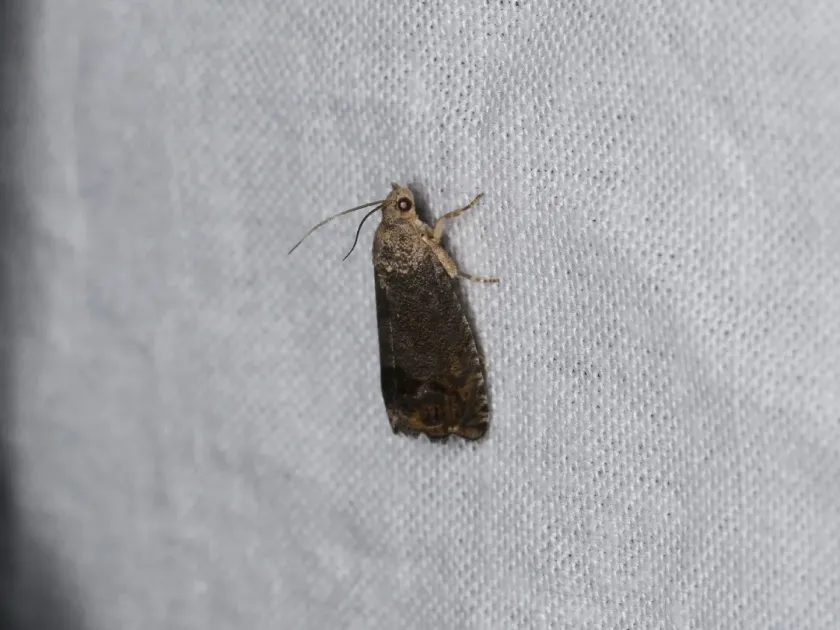
The acorn moth Cydia splendana is a species of moth belonging to the family Tortricidae. The adult moth has a wingspan of 18–20 mm, with forewings that vary in color from grayish-brown to dark brown, often featuring subtle transverse darker bands.
The larvae, which are the main destructive stage, grow up to 18 mm in length. They are characterized by a whitish to pinkish body and a distinct brown head capsule, which helps in identifying them within the infested fruit.
The biological cycle of this insect is closely synchronized with the phenology of its host plants. Typically, there is one generation per year, although in warmer climates, partial second generations may occur if environmental conditions are favorable.
The species overwinters as a mature larva in a silk cocoon, usually buried in the soil up to 10–15 cm deep or within the leaf litter beneath the trees. Pupation occurs in the spring, followed by the emergence of adults.
Adult females lay their eggs singly on the surface of young oak acorns or chestnuts. A single female can deposit between 50 and 100 eggs, which can lead to high infestation levels in years with favorable conditions for the pest.
What it damages
The primary hosts for the acorn moth are the fruits of the common oak and sessile oak, as well as the sweet chestnut. Occasionally, it may also attack the fruits of beech trees.
The damage is caused by the larvae feeding on the inner tissues of the fruit. They consume the nutritious cotyledons, filling the interior with excrement, which renders the nut completely non-viable for germination.
In forestry, this pest is a major problem for seed harvesting. Because infested acorns are unable to sprout, significant portions of the seed bank intended for reforestation can be destroyed during peak years of moth activity.
The entry points created by the larvae provide an entry route for various secondary infections, including molds and fungi. These pathogens often cause the fruit to rot while it is still hanging on the tree or shortly after falling.
Even if the larva does not fully consume the kernel, the presence of holes and internal decay significantly reduces the market and ecological value of the acorns, especially for nursery propagation or wildlife food sources.
When it appears
Adult moth activity typically begins in mid-summer, spanning from late June to August. They are nocturnal insects and spend their daytime hours hiding within the tree canopy or in cracks in the bark.
Egg-laying begins shortly after emergence, and embryonic development lasts approximately 7 to 12 days, depending on temperature. The larvae hatch and immediately search for a suitable fruit to bore into.
Larval development inside the fruit takes about 30 to 45 days. Once fully grown, the larvae exit the acorn and move toward the soil to prepare for winter hibernation.
The mass exit of larvae often coincides with the natural fall of the acorns in September and October. This behavior ensures that the larvae are already located near their wintering sites in the soil or ground cover.
Climate fluctuations, such as extreme heat or drought during the summer months, can shift the timing of these biological stages, but the overall life cycle remains tied to the maturation cycle of the host tree's fruit.
Signs of infestation
The most obvious sign of an acorn moth infestation is a small, circular entry or exit hole on the shell of the acorn. Fine, brownish dust-like frass (excrement) is often visible around these holes.
Infested acorns may appear normal on the outside but often feel lighter than healthy ones. Shaking the acorn might produce a hollow sound, indicating that the inner tissue has been consumed.
- Premature drop of acorns that have not yet fully ripened.
- Larvae crawling out of acorns stored in containers or warehouses.
- Fine webbing around the base or surface of the nut.
- Darkening or softening of the shell near the point of larval entry.
Upon breaking open an infested acorn, one will find the larva inside along with dark, granular frass that completely occupies the space where the healthy kernel should have been.
The presence of cocoons in the bark crevices or in the soil surface layer under the tree crown indicates an active population established in the area during the previous season.
Control measures
Cultural control is the most effective approach. This includes the prompt collection and destruction of fallen acorns (the "drop") to prevent larvae from escaping the fruit and entering the soil to overwinter.
Autumn cultivation, such as tilling or digging the soil around the tree, can help expose the over-wintering larvae to harsh conditions and predators, significantly reducing the moth population for the following year.
Pheromone traps are highly effective for monitoring adult moth populations. This data helps foresters and nursery managers decide if and when to apply chemical control methods.
Chemical protection is usually reserved for valuable orchards or nurseries. Insecticides must be applied during the window of egg-hatching and before the larvae penetrate the fruit shell, as they are shielded once inside.
Biological control, such as the use of Trichogramma wasps, can be employed to parasitize the eggs of the acorn moth, effectively lowering population levels without the need for broad-spectrum chemical sprays.
Taxonomy
- Latin name
- Cydia splendana
- Order
- Lepidoptera (butterflies)
- Family
- Tortricidae
- EPPO code
- LASPSL
Discussion
No discussions yet — be the first.