
Spruce bark moth
Cydia pactolana
Description
How to identify
The spruce bark moth (Cydia pactolana) is a member of the Tortricidae family within the order Lepidoptera. This small moth is a specialized pest targeting coniferous trees, particularly spruce species.
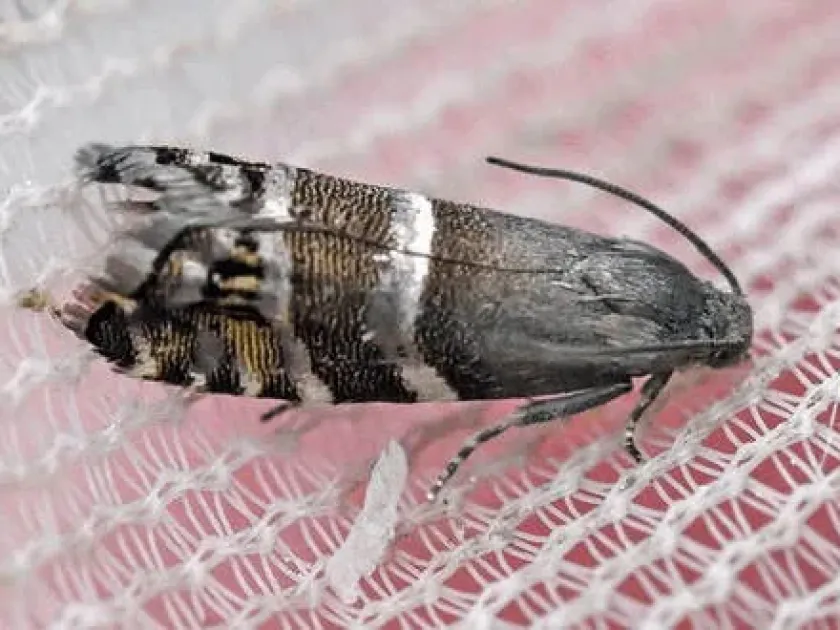
Adult moths have a wingspan of approximately 12–15 mm. Their forewings are characterized by a greyish-brown hue with a metallic sheen, featuring distinct transverse light bands and a speculum typical of this genus.
The larvae, or caterpillars, are typically whitish or pale pink with a dark brown head capsule. They are adapted to a life under the bark, which provides protection from predators and environmental extremes.
The pupation stage takes place inside dense, well-camouflaged cocoons constructed by the larvae within their galleries beneath the tree bark.
Female moths lay their eggs singly or in small clusters on the smooth bark of young spruce trees, often near wounds or branch nodes to facilitate the penetration of hatching larvae.
What it damages
The primary host for this pest is the Norway spruce (Picea abies), though other coniferous species can occasionally be affected. The damage is exclusively caused by larvae feeding on the inner bark and cambium layers.
Larval activity creates complex, branching tunnels under the bark. This disruption of the phloem and cambium layer impedes nutrient transport, which can significantly weaken the tree.
The tree responds to this injury by exuding resin at the site of attack. These resin flows are a primary indicator of larval activity and can be seen on the trunk and around branch junctions.
Severe infestations can lead to necrosis of the bark, inhibited growth, and increased susceptibility to secondary pests such as bark beetles, which often invade stressed trees.
In forest nurseries and young plantations, the cumulative damage can result in growth loss, poor tree form, and, in extreme cases, the mortality of the host plant.
When it appears
Adult moths are typically active during late spring and early summer. The emergence period is synchronized with the phenological development of the spruce tree.
The spruce bark moth completes one generation per year, making it a univoltine species. This life cycle is strictly tied to the seasonal growth patterns of its host.
The species overwinters as late-instar larvae. They hibernate within the galleries they have excavated under the bark, allowing them to withstand harsh winter conditions.
As temperatures rise in the spring, the overwintering larvae resume feeding or begin their final maturation process before pupating.
The adult flight phase lasts for several weeks, during which mating and oviposition occur, ensuring the continuation of the population for the next growing season.
Signs of infestation
Resin flow is the most prominent visual sign of infestation. You will observe fresh or hardened resin streaks on the bark, particularly around the whorls of branches.
The presence of boring dust or frass, which is ejected by the larvae from their tunnels, often accumulates at the base of the tree or on lower branches.
Discoloration of the needles, which may turn pale green or yellow before dropping, serves as a symptom that the vascular supply to the branch has been compromised.
Close inspection of the bark surface may reveal small entrance holes where the larvae have successfully penetrated the outer layer of the tree.
- Visible resin drips on the trunk.
- Accumulation of boring dust on the bark or ground.
- Localized wilting and yellowing of the crown.
- Deformation or swelling of the bark in infested zones.
Control measures
Silvicultural management, including the removal and destruction of heavily infested trees, is the most effective approach to reduce pest populations in forest stands.
Biological control methods, such as the application of entomopathogenic bacteria or fungi, can be effective if timed precisely with the larval emergence phase.
For high-value ornamental trees or nursery stocks, systemic insecticides can provide temporary protection, though their application requires professional knowledge.
Encouraging natural predators, such as parasitic wasps and predatory beetles, can help maintain the moth population below the economic threshold in healthy forest ecosystems.
Regular forest health monitoring and the maintenance of diverse, resilient stands are essential strategies to minimize the risk of large-scale spruce bark moth outbreaks.
Taxonomy
- Latin name
- Cydia pactolana
- Order
- Lepidoptera (butterflies)
- Family
- Tortricidae
- EPPO code
- LASPPC
Discussion
No discussions yet — be the first.