
Pecan nut casebearer
Cydia ingens
Description
How to identify
The pecan nut casebearer (Cydia ingens) belongs to the Tortricidae family of moths and is a significant pest of pecan trees and related nut-producing species.
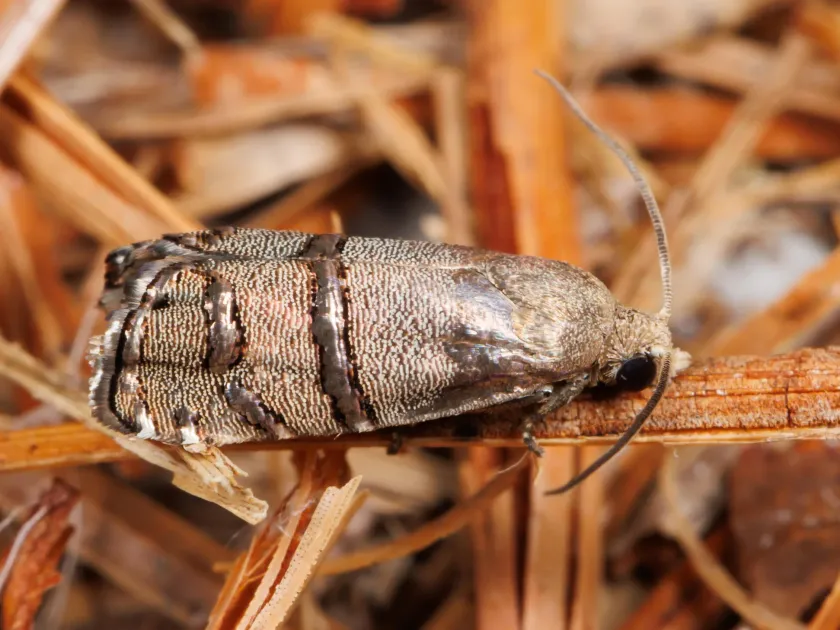
The adult moth has a wingspan of approximately 15–20 mm, with grayish-brown forewings that feature a dark ridge or band, providing effective camouflage against bark.
The larvae, which are the damaging stage, go through several instars. Early larvae are often pale, becoming more pinkish as they mature with dark head capsules.
The biological cycle is synchronized with the development of the nut. Moths typically produce two to three generations per year depending on regional temperatures.
Overwintering occurs as larvae in protective hibernacula (small cocoons) constructed in crevices on the tree bark or at the base of buds.
What it damages
The primary host for Cydia ingens is the pecan nut. The larvae feed by boring into the young nuts, causing them to hollow out completely.
One larva can destroy several nuts within a cluster, as it moves from one fruit to another while feeding, which significantly compounds the economic impact.
Damaged nuts are often shed prematurely from the tree, and those that remain may be infested with secondary fungi or rot, rendering them non-marketable.
High infestations can lead to a drastic reduction in total yield, sometimes destroying the majority of the crop if control measures are not implemented.
The pest is most destructive in early summer when nutlets are still developing and are most vulnerable to larval feeding and entry.
Signs of infestation
The most reliable sign of an infestation is the appearance of small entry holes, often accompanied by silk webbing and larval excrement (frass) at the base of the nut cluster.
Premature nut drop is a clear indicator that larvae are active within the orchard, often occurring shortly after the eggs have hatched.
Upon inspecting a cluster, growers can find hollowed-out nuts with visible galleries created by the larvae inside the shell.
Monitoring the flight of adult moths using pheromone traps is the standard industry practice for timing necessary control interventions.
Observing silk tunnels on the shoots or around the nut bases is a diagnostic feature of the casebearer's presence in the tree canopy.
Control measures
Integrated Pest Management (IPM) is essential for controlling the pecan nut casebearer, combining monitoring, biological control, and targeted chemical treatments.
Chemical control must be applied precisely when eggs are hatching but before the larvae bore into the nuts, as internal larvae are protected from contact insecticides.
Beneficial insects, such as parasitic wasps, play a significant role in reducing larval populations naturally and should be protected by avoiding broad-spectrum pesticides.
Cultural practices include monitoring and removal of infested clusters to limit the spread of the current generation within the orchard.
- Use pheromone traps to time insecticide applications.
- Apply growth regulators or selective insecticides correctly.
- Maintain orchard hygiene by removing dropped clusters.
Taxonomy
- Latin name
- Cydia ingens
- Order
- Lepidoptera (butterflies)
- Family
- Tortricidae
- EPPO code
- LASPIN
Discussion
No discussions yet — be the first.