
Beech moth
Cydia fagiglandana
Description
How to identify
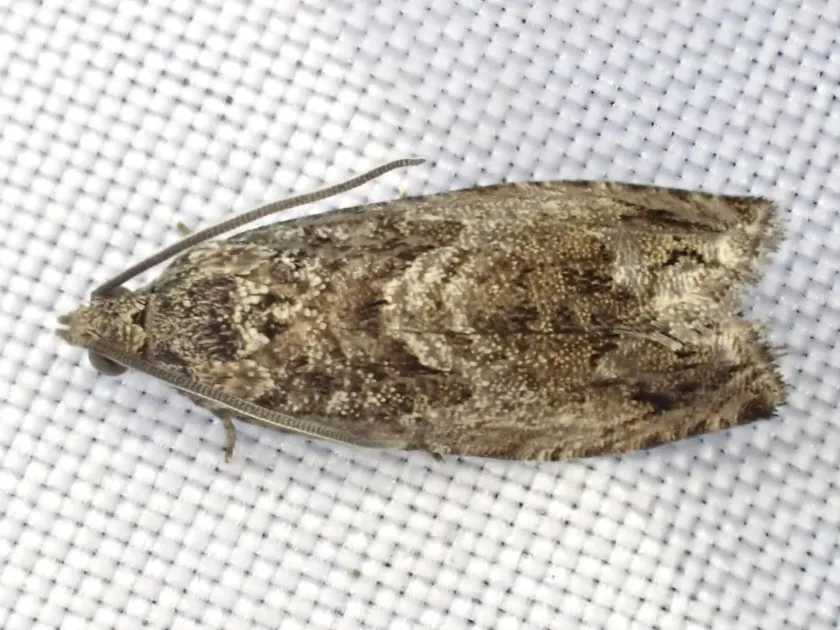
The beech moth (Cydia fagiglandana) is a member of the Lepidoptera order and the Tortricidae family. The adult moth typically has a wingspan ranging from 14 to 18 mm.
The forewings are characterized by a brownish-grey color with a pattern of transverse light bands and darker spots. The hindwings are generally paler, often featuring a fringe along the edges.
The larvae, which are the primary damaging stage, reach a length of 12–15 mm. They are cream-colored or pinkish with a dark, often black or brown, head capsule.
The pupa is light brown and develops either within the beech nut or in the forest litter, where the insect undergoes diapause during the winter months.
The life history of this species is highly specialized, having evolved to synchronize its developmental stages with the phenology of the beech tree.
What it damages
The main target of the beech moth larvae is the seed (nut) of the European beech (Fagus sylvatica). The larvae bore into the fruit to consume the developing kernel.
During outbreak years, this pest can cause significant losses in seed yield, which is a critical concern for natural forest regeneration and nursery production.
Beyond the direct consumption of seeds, larval activity exposes the internal tissues to fungal pathogens, further reducing seed quality and viability.
The economic impact is particularly pronounced in beech seed orchards, where the goal is to produce high-quality, pest-free seeds for reforestation projects.
Forest management strategies must account for these potential losses, as high infestation rates can prevent successful natural regeneration in managed beech stands.
When it appears
The flight period of adult moths typically occurs in the spring, corresponding with the flowering and early fruit development of beech trees, usually in May or June.
Females deposit eggs on the young fruit or nearby leaves. After hatching, the larvae immediately seek out a site to bore into the developing beech nuts.
The larval stage lasts throughout the summer, during which they feed continuously on the nutrient-rich kernel inside the shell.
In the autumn, mature larvae exit the damaged nuts, descend to the forest floor, and seek shelter in the leaf litter to overwinter as pupae.
The species completes one generation per year, making its population dynamics highly dependent on the success of beech seed production cycles.
Signs of infestation
Signs of infestation include small, circular entry holes on the surface of the beech nut, often accompanied by visible frass or brownish boring dust.
Darkened or sunken areas on the nut shell may indicate that a larva has successfully penetrated the shell and is feeding on the interior tissues.
Upon breaking open a suspected nut, one can observe larval tunnels and remnants of consumed endosperm, confirming the presence of the pest.
Prematurely dropped nuts found beneath the canopy are another indicator, as larval feeding often causes the tree to shed the damaged fruit early.
- Entry holes on the shell
- Presence of larval frass
- Premature fruit drop
- Darkened patches on the shell surface
- Hollowed-out seed kernels
Control measures
Controlling the beech moth is challenging because the larvae are protected inside the fruit for most of their active life cycle, limiting insecticide efficiency.
Pheromone traps are currently the most reliable method for monitoring population levels and determining the appropriate timing for targeted interventions.
Silvicultural practices, such as the systematic removal of infested nuts from the forest floor, can help reduce the local population of overwintering pupae.
Biological control agents, including entomopathogenic fungi or specialized predators, are being researched as potential long-term solutions for nursery management.
For seed production purposes, post-harvest treatment methods like fumigation or controlled heat treatment are essential to kill larvae hidden within the shells.
Taxonomy
- Latin name
- Cydia fagiglandana
- Order
- Lepidoptera (butterflies)
- Family
- Tortricidae
- EPPO code
- LASPGR
Discussion
No discussions yet — be the first.