
Spruce shoot moth
Cydia duplicana
Description
How to identify
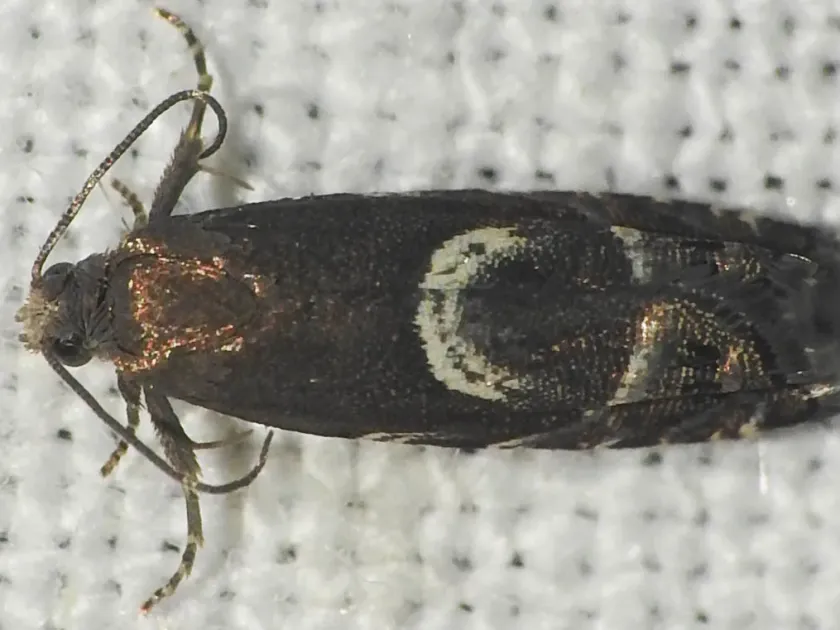
The spruce shoot moth (Latin: Cydia duplicana) belongs to the order Lepidoptera, family Tortricidae. It is a small moth with a wingspan of approximately 15–18 mm.
The forewings have a greyish-brown pattern with intricate transverse lines and light spots, providing excellent camouflage against tree bark.
The larvae are typically 12–14 mm long, with a cylindrical body ranging from dirty white to yellowish-pink, accompanied by a dark-colored head.
These moths are notoriously elusive, as they maintain a cryptic lifestyle that makes visual identification difficult during early infestation stages.
Adults are primarily active during twilight hours, when mating occurs and females search for suitable bark crevices to lay their eggs.
What it damages
The primary host for this pest is the Norway spruce, though it can also infest other coniferous species in forests and ornamental plantations.
The larvae cause significant damage by feeding on the bark and cambium layer, particularly at the junctions of branches and the main trunk.
This feeding activity disrupts the tree's vascular system, often resulting in the wilting and eventual death of individual branches or the entire top of the tree.
High infestation levels can cause stem deformation and weaken the tree's health, predisposing it to secondary attacks by bark beetles and pathogens.
Economic damage includes reduced timber quality, stunted growth, and the loss of aesthetic value in parks and garden settings.
When it appears
The life cycle is generally univoltine, with the flight period of adults occurring from late spring through early summer.
After mating, females deposit eggs individually or in small clusters within bark fissures, often near mechanical injuries or dormant buds.
Upon hatching, larvae immediately bore into the bark, constructing galleries where they feed on inner tissues throughout the summer and autumn.
Overwintering takes place in the larval stage, protected within the galleries or in silken cocoons spun beneath the bark scales.
Pupation occurs in early spring within the larval galleries, followed by the emergence of the next generation of adults.
Signs of infestation
The most prominent sign of infestation is the appearance of resin flows on the trunk and at branch attachment points.
Visible accumulations of brownish wood debris, mixed with resin and larval frass, often signal active feeding tunnels beneath the bark.
Affected foliage changes color, typically turning yellow or reddish, which indicates that the branch has been girdled or severely damaged.
Close inspection of the tree bark reveals small entry holes, which are typical of the larvae's boring activity.
During the flight season, moths may be observed resting on trunks during the day, although they are most active during the evening.
Control measures
Cultural control involves the routine inspection of coniferous trees and the prompt removal and destruction of heavily infested branches.
Maintaining high tree vigor through proper silvicultural practices is essential for enhancing natural resistance against larval boring.
Chemical control can be effective when systemic insecticides are applied precisely during the egg-hatching period to target young larvae.
Pheromone traps are highly recommended for monitoring adult populations and timing intervention measures accurately.
- Sanitary pruning of infested branches.
- Strategic application of systemic insecticides.
- Encouraging natural predators such as parasitic wasps and insectivorous birds.
Taxonomy
- Latin name
- Cydia duplicana
- Order
- Lepidoptera (butterflies)
- Family
- Tortricidae
- EPPO code
- LASPDU
Discussion
No discussions yet — be the first.