
Spruce resin moth
Cydia coniferana
Description
How to identify
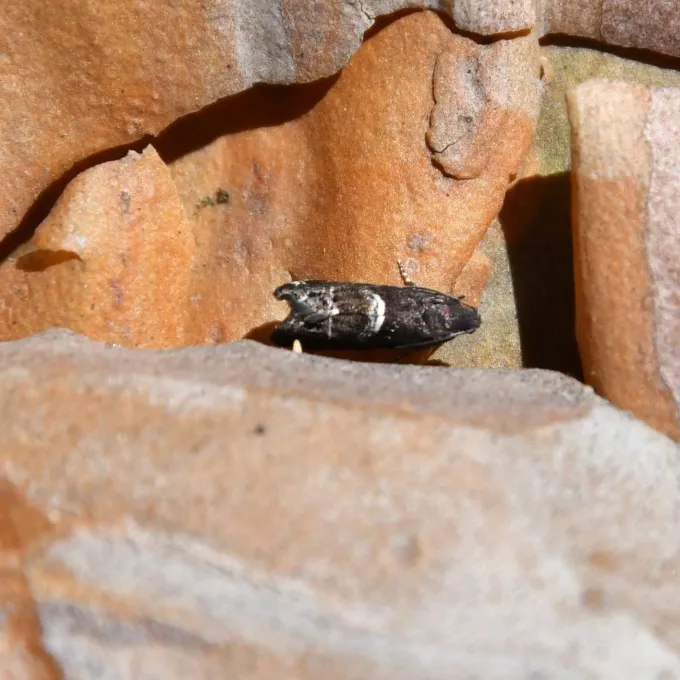
The spruce resin moth (Cydia coniferana) is a small moth belonging to the Tortricidae family within the order Lepidoptera. Adult individuals have a wingspan of 12 to 16 millimeters, making them difficult to spot within the dense canopy of a tree.
The wings exhibit a characteristic ochre or brownish hue with a distinct reticulated pattern and light transverse bands. This provides ideal camouflage against the bark of coniferous species, where the moth spends most of its time.
The larvae of this pest reach a length of 10-12 millimeters. Their bodies are pinkish-brown in color with a dark head and a prominent thoracic shield, which is a key diagnostic feature for species identification under magnification.
The pupae develop inside the tunnels created within the bark. They are brown in color and are often protected by a silken cocoon mixed with bark particles and frass, which makes them difficult to detect during routine inspections.
The insect's life cycle is closely tied to coniferous tissues. Adult moths are crepuscular, meaning they are active during twilight, which complicates population monitoring using visual methods without the use of pheromone traps.
What it damages
The primary hosts of the spruce resin moth are trees of the genus Picea (spruce). The pest prefers to inhabit both wild specimens in forest stands and ornamental plantings in gardens and public parks.
Secondary food sources can include other conifers, particularly Pinus sylvestris (Scots pine). Infestation occurs at various life stages, affecting everything from young saplings to mature forest trees.
The greatest damage is caused to young trees, where stem injury can lead to leader deformation or even the death of the sapling due to the disruption of nutrient flow through the phloem.
Damage is localized primarily in areas of mechanical bark injury or where natural irregularities exist. Larvae burrow into the bark, forming channels, which triggers active resin flow in healthy trees as a defense mechanism.
Heavy infestation weakens the tree, making it highly susceptible to secondary pests such as bark beetles and wood borers, which can rapidly accelerate the decline and eventual death of the affected plant.
When it appears
The flight period for adult spruce resin moths begins in late spring, typically in May, and continues throughout June, sometimes extending into early July depending on the local climate and weather conditions.
Females deposit eggs singly or in small clusters directly on the bark of trunks or branches, often near whorls. Embryonic development is relatively rapid, followed by the hatching of young larvae.
The larvae begin their active feeding phase in mid-summer. They chew through the bark and tunnel underneath, where they develop over a long period, feeding on the cambium and inner bark tissues.
Overwintering occurs in the final larval instar within tunnels chewed into the wood or bark. They remain in a state of diapause until spring warming, when they resume their biological activity.
Pupation takes place in the spring before the emergence of the next generation of moths. Thus, the pest has a univoltine life cycle, which allows it to adapt efficiently to seasonal temperature fluctuations.
Signs of infestation
The most obvious sign of the resin moth's presence is abundant resin exudation (bleeding) on the surface of the trunk and branches. The resin often hardens into characteristic lumps or continuous streaks.
Upon inspecting the damage sites, one can often find a brownish "boring dust" mixed with resin. This is a collection of larval frass and bark particles pushed out during the insect's boring activities.
In the early stages of infestation, terminal shoots may start to curl or show reduced growth rates. This happens because the larva undermines the bark around the branch whorl, disrupting normal sap flow.
If a section of bark is removed in areas with heavy resin flow, winding tunnels created by the larvae can be observed running parallel to the stem axis. Larvae or debris from their activity are often found inside these galleries.
By the end of the growing season, bark patches damaged by the pest may die off and fall away. This creates entry points for pathogenic fungi, which can lead to decay and additional stem diseases.
Control measures
The primary control measure is the strict adherence to good arboricultural practices. It is crucial to prevent mechanical bark injury when caring for trees, as these wounds are preferred egg-laying sites for the moth.
Preventive sanitary pruning of heavily infested branches during the autumn or winter period helps to significantly reduce the pest population, as the larvae overwinter within the tree tissues.
Chemical treatments with systemic insecticides are effective during the period when larvae hatch before they bore into the bark. Products based on imidacloprid or deltamethrin are generally recommended.
The use of biological control agents, such as bacteria-based biopesticides, can be effective in the early stages of infestation. Applications must be timed precisely with the phenological stages of the insect's development.
- Removal and destruction (burning) of pruned infested branches.
- Sealing mechanical wounds with arboricultural grafting wax.
- Regular trunk inspections during May and June.
- Installation of pheromone traps to monitor moth flight.
Taxonomy
- Latin name
- Cydia coniferana
- Order
- Lepidoptera (butterflies)
- Family
- Tortricidae
- EPPO code
- LASPCN
Discussion
No discussions yet — be the first.