
Pecan nut casebearer
Cydia caryana
Description
How to identify
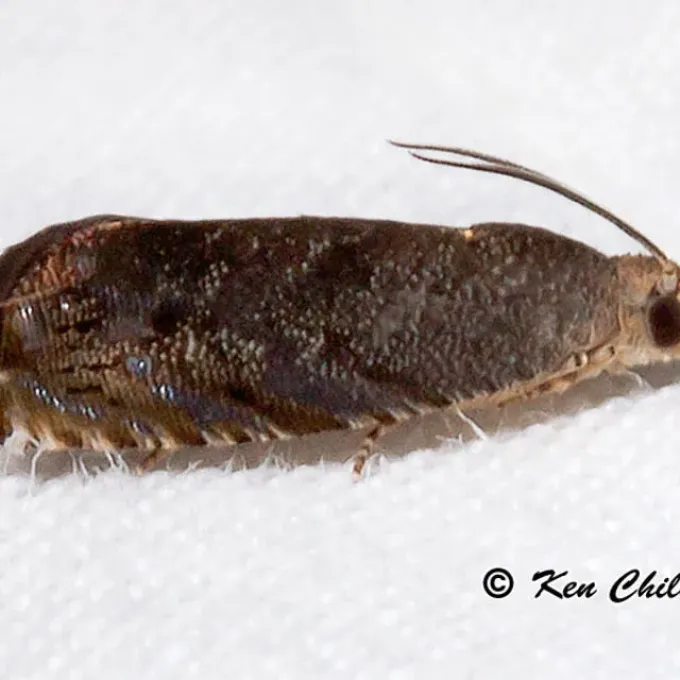
The pecan nut casebearer (lat. Cydia caryana) belongs to the Tortricidae family within the order Lepidoptera. The adult is a small moth with a wingspan of approximately 12–15 millimeters.
Its forewings are grayish-brown with a distinct pattern of transverse bands, providing effective camouflage against the bark of host trees during the day.
The eggs are tiny and oval-shaped, typically deposited by females on the surface of developing pecan nuts where the larvae will eventually emerge.
The larvae progress through several developmental stages. Young larvae are light in color, while older larvae develop a pinkish or yellowish tint with a dark head capsule.
Pupation occurs either inside the damaged nut or within the soil, depending on the generation and the specific environmental conditions of the growing season.
What it damages
The primary host of this pest is the pecan (Carya illinoinensis). The larvae are specialized in feeding on the fruit at various stages of nut development.
Early in the season, young larvae may feed on the nut shuck, leading to premature drop of the fruit, which significantly impacts overall yields.
Mature larvae tunnel into the interior of the nut and consume the developing kernel, rendering the entire fruit unmarketable and unsuitable for human consumption.
During years of heavy infestation, losses in neglected orchards can reach 50–80%, causing severe economic damage to commercial pecan producers.
The feeding holes created by the larvae also serve as entry points for secondary fungal infections, which further degrade the quality of the harvested nuts.
When it appears
The life cycle of the pecan nut casebearer is heavily dependent on regional climate. In warmer areas, the insect can produce several generations per season.
The emergence of the first generation of moths typically coincides with the nut setting period, making the future crop vulnerable to infestation early on.
Adult females begin laying eggs shortly after emergence, selecting the most developed and healthy-looking nut clusters for their offspring.
The developmental period from egg to adult takes approximately 30 to 45 days, allowing for a rapid population expansion during the peak summer months.
The insect typically overwinters as a late-instar larva inside a tightly woven hibernaculum located in tree bark crevices or soil debris.
Signs of infestation
The most reliable sign of an infestation is the presence of entry holes on the nut surface, often surrounded by frass (larval excrement) held together by silken threads.
Premature nut drop during the late spring and early summer is a critical indicator of active infestation within the pecan orchard canopy.
When an infested nut is cracked open, one can find the larva or the hollowed-out cavity where the kernel should have developed.
Monitoring for adult moths using pheromone traps is the industry standard for determining the timing of control measures in professional orchards.
- Darkened spots on the nut shuck near the entry points.
- Sudden nut drop during the early fruit development stage.
- Accumulation of granular frass on the outside of the nut.
- Hollow cavities or damaged kernels inside the shell.
Control measures
Chemical control involves the application of targeted insecticides during peak larval emergence, which requires precise timing based on pheromone trap data.
Pheromone traps are essential for integrated pest management (IPM), as they indicate when the population levels exceed the economic threshold for intervention.
Cultural control practices include the removal and destruction of fallen nuts, which can harbor overwintering larvae and reduce the population for the following year.
Biological control options involve the use of beneficial insects, such as Trichogramma wasps, which parasitize the pest eggs and effectively limit population growth.
An effective management strategy combines continuous orchard scouting, selective chemical treatments, and maintaining tree vigor to minimize harvest losses.
Taxonomy
- Latin name
- Cydia caryana
- Order
- Lepidoptera (butterflies)
- Family
- Tortricidae
- EPPO code
- LASPCA
Discussion
No discussions yet — be the first.