
Fir seed moth
Cydia bracteatana
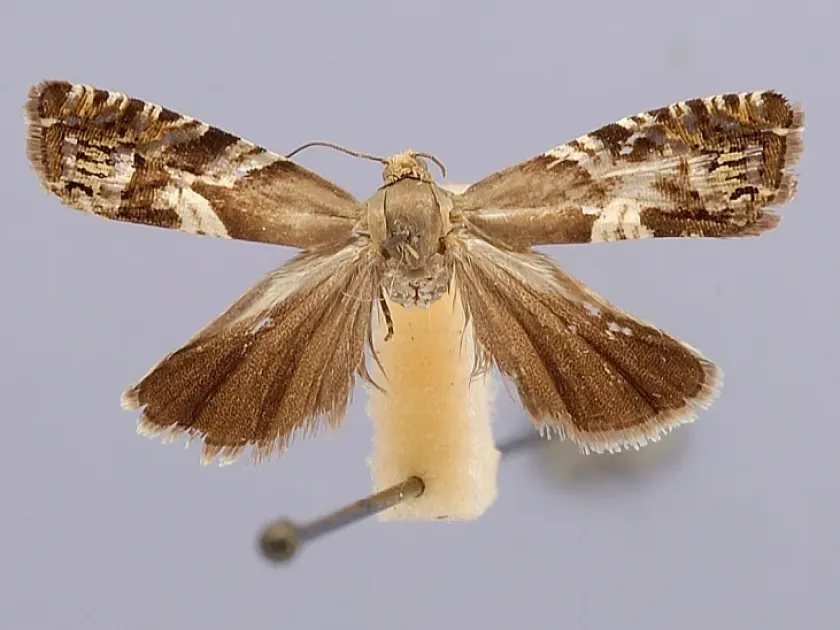
Description
How to identify
The fir seed moth (Cydia bracteatana) is a member of the Tortricidae family within the order Lepidoptera. This small moth is a specialist pest that targets the reproductive structures of various fir species. The adult moth has a wingspan of approximately 15–18 mm and features brownish-grey forewings with metallic reflections.
The larvae are small, usually measuring up to 15 mm, with a yellowish-white body and a dark brown head. Because they feed internally within the cones, they are rarely seen by foresters, making identification dependent on recognizing damage patterns.
Taxonomically, the species is closely related to other seed-infesting moths. Adult moths are primarily nocturnal, which explains why they often go unnoticed until the damage to the seed crop becomes evident.
This species is widely distributed throughout the natural range of its host trees, primarily various Abies species. Its population density is highly dependent on the annual production of cones in local forest stands.
Understanding the moth's biology is essential for silviculture, as it is one of the most critical threats to the long-term sustainability of seed orchards and natural forest regeneration.
What it damages
The primary damage caused by the fir seed moth is the destruction of seeds within fir cones. Larvae tunnel into developing cones and consume the seeds and the surrounding tissue, rendering the cones useless for seed collection.
During their development, larvae create extensive galleries filled with frass and webbing. This internal damage often leads to the premature drying and deformation of the cones, resulting in a significantly reduced seed yield.
In peak infestation years, the fir seed moth can destroy nearly the entire seed crop of an individual tree. This can be devastating for forestry projects that rely on natural or collected seeds for planting programs.
Beyond seed loss, the physical injury to the cone tissues weakens the tree's reproductive health and can create entry points for various fungal infections that further damage the cone's structural integrity.
In seed orchards, even moderate infestations can cause significant economic losses, as the quality and quantity of the germinable seeds are compromised by the larval feeding process.
When it appears
The flight period for adult moths typically occurs in the late spring or early summer, coinciding with the flowering and cone development of the fir trees. The precise timing is driven by local temperature and elevation.
After mating, females lay eggs on the surface of young cones. Once the larvae hatch, they immediately bore into the cone tissue, ensuring their protection from predators and environmental factors for the remainder of their larval stage.
Larval development takes place throughout the summer as they feed on the internal seeds. The larvae grow steadily, completing their development within the cone before preparing to overwinter.
The insect overwinters as a mature larva inside the cone, whether it remains on the branch or has fallen to the forest floor. Pupation occurs the following spring, just before the adult moths emerge.
Monitoring these seasonal phases is key to implementing effective control measures, as the window of opportunity to intervene is limited to the period before the larvae have successfully bored into the cones.
Signs of infestation
Early signs of infestation include the presence of fine brownish frass and excrement on the outside of young cones. This material is often held together by silk webbing produced by the larva.
Resin flow at the entry points is another diagnostic feature. Infested cones often appear distorted, stunted, or significantly smaller than healthy ones, which is a clear indicator of restricted growth due to internal feeding.
In harvested cone crops, one can identify infested cones by the presence of exit holes and the hollowed-out interior lacking any viable seeds. These cones are typically much lighter than their healthy counterparts.
During spring, you might observe empty pupal cases protruding from the exit holes in older cones left on the trees from the previous season.
- Brownish frass on the cone surface.
- Presence of silken webbing.
- Deformed and stunted cones.
- Resin patches on the cone exterior.
- Internal galleries and lack of seeds.
Control measures
Management of the fir seed moth often involves a combination of cultural and chemical strategies. In seed orchards, the manual collection and destruction of fallen cones is highly effective for reducing the overwintering population.
Chemical applications are targeted at the period of adult moth flight and egg-laying. Systemic insecticides can prevent the larvae from successfully penetrating the cone tissues if applied correctly.
Pheromone traps serve as essential monitoring tools, allowing managers to time their protection efforts based on the actual presence and density of adult moths in the area.
Biological control methods, such as the augmentation of natural parasitoids, have been researched as a long-term solution in forest stands where chemical intervention is not feasible or desired.
Maintaining proper distance between new plantations and old, infested stands can also minimize the risk of re-infestation and help ensure the health of future seed crops.
Taxonomy
- Latin name
- Cydia bracteatana
- Order
- Lepidoptera (butterflies)
- Family
- Tortricidae
- EPPO code
- LASPBR
Discussion
No discussions yet — be the first.