
Araucaria moth
Cydia auraucariae
Description
How to identify
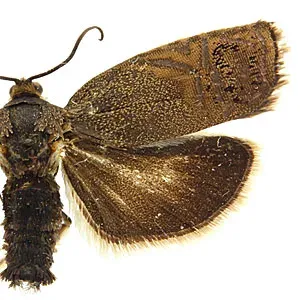
The Araucaria moth (Cydia auraucariae) belongs to the order Lepidoptera and the family Tortricidae. It is a specialized pest exclusively associated with trees of the genus Araucaria.
The adult moth is relatively small, with wingspan typically ranging from 15 to 20 mm, exhibiting brown and grey cryptic coloration to blend with tree bark.
The larval stage consists of several instars, with caterpillars transitioning through stages of varying pigmentation, typically developing into brown or pinkish larvae.
Its biological cycle is strictly dependent on the cone production of host trees, ensuring that the larval development coincides with the formation of seeds.
Pupation occurs within the protective environment of the damaged cones, allowing the insect to survive through unfavorable conditions until the next season.
What it damages
The primary damage is caused by larvae feeding on developing seeds within the cones of Araucaria trees, significantly impacting seed production.
Larvae tunnel through the scales and the central axis of the cone, which often causes the cones to deteriorate or drop from the tree prematurely.
Because the larvae reside deep within the cone tissues, they are protected from environmental factors and surface-contact pesticides for a significant portion of their life cycle.
Large-scale infestations can cause severe economic losses in seed orchards and nurseries where Araucaria is cultivated for reforestation or timber production.
In ornamental horticulture, the presence of damaged, resin-coated, or prematurely shed cones significantly detracts from the aesthetic value of the trees.
Signs of infestation
Visible signs of infestation include brown frass and debris expelled by larvae, which accumulate around the entrance holes on the cone surface.
Resin exudation is a common defense mechanism of the plant, resulting in hardened resin blobs around the penetration points where larvae have entered.
Discoloration and localized drying of individual cone scales, often appearing before the natural maturation process, indicate internal larval activity.
A high rate of premature cone drop is a strong indicator of an active pest population inhabiting the tree canopy.
Dissection of fallen cones usually reveals complex larval galleries and destruction of the seeds, confirming the presence of the Araucaria moth.
Control measures
Sanitation is the most effective management practice, involving the regular collection and destruction of infested cones to reduce the pest population.
Chemical control involving systemic insecticides can be applied during the peak flight of adult moths to prevent egg-laying on developing cones.
Biological control using microbial insecticides, such as those based on Bacillus thuringiensis, offers an environmentally friendly approach for sensitive areas.
Pheromone traps serve as essential monitoring tools to determine the precise timing for intervention, ensuring treatments are applied when larvae are most vulnerable.
- Pruning and removal of infected branches and cones.
- Implementation of integrated pest management (IPM) strategies.
- Enhancing tree vigor through proper irrigation and nutrient management.
Taxonomy
- Latin name
- Cydia auraucariae
- Order
- Lepidoptera (butterflies)
- Family
- Tortricidae
- EPPO code
- CYDIAR
Discussion
No discussions yet — be the first.