
Nut fruit moth
Cydia amplana
Description
How to identify
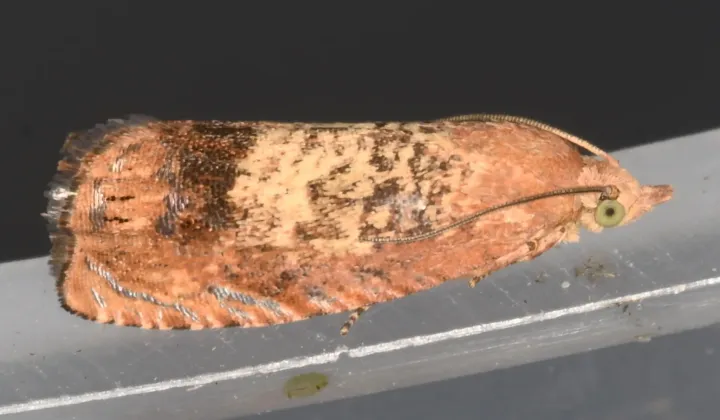
The nut fruit moth (Cydia amplana) is a lepidopteran insect belonging to the Tortricidae family. The adult moth has a wingspan of 15-22 mm, featuring greyish-brown forewings with a characteristic dark pattern.
The larva, or caterpillar, reaches up to 18 mm in length. Its body is typically pinkish-white or creamy, with a distinct brown head capsule, which is the primary stage responsible for crop damage.
The insect undergoes a complete metamorphosis: egg, larva, pupa, and adult. It typically overwinters as a mature larva inside a dense silk cocoon in the soil or under debris in orchards.
Adults are nocturnal and crepuscular, with their flight activity and egg-laying processes being highly dependent on favorable spring and summer temperatures and moderate humidity levels.
Monitoring for this pest is best conducted using pheromone traps, which assist growers in determining exact population peaks and timing insecticide applications effectively.
What it damages
This species is a specialized feeder that primarily targets nut-bearing trees. Its main hosts include hazelnut (Corylus avellana), walnut (Juglans regia), and sweet chestnut (Castanea sativa).
Larvae bore into developing nuts, excavating tunnels through the husk and the kernel itself. This feeding activity causes premature fruit drop and significant reduction in overall yield.
The infestation inside the nut leads to contamination by larval frass and silk, which often triggers the colonization of secondary pathogens, such as molds and various fungi.
Once a nut is infested, it becomes unsuitable for human consumption or processing. In neglected orchards, the nut fruit moth can cause devastating losses, affecting over half of the harvest.
The economic impact is particularly severe during years of high population density, necessitating active orchard management to preserve the quality and market value of the nut crop.
When it appears
The life cycle begins in late spring, usually in June, when air temperatures consistently reach +15°C to +18°C, triggering the emergence of adults from overwintering sites.
The moth flight period can be quite prolonged. Depending on the local climate and temperature accumulation, the insect may complete one or even two generations per season.
Females deposit eggs on young nuts, foliage, or twigs near the developing clusters. Embryonic development generally takes between one to two weeks depending on thermal conditions.
Upon hatching, larvae seek entry points into the nuts. They remain inside the fruit throughout their larval stage, feeding on the developing kernel until they are ready to pupate.
Mature larvae exit the fruit and descend to the soil or crevices in bark to form cocoons for pupation or to enter diapause for the upcoming winter season.
Signs of infestation
The most visible sign of an infestation is the presence of small entry holes on the surface of the nut, often surrounded by accumulation of brown larval frass (sawdust-like debris).
Premature yellowing and dropping of immature nuts during the summer are classic indicators that larvae have disrupted the development of the fruit from the inside.
Opening an infested nut reveals internal tunnels filled with brown excrement and fine silk webbing, with the caterpillar often found feeding deep within the center.
External surface discolorations or depressed spots on the nut shell may also indicate an attempt by the larva to penetrate the fruit or early-stage successful entry.
- Entry holes with visible larval waste
- Unexpected premature nut drop
- Webbing and frass inside the shell
- Darkening of the shell around the entry point
- Presence of larvae upon cracking the nut
Control measures
Cultural control practices are essential, including the collection and destruction of fallen nuts and orchard debris to remove overwintering sites for the larvae.
Mechanical cultivation of the soil in the orchard floor during autumn and spring helps disrupt pupation sites and significantly reduces the overwintering population.
Biological control involves the application of entomopathogenic nematodes or biological insecticides based on specific bacteria, which can target larvae before they burrow into the fruit.
Chemical control should be timed precisely to target young larvae after egg hatching but before they penetrate the nut shell. Use contact or systemic insecticides as recommended.
The use of pheromone traps serves a dual purpose: it helps monitor population levels and can provide a level of mating disruption to reduce total infestation pressure.
Taxonomy
- Latin name
- Cydia amplana
- Order
- Lepidoptera (butterflies)
- Family
- Tortricidae
- EPPO code
- LASPAM
Discussion
No discussions yet — be the first.