
Codling moths
Cydia
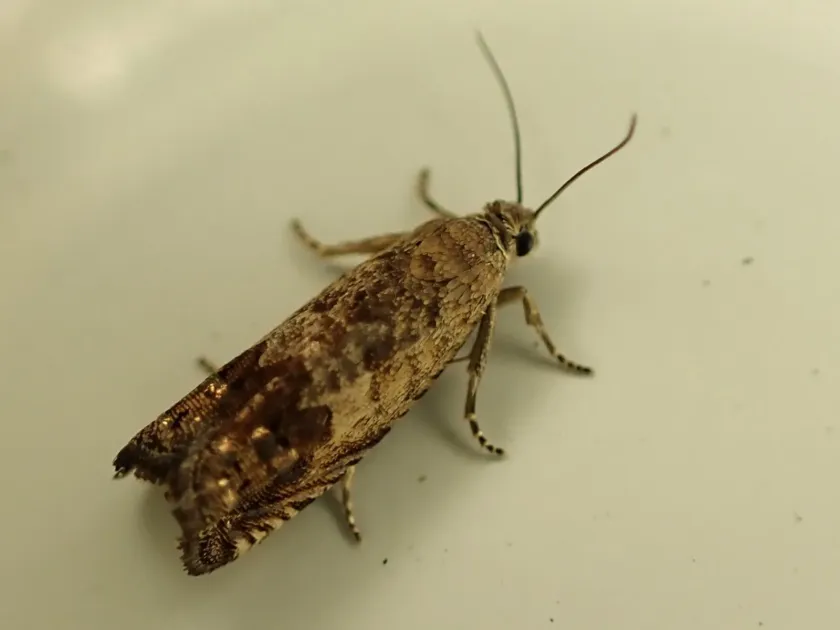
Description
How to identify
Codling moths belong to the Tortricidae family within the order Lepidoptera. These are relatively small moths that are primarily active during twilight hours, making them hard to spot.
The adult moths have a mottled gray-brown wing pattern, which provides excellent camouflage against tree bark. When at rest, their wings are folded along their body.
The larvae, which cause the actual damage, grow up to 20 mm in length. They are typically creamy-white or pinkish with a distinct dark brown head capsule.
Eggs are laid individually by the female on leaves or fruit surfaces. They are tiny, translucent, and oval-shaped, making them very difficult to find during routine inspection.
Pupation occurs inside dense silk cocoons, which larvae build in protected areas like bark crevices, soil, or pruning debris to survive unfavorable conditions.
What it damages
Codling moths mainly target pome and stone fruits, including apples, pears, peaches, and plums. Each specific species has its own preferred host plants.
Larvae bore into the fruit to reach the seeds, which are their preferred food source. This tunnel activity leads to premature fruit drop and significant yield loss.
Infested fruit is often visually spoiled by entry holes and brown frass (waste) pushed to the surface, making the fruit unsalable or inedible for fresh consumption.
Fruit damage often serves as an entry point for secondary infections such as fungal pathogens, including brown rot, which can ruin even more fruit during storage.
Heavy infestations can devastate an entire crop, leaving almost no fruit suitable for harvest if no preventive measures are taken during the season.
When it appears
The flight of the first generation usually begins during the apple blossom period, triggered by temperatures consistently reaching above 15°C in the evenings.
Depending on the geographic region, the number of generations per year can vary from one to four. Warmer climates allow for more rapid life cycles.
The insects overwinter as fully grown larvae inside their cocoons. When spring weather stabilizes, they pupate and transform into adult moths.
Peak moth activity occurs when the fruit is actively growing, providing ample food for the newly hatched larvae to bore into the fruit.
Later generations often overlap, leading to a constant presence of larvae throughout the summer months, which requires ongoing monitoring.
Signs of infestation
The most recognizable sign is the presence of an entry hole in the fruit surrounded by brown frass, which is the larva's waste material.
Premature fruit drop is a strong indicator of an active infestation, especially if the dropped fruit shows tunnels leading toward the core.
Adult moths caught in pheromone traps provide early warning signals, alerting orchardists to the optimal timing for protective spraying.
During the dormant season, careful inspection of the tree trunk and bark can reveal cocoons where larvae are overwintering.
Visible surface blemishes or small scars on the skin of young fruit can also indicate where a larva unsuccessfully attempted to enter the fruit.
Control measures
An effective management strategy integrates cultural, biological, and chemical methods to disrupt the codling moth life cycle at different stages.
- Setting up pheromone traps for monitoring populations and mating disruption.
- Sanitation by removing and destroying fallen fruit to prevent larvae from completing their life cycle in the soil.
- Utilizing biological controls like granulovirus or beneficial nematodes that target larvae.
- Wrapping tree trunks with cardboard or burlap bands to trap larvae seeking pupation sites.
- Applying targeted insecticides only during the period of mass egg hatching to minimize harm to beneficial insects.
Taxonomy
- Latin name
- Cydia
- Order
- Lepidoptera (butterflies)
- Family
- Tortricidae
- EPPO code
- CYDISP
Discussion
No discussions yet — be the first.