
Cyclorhipidion pelliculosum
Cyclorhipidion pelliculosum
Description
How to identify
Cyclorhipidion pelliculosum is a wood-boring beetle belonging to the family Curculionidae, subfamily Scolytinae. These insects are commonly referred to as ambrosia beetles due to their unique relationship with symbiotic fungi.
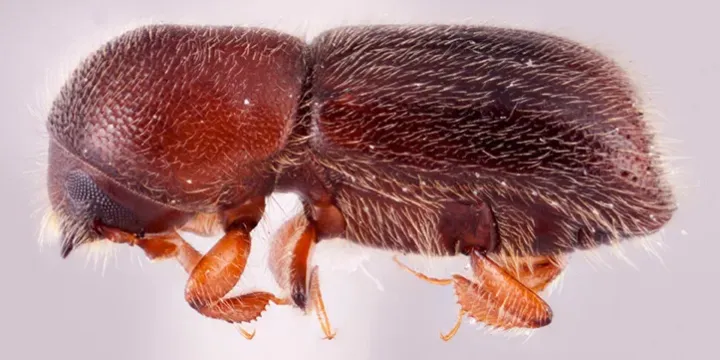
The adult beetles are small, cylindrical, and dark-colored, adapted for tunneling into wooden tissues. The larvae are white, legless, and thrive in galleries created by the parents, feeding primarily on the fungal mycelium growing on the tunnel walls.
The life cycle involves the female carrying fungal spores in specialized structures known as mycangia. Upon entering a host tree, the female introduces these fungi, which grow to create a favorable environment for the developing larvae.
These beetles are particularly attracted to trees that are stressed or weakened, as such trees offer the necessary moisture levels required for the symbiotic fungi to flourish inside the wood.
Taxonomically, this species has been reclassified in recent years, reflecting a better understanding of the diversity within the Scolytinae subfamily and the specific evolutionary adaptations of the Cyclorhipidion genus.
What it damages
The primary hosts of Cyclorhipidion pelliculosum are various deciduous tree species. They frequently infest forest stands, targeting weakened or dying trees that provide a suitable habitat for colonization.
Beech and other hardwood families are commonly affected. The damage caused is twofold: direct destruction of wood tissue via galleries and the introduction of pathogenic fungi that disrupt the tree's vascular system.
In forestry, this beetle plays a role in the natural decomposition of timber. While they can be beneficial in recycling nutrients in deadwood, their presence in standing timber often indicates underlying health issues in the forest stand.
In orchard settings, the infestation is often a secondary symptom of poor tree health. Environmental stressors such as drought, nutrient deficiency, or prior disease make trees vulnerable to successful colonization by these beetles.
The beetle’s activity reduces the commercial value of lumber due to the tunnels and the accompanying fungal staining of the wood, which is often dark or black in appearance.
Signs of infestation
The most visible sign of infestation is the presence of fine wood dust, or "frass," accumulating around tiny circular entry holes on the bark of the host tree.
Unlike bark beetles that create galleries just beneath the bark, Cyclorhipidion pelliculosum tunnels deep into the xylem. These galleries extend radially towards the center of the tree trunk.
A cross-section of infested wood often reveals dark staining or discolored streaks. This is caused by the growth of the ambrosia fungus, which the beetle encourages to grow as a food source for its offspring.
Tree decline symptoms include yellowing leaves, premature leaf drop, and overall canopy thinning. These signs appear as the internal vascular transport system is compromised by the fungal colonization.
In some cases, sapwood bleeding may occur at the point of entry, although this is more dependent on the tree species and the season of attack rather than a universal symptom.
Control measures
Effective management begins with silvicultural practices that maintain tree vigor. Trees with high hydraulic conductivity and vitality are naturally resistant to successful beetle colonization.
Sanitation is critical; the timely removal and disposal of infested trees prevent the buildup of beetle populations and the spread of fungal pathogens to neighboring healthy trees.
For orchards and urban forestry, ensuring proper irrigation and nutrient management is the best defense. Minimizing mechanical damage to trunks reduces sites where beetles can easily gain entry.
Monitoring using pheromone-baited traps can help assess population density and timing of adult flight, allowing for targeted interventions if necessary.
- Regular forest health surveys to identify early signs of infestation.
- Prompt sanitation harvesting and destruction of brood trees.
- Maintaining optimal soil moisture and nutrient status for trees.
- Application of protective trunk treatments if high population levels are detected.
- Prevention of logging slash and fresh wood accumulation in susceptible areas.
Taxonomy
- Latin name
- Cyclorhipidion pelliculosum
- Order
- Coleoptera (beetles)
- Family
- Curculionidae
- EPPO code
- XYLBPL
Discussion
No discussions yet — be the first.