
Cyclorhipidion
Cyclorhipidion
Description
How to identify
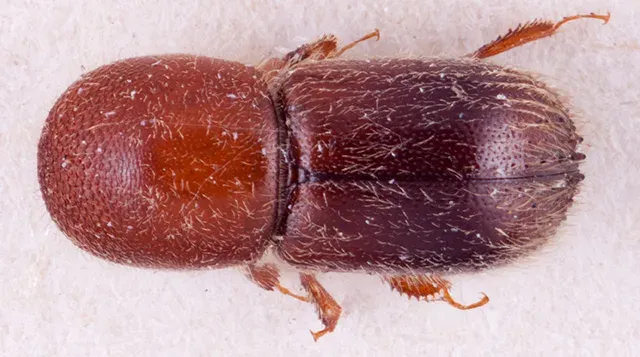
Cyclorhipidion is a genus of ambrosia beetles belonging to the family Curculionidae and the subfamily Scolytinae. These small, cylindrical beetles typically measure between 2 and 4 millimeters in length, making them difficult to spot on the bark.
Adult beetles usually have a dark brown or black coloration, often covered with fine setae. A defining morphological characteristic is the pronotum, which often overhangs the head, shielding it from view when observed from above.
The life cycle of these beetles is fundamentally linked to symbiotic ambrosia fungi. Adult females carry fungal spores in specialized thoracic structures called mycangia, which they introduce into the tree when excavating galleries.
Sexual dimorphism is highly pronounced in this genus. Males are significantly smaller than females, typically flightless, and rarely leave the parental gallery, which serves as the primary site for mating.
Due to the high species diversity and external similarity, accurate identification often requires professional expertise, including the examination of the male genitalia or molecular barcoding techniques.
What it damages
Cyclorhipidion beetles primarily target stressed, dying, or recently felled deciduous and coniferous trees. Host plants include a wide variety of species, such as maple, oak, birch, and several fruit-bearing trees.
The damage is caused not only by the boring of galleries but also by the introduced fungi. The fungal growth colonizes the xylem, obstructing the vascular system and preventing the efficient transport of water and nutrients.
In managed landscapes, these beetles can attack healthy trees if they are under environmental stress, such as severe drought or recent mechanical injury. Such trees lack the resinous pressure to repel the initial attacks.
Economic losses occur in timber production due to the degradation of wood quality caused by beetle galleries and fungal staining. In ornamental horticulture, the infestation leads to branch dieback and overall tree decline.
The impact of these beetles is particularly severe in dense forest stands or poorly maintained orchards, where high pest density can lead to the rapid death of vulnerable tree species.
Signs of infestation
The most common sign of an infestation is the appearance of small, circular entry holes on the bark surface. These holes are usually accompanied by fine, light-colored frass or wood dust accumulating near the entry point.
Removing a section of the bark reveals complex, branching galleries. The internal walls of these galleries are often stained dark by the growth of symbiotic fungi, which distinguishes them from typical bark beetle galleries.
Visible decline in the crown, such as yellowing or wilting leaves and premature foliage drop, is a late-stage symptom indicating that the vascular system has been severely compromised by the fungi.
Some tree species may exhibit sap or gum exudation at the sites of beetle entry as a defense mechanism, although this is often insufficient against a mass attack by a large number of beetles.
Branch dieback usually begins in the upper canopy or on weakened limbs and spreads downwards as the colony grows. If left unmanaged, the tree will eventually succumb to the combined stress of boring and fungal infection.
Control measures
Sanitation is the primary management tool. Infested branches or whole trees must be removed and destroyed before the new generation of beetles emerges to ensure that the local population does not increase.
Maintaining tree vigor through proper irrigation, mulching, and fertilization is essential for prevention. Healthy, well-hydrated trees possess stronger physiological defenses against ambrosia beetle colonization.
Systemic insecticides can be applied as a preventive treatment for high-value trees during the flight period of the beetles. However, efficacy is limited once the insects have already established their galleries deep in the wood.
The use of ethanol-baited traps helps in monitoring local beetle activity and determining the flight peak, which allows for precise timing of any necessary chemical applications or preventive measures.
For high-value ornamental trees, trunk injection of appropriate insecticides or fungicides can be a highly effective, albeit expensive, method to mitigate both the insects and the associated fungal pathogens.
Taxonomy
- Latin name
- Cyclorhipidion
- Order
- Coleoptera (beetles)
- Family
- Curculionidae
- EPPO code
- CYCRSP
Discussion
No discussions yet — be the first.