
Oak hairy weevil
Curculio villosus
Description
How to identify
The oak hairy weevil (Curculio villosus) belongs to the Curculionidae family within the order Coleoptera. It is a specialized pest primarily targeting oak trees.
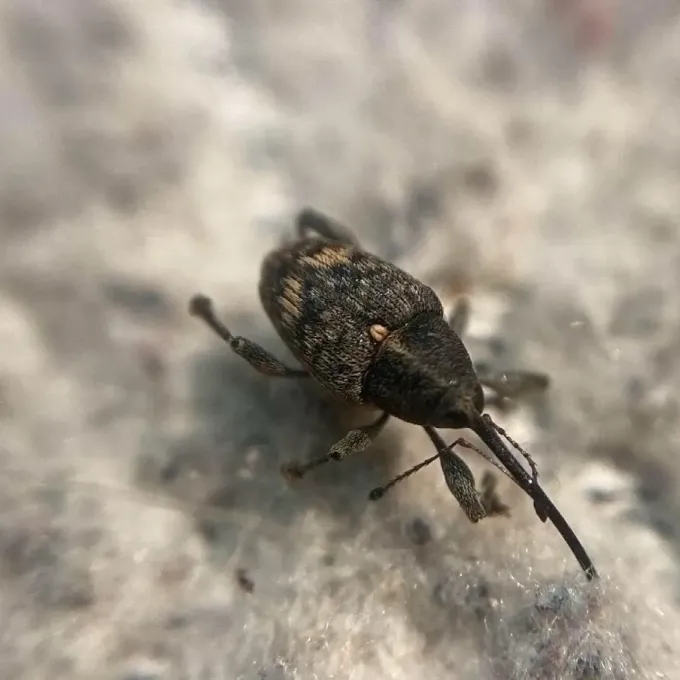
Adult weevils are characterized by a long, slender rostrum (snout) which is particularly prominent in females, allowing them to deposit eggs deep into plant tissues.
The body is covered with dense, hair-like scales, usually ranging from yellowish-grey to brown, which provide excellent camouflage against oak bark.
Larvae are legless, fleshy, and typically white with a hardened, dark brown head capsule, specialized for feeding inside wood and buds.
This species is highly adapted to the oak ecosystem and exhibits distinct behavioral patterns that coincide with the growth cycles of the host trees.
What it damages
This weevil primarily infests various species of the Quercus genus. It poses a significant threat to young oak plantations and nursery stock.
Adults cause damage by feeding on swelling buds in early spring, which can stunt leaf development and reduce the photosynthetic capacity of the young trees.
The larvae are the most destructive stage, tunneling into young twigs and shoots, causing them to wilt, wither, and eventually die back.
Severe infestations often result in deformed tree growth and reduced vitality, making saplings susceptible to secondary infections and environmental stress.
In forest nurseries, this pest can cause substantial economic loss by compromising the form and health of seedlings intended for reforestation.
When it appears
The life cycle of the oak hairy weevil is strictly synchronized with the phenology of oak trees. Adults overwinter in the soil or leaf litter.
Activity commences in early spring as temperatures rise and oak buds begin to swell. Adults emerge to feed and locate suitable sites for oviposition.
Mating occurs during the spring, after which females drill holes into the buds or young twigs to lay eggs individually.
Larval development occurs throughout the summer months inside the shoots. The larvae feed on the internal tissues, which typically leads to the death of the shoot.
By autumn, fully developed larvae leave the twigs, drop to the ground, and burrow into the soil to pupate and remain until the following spring.
Signs of infestation
Early warning signs include small, clean-cut, circular holes in the bud scales or young bark, indicating where the adult has fed or laid eggs.
The most visible symptom in late spring is the sudden wilting and browning of new shoots, often mistaken for frost damage or drought stress.
Closer inspection of damaged twigs may reveal hollowed-out centers and frass (insect excrement) near the entry points made by the larvae.
Adults can occasionally be found by shaking branches over a white sheet during warm, sunny periods when they are most active on the foliage.
- Wilted and necrotic tips of young shoots.
- Circular feeding punctures on buds and twigs.
- Presence of frass on the surface of infested branches.
Control measures
Management of the oak hairy weevil relies on a combination of physical and chemical approaches to suppress populations below economic thresholds.
Sanitation is a key control method: identifying and pruning out infested, wilting shoots in late spring can significantly reduce the local population of larvae.
Chemical control with systemic or contact insecticides is effective if applied during the period of adult emergence and before egg-laying occurs.
Encouraging the presence of natural enemies, such as parasitic wasps and insectivorous birds, is a sustainable approach for integrated pest management.
Regular monitoring of nurseries in early spring allows for timely intervention, protecting young trees during their most vulnerable growth phase.
Taxonomy
- Latin name
- Curculio villosus
- Order
- Coleoptera (beetles)
- Family
- Curculionidae
- EPPO code
- CURCVI
Discussion
No discussions yet — be the first.