
Acorn weevil
Curculio venosus
Description
How to identify
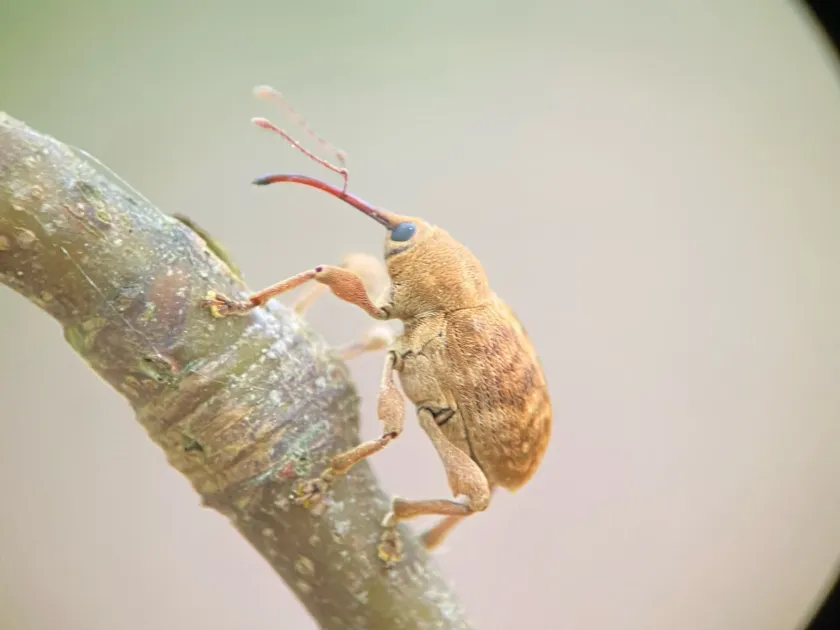
The acorn weevil (Curculio venosus) belongs to the Curculionidae family and is easily recognized by its exceptionally long, slender, and curved snout.
Adult beetles typically measure between 6 and 9 mm in length, featuring a marbled pattern of scales on their brown or reddish-brown wing covers.
The female's snout can be as long as its entire body, a specialized tool used to drill deep holes into acorns for egg-laying.
The larvae are legless, C-shaped grubs with creamy white bodies and distinct brown head capsules, specifically adapted for feeding inside seeds.
They undergo a complete metamorphosis, spending the pupal stage within the soil during the winter months.
What it damages
The primary hosts for this insect are oak species, as the larvae feed exclusively on the internal contents of the acorns.
During outbreak years, the weevil can decimate up to 90% of an acorn crop, severely hindering natural forest regeneration.
By consuming the embryo and endosperm, the larvae render the acorns completely non-viable for germination or nursery propagation.
The damage is not just limited to reproductive loss; it also degrades the nutritional value of the forest floor for wildlife that depends on acorns.
Repeated infestation can weaken the overall seed bank and lead to a significant decline in young oak recruitment in affected areas.
When it appears
Adult weevils emerge from their underground overwintering sites in late spring, generally starting in May.
They feed on young leaves and developing fruit throughout the early summer months until the acorns reach an appropriate size.
Egg-laying activity peaks during the mid-summer period as the acorns develop the necessary nutritional profile for the larvae.
Larval development is rapid, usually concluding by early autumn, at which point the larvae chew their way out of the acorn.
Once they emerge from the acorns, they burrow into the soil to spend the winter, awaiting the next cycle of development.
Signs of infestation
The most telltale sign of an infestation is the presence of small, precise, pin-like holes on the surface of developing or fallen acorns.
These holes are the entry points created by the female weevil; they may show slight discoloration or sap weeping around the margins.
A significant amount of prematurely dropped acorns under an oak tree is a strong indicator of high weevil infestation levels.
If you split open a fresh, fallen acorn, you may find the larvae or the dark, powdery frass left behind after their feeding.
Larger, circular exit holes indicate that the larvae have already matured and left the acorn to enter the soil.
Control measures
Deep cultivation of the soil under oak trees during the autumn can help disrupt the life cycle by destroying the overwintering chambers.
Promptly collecting and destroying fallen acorns before the larvae emerge is one of the most effective ways to manage local populations.
In forest nurseries, heat treatment of harvested acorns in warm water can kill hidden larvae without damaging the seed's viability.
Encouraging natural predators, such as insectivorous birds and parasitic wasps, can help keep population levels in balance.
- Regular inspection of stored seed batches.
- Manual removal of infested acorns during collection.
- Use of protective netting in specialized seed orchards.
Taxonomy
- Latin name
- Curculio venosus
- Order
- Coleoptera (beetles)
- Family
- Curculionidae
- EPPO code
- CURCVE
Discussion
No discussions yet — be the first.