
Lesser nut weevil
Curculio pellitus
Description
How to identify
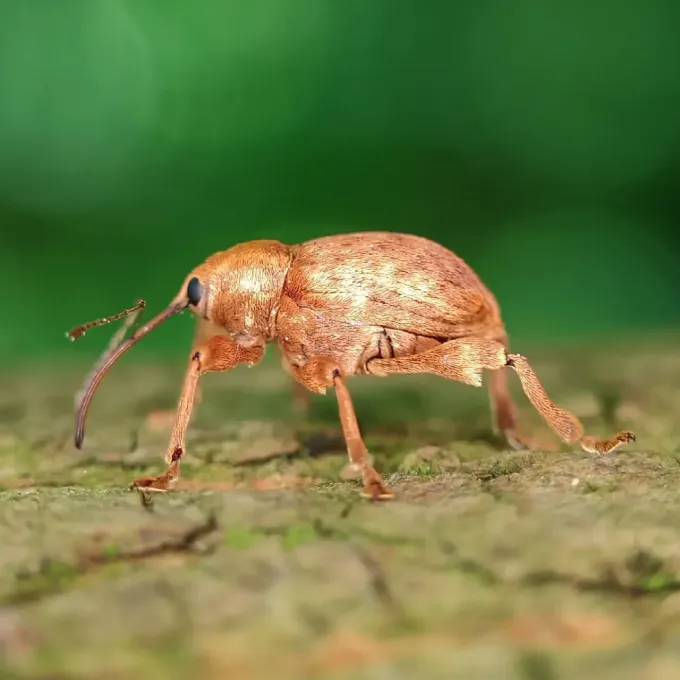
The lesser nut weevil (Curculio pellitus) is a member of the Curculionidae family of beetles. It is primarily known as a significant pest of hazelnut and other nut-bearing trees, characterized by its remarkably long, slender rostrum used for feeding and egg-laying.
Adult beetles typically range from 6 to 9 mm in length. Their bodies are covered in dense, light brown to yellowish scales, often displaying a mottled pattern that helps them blend into tree bark and foliage.
The larvae are legless, C-shaped grubs with a cream-white body and a reddish-brown head capsule. They spend their entire feeding stage inside the developing nut.
Pupation occurs within the soil, where the insect constructs a specialized chamber. This stage is critical for the insect as it spends a significant portion of its life cycle underground.
The species is distinguished from other nut weevils by specific features on the rostrum and the color pattern of its scales, which require close inspection under magnification.
What it damages
The primary hosts for Curculio pellitus include hazel (Corylus) species. The weevils target the fruit, causing direct damage during the initial development phases of the nut.
Adults puncture the young nut husks to feed on the milky endosperm, often causing the fruit to wither and fall prematurely from the tree.
The most severe damage is caused by the larvae, which hollow out the interior of the nut. By feeding on the developing kernel, they destroy the crop's market value.
Economic losses in infested orchards can be substantial, as the presence of even a single larva renders the nut inedible and unsuitable for sale or processing.
Infested nuts are also prone to secondary contamination by fungi and various pathogens due to the entry and exit holes created by the insect, leading to further quality degradation.
When it appears
Adults emerge from their overwintering sites in the soil during late spring, typically coinciding with the development of young nut fruits on the trees.
Mating and oviposition occur throughout early summer. The female uses her long snout to drill a hole through the soft shell of the young nut to deposit an egg.
The larvae develop inside the nut throughout the summer months, feeding continuously until the nut matures or falls to the ground.
Once the larval stage is complete, they bore a small exit hole through the shell and drop to the soil, where they bury themselves to overwinter or pupate.
The life cycle can be prolonged, with some individuals remaining in the soil for several years before emerging, which makes pest population cycles unpredictable.
Signs of infestation
The most diagnostic sign of an infestation is the presence of perfectly round exit holes, approximately 1–2 mm in diameter, found on the shell of fallen nuts.
Early-season signs include small, dark punctures on the husk of developing nuts, often accompanied by sap oozing from the entry point.
Lightweight or hollow nuts found during the harvest are a strong indicator of larval activity, as the kernel has been entirely consumed.
In cases of high infestation, shaking the branches of trees in the early morning can reveal the presence of adult beetles, which often feign death and drop to the ground.
- Circular holes in harvested nuts.
- Premature nut drop during the growing season.
- Presence of larvae in fallen, soft-shelled nuts.
- Brown, withered husk development on young nuts.
Control measures
Sanitation is a critical management strategy; gathering and destroying fallen nuts promptly prevents larvae from escaping into the soil to complete their development.
Cultivating the soil beneath the canopy in late summer or autumn can disrupt the pupal chambers, exposing the insects to predators and environmental stress.
Chemical control focuses on applying targeted insecticides during the adult emergence phase, precisely timing the treatment before egg-laying begins.
Monitoring using pheromone traps is an effective way to track adult activity levels and determine the optimal window for intervention in commercial orchards.
Biological control options, such as using entomopathogenic nematodes to target larvae in the soil, offer an environmentally friendly alternative to traditional pesticides.
Taxonomy
- Latin name
- Curculio pellitus
- Order
- Coleoptera (beetles)
- Family
- Curculionidae
- EPPO code
- CURCPE
Discussion
No discussions yet — be the first.