
Nut weevil
Curculio obtusus
Description
How to identify
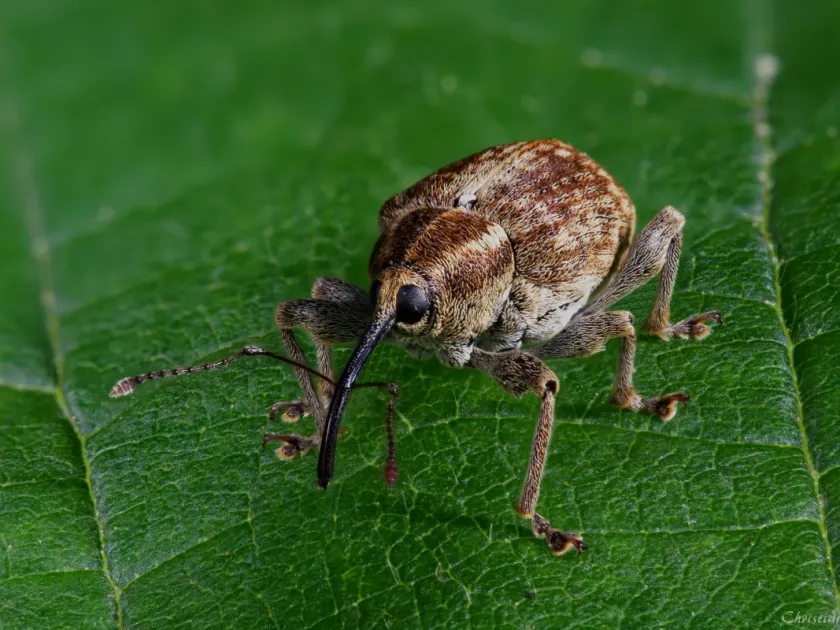
The nut weevil (Curculio obtusus) is a member of the Curculionidae family within the order Coleoptera. Adult beetles are easily recognized by their extremely long, slender, and curved snout (rostrum), which is often as long as or longer than their body.
The adult insect is typically brownish or grayish in color with mottled patterns, allowing it to blend perfectly into the tree bark. The body is round and covered in dense, fine scales that provide a dull, textured appearance.
The larvae of the nut weevil are legless, C-shaped grubs with a distinct, hardened brown head. They spend their entire larval developmental stage protected inside the hazelnut kernel.
The pupal stage occurs underground in a small earthen cell constructed by the larva. This phase is crucial for the insect's survival, as the larvae must successfully overwinter in the soil to pupate in the spring.
The species undergoes a complete metamorphosis: egg, larva, pupa, and adult. The majority of its life cycle is spent in the soil, which makes direct control difficult during the underground stages.
What it damages
The primary host of this pest is the hazel tree (Corylus). Both adults and larvae cause damage, but the larvae are responsible for the most significant economic loss by consuming the kernel of the developing nut.
Adult females use their snouts to puncture the soft shells of developing hazelnuts and deposit eggs inside. Once the larva hatches, it feeds exclusively on the kernel, hollowing it out.
Infested nuts often drop prematurely from the tree. Those that remain on the branches are typically empty or contain frass (larval waste), rendering the crop unmarketable and unsuitable for human consumption.
A severe infestation can result in substantial yield losses, sometimes exceeding 50% of the total harvest. This makes the nut weevil a primary pest of concern in commercial hazelnut cultivation.
Beyond cultivated orchards, these weevils thrive on wild hazelnuts, which act as a reservoir for the pest, allowing it to migrate easily into commercial orchards in adjacent areas.
When it appears
Adult weevils emerge from the soil in the spring, typically when soil temperatures reach 10-12 degrees Celsius. This emergence usually coincides with the expansion of new leaves and the formation of young nuts.
After emerging, adults undergo a period of supplemental feeding on leaves and buds, lasting two to three weeks. This is a critical window for intervention before the egg-laying process begins.
Egg-laying takes place during the early development stages of the nut. Females are highly selective, preferring nuts at the milk stage for optimal larval nutrition.
Larval development inside the nut lasts approximately 30 to 40 days. Once mature, the larva bores a small, circular exit hole through the shell, drops to the ground, and burrows into the soil.
In most regions, the insect completes one generation per year, though some larvae may enter a diapause and remain in the soil for up to two years, resulting in uneven population cycles.
Signs of infestation
The most reliable sign of a nut weevil infestation is the presence of small, perfectly circular exit holes (1–2 mm in diameter) on the shell of the hazelnuts.
Premature yellowing and drop of the hazelnuts during mid-summer are clear indicators that larvae are feeding inside, causing the tree to abort the damaged fruit.
Finding "frass" or dusty debris near the holes in the shells confirms that a larva has been feeding on the kernel, and the damage is likely severe.
Adults can be observed on the leaves of the host trees. Since they often drop to the ground or freeze in a "death-feigning" posture when disturbed, they are best detected by shaking branches over a collection cloth.
Small, irregular holes on the foliage, created by adult feeding, provide an early warning sign that the weevil population is active in the orchard.
Control measures
Fall tillage of the soil beneath the canopy is a highly effective cultural control method, as it disturbs the earthen cells and exposes the overwintering larvae to predators and environmental stress.
Promptly collecting and destroying all fallen nuts throughout the summer is essential to prevent the larvae from exiting the fruit and burying themselves in the soil for the next generation.
Systemic insecticides, if applied at the correct timing (during adult emergence but before egg-laying), can significantly suppress the population and prevent mass infestation.
- Monitor adult activity using light traps or by shaking branches.
- Maintain orchard sanitation by removing overgrown wild hazel thickets nearby.
- Utilize biological control agents, such as entomopathogenic nematodes applied to the soil.
An integrated pest management (IPM) approach, combining mechanical soil cultivation with targeted chemical treatments, is the most sustainable way to maintain a healthy and productive orchard.
Taxonomy
- Latin name
- Curculio obtusus
- Order
- Coleoptera (beetles)
- Family
- Curculionidae
- EPPO code
- CURCOB
Discussion
No discussions yet — be the first.