
Nut weevil
Curculio nucum
Description
How to identify
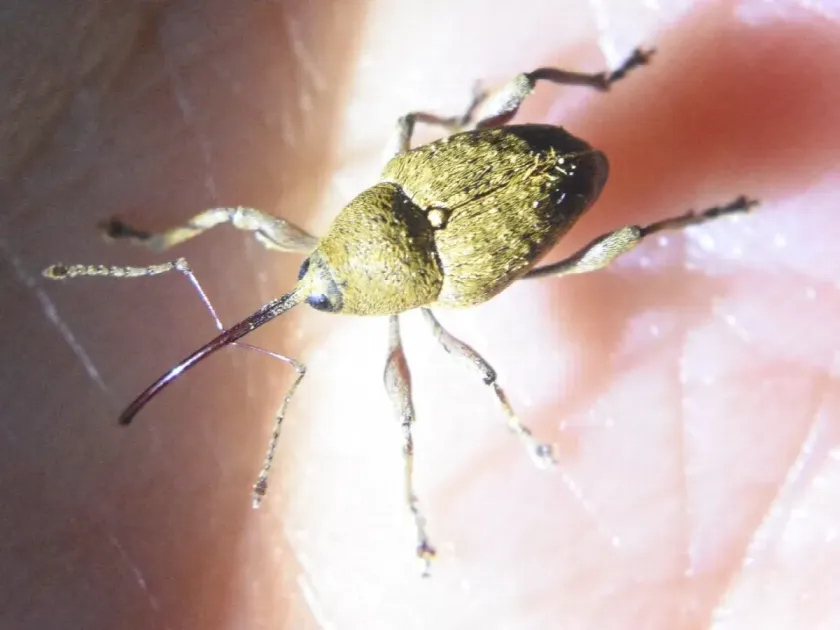
The Nut weevil (Curculio nucum) is a beetle belonging to the Curculionidae family. It is recognized as one of the most serious pests of hazelnut orchards. The adult insect is 6–9 mm long, with a robust body covered in greyish-yellow to brown scales.
The most distinctive feature of this beetle is its long, slender snout (rostrum), which can be as long as its entire body in females. This specialized mouthpart is essential for boring holes into the developing nuts to deposit eggs.
The larvae are legless, C-shaped grubs with a creamy-white body and a dark brown head capsule. They spend their entire developmental period protected within the shell of the nut, feeding on the developing kernel.
This species undergoes complete metamorphosis. Most of its lifecycle occurs within the soil, where it spends the winter as a larva or sometimes an adult before emerging in the spring to start a new cycle.
Due to their cryptic behavior and excellent camouflage, adult weevils are difficult to spot in the canopy, making early detection a significant challenge for orchard managers without active monitoring.
What it damages
Hazelnut (Corylus avellana) is the primary host for the Nut weevil. However, the pest also infests other nut-bearing trees such as walnuts and chestnuts, adapting its lifecycle to the availability of the host fruit.
While adult beetles cause minor damage by feeding on leaves and young buds, the larvae are responsible for the vast majority of economic losses. A single larva can consume the entire kernel, rendering the nut hollow and inedible.
In addition to kernel destruction, the presence of the larva creates an entry point for various molds and fungal pathogens. This secondary infection often leads to the complete spoilage of the affected nuts, making them unfit for sale.
Economic damage is severe because infestation often goes unnoticed until the larvae emerge, at which point the nut is already destroyed. In years of high pest pressure, losses can reach over 50% of the total yield.
Infested nuts often drop prematurely from the tree, which is a clear signal that the pest has successfully completed its feeding cycle inside the kernel and has moved to the soil for pupation.
When it appears
Adult weevils emerge from the soil in the spring when temperatures consistently rise above 12–15 degrees Celsius. This emergence is closely synchronized with the development of the young hazelnut fruits.
After emergence, the adults feed for a short period to mature. This stage is crucial for control, as it is the only time the adult population is exposed to potential contact or systemic insecticide treatments.
Egg-laying begins as soon as the hazelnuts reach the milk stage. The female bores a precise hole through the soft shell and deposits a single egg. The opening is then carefully sealed to protect the offspring.
The larval stage lasts for several weeks. Once the larva completes its growth, it cuts a characteristic circular hole through the shell, exits the nut, and drops to the ground to burrow into the soil.
The overwintering phase in the soil is highly flexible, with some larvae remaining in diapause for several years. This extended lifecycle makes the Nut weevil notoriously difficult to eradicate from an orchard.
Signs of infestation
The most diagnostic sign of a Nut weevil infestation is the presence of perfectly round, smooth holes in the shells of fallen or harvested nuts. These are the exit holes created by the larvae.
Premature nut drop is another strong indicator. If a significant number of young nuts fall to the ground in mid-summer, it is advisable to inspect them for larvae or internal decay to confirm the presence of Curculio nucum.
Visual inspection of the tree canopy in the early morning is recommended, as the beetles are less active and can be spotted or collected using the sheet-shaking method where they fall onto a white cloth.
The presence of fine, sawdust-like frass (excrement) around the exit holes is a clear indicator that the larvae have recently departed, leaving the nut empty and infested with mold.
Reduced crop quality and the appearance of hollow nuts during the drying process are final signs that a significant portion of the harvest has been compromised by this pest.
Control measures
Mechanical control is essential. Regularly collecting and disposing of fallen nuts prevents the larvae from completing their migration into the soil, thereby reducing the population for the following year.
Tillage of the soil beneath the canopy during late autumn or early spring can expose the overwintering larvae to predators and unfavorable weather, significantly reducing their survival rate.
Chemical control must be applied at the right time—between adult emergence and the hardening of the nut shell. Using systemic insecticides during this window is highly effective against the adult population.
In smaller orchards, physical barriers or manual collection of adults using shaking techniques during the cooler hours of the morning can supplement or replace the need for heavy chemical intervention.
- Planting resistant hazelnut cultivars.
- Removing abandoned hazelnut trees nearby.
- Using pheromone traps for accurate monitoring of adult populations.
- Promoting biodiversity to encourage natural predators like parasitic wasps and birds.
Taxonomy
- Latin name
- Curculio nucum
- Order
- Coleoptera (beetles)
- Family
- Curculionidae
- EPPO code
- CURCNU
Discussion
No discussions yet — be the first.