
Nut weevil
Curculio neocorylus
Description
How to identify
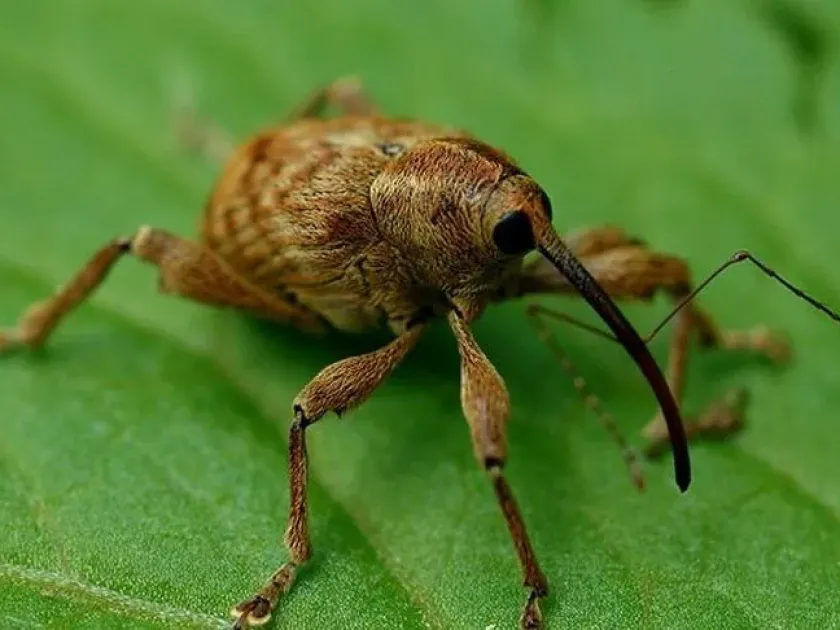
The nut weevil (Curculio neocorylus) belongs to the Curculionidae family within the order Coleoptera. This small beetle is easily recognized by its distinctive, extremely long, slender snout, which is particularly pronounced in females.
Adult weevils measure approximately 6–9 mm in length and are covered in brownish or grayish scales, providing them with excellent camouflage against the bark of host trees.
The larvae are legless, C-shaped grubs with creamy-white bodies and tan or brown head capsules. They spend their entire developmental period hidden inside the nuts, feeding on the kernel.
The insect undergoes complete metamorphosis, consisting of egg, larva, pupa, and adult stages. The timing of their life cycle is highly specialized and synchronized with the development of the host plant's fruit.
Wintering occurs primarily in the soil as mature larvae, which construct protective earthen cells at a depth of 10–20 cm to pupate when temperatures rise in the spring.
What it damages
The primary hosts for this pest include hazelnut (Corylus) species. In commercial orchards, the nut weevil can cause severe economic losses by significantly reducing crop yield and quality.
Both adults and larvae cause damage, though the larval damage is far more destructive. Adults feed on tender leaves and developing nutlets, creating small puncture wounds.
The critical damage begins when the female uses her snout to drill a hole into the developing nut shell and deposits an egg inside. The resulting larva consumes the entire kernel.
As the larva feeds, it hollows out the inside of the nut, filling the cavity with frass. Infested nuts often drop prematurely from the tree, leading to significant harvesting losses.
An infestation can destroy a high percentage of the harvest, making the nuts unmarketable and reducing the overall vigor of the hazelnut stand over consecutive years.
When it appears
Adults typically emerge from the soil in late spring or early summer (May to June), depending on soil temperature and the specific climate of the region.
After emergence, the adults undergo a period of supplemental feeding on the foliage and developing nuts for several weeks before the mating and oviposition process begins.
Egg-laying coincides with the milk-to-dough stage of nut development, when the shells are still soft enough for the female to penetrate them easily with her rostrum.
Larval development takes place throughout the summer months. By late August or September, the larvae mature, exit the nut through a distinct circular hole, and burrow into the ground to overwinter.
The life cycle is typically univoltine (one generation per year), although environmental factors can sometimes cause the life cycle to extend into a two-year period.
Signs of infestation
The most tell-tale sign of a nut weevil infestation is the presence of perfectly round, small exit holes (approx. 1 mm in diameter) on the shells of fallen or harvested nuts.
In mid-summer, a premature drop of green or yellowing hazelnuts can indicate that larvae have successfully penetrated the fruits and are causing damage inside.
Leaf damage, appearing as small, irregular holes or spots, may be observed in the spring, which serves as an early indicator of adult weevil activity in the orchard canopy.
If an infested nut is cracked open, it will contain a characteristic white grub or the dark, powdery remains of the consumed kernel, proving the presence of the pest.
Monitoring using white cloth sheets placed under the trees during the morning hours can help detect the presence of adults, which often drop from the branches when disturbed.
Control measures
Good orchard sanitation is the most critical first step. Regularly gathering and destroying all fallen nuts prevents larvae from exiting the shells and entering the soil to pupate.
Cultivating the soil beneath the canopy in late autumn or early spring can expose the overwintering larvae to predators and harsh weather, significantly reducing the next generation's population.
Chemical control, if necessary, should be applied as a targeted foliar spray during the period of adult emergence, prior to the onset of egg-laying, to prevent fruit infestation.
- Use of pheromone or light traps to monitor population density and time interventions.
- Manual collection of weevils from branches during the early morning cool hours.
- Maintaining healthy tree vigor through proper pruning, fertilization, and irrigation.
Biological control options, such as the application of entomopathogenic nematodes or fungi to the soil, can effectively suppress the overwintering population of weevil larvae.
Taxonomy
- Latin name
- Curculio neocorylus
- Order
- Coleoptera (beetles)
- Family
- Curculionidae
- EPPO code
- CURCNE
Discussion
No discussions yet — be the first.