
Chestnut weevil
Curculio elephas
Description
How to identify
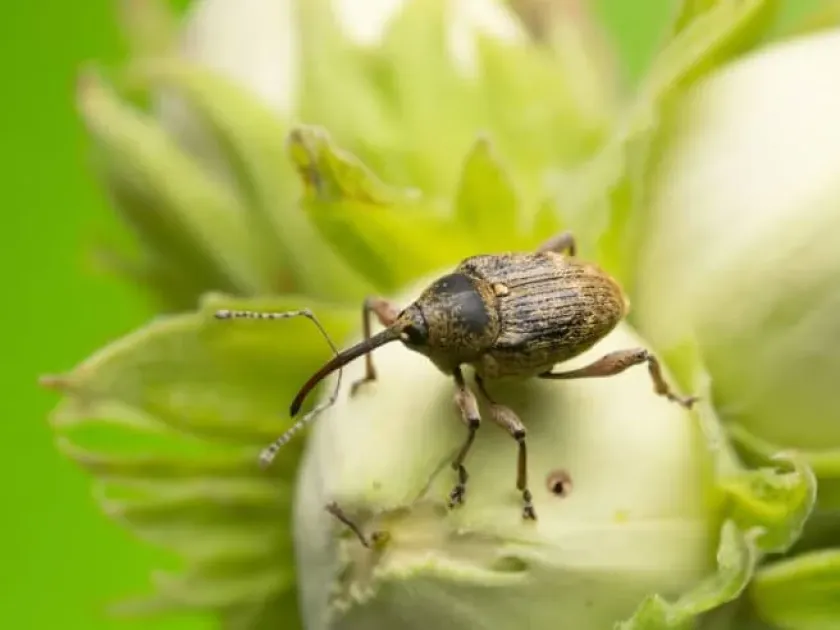
The chestnut weevil (Curculio elephas) is a member of the Curculionidae family of beetles. It is easily identified by its distinctive long, thin snout (rostrum), which in females can exceed the length of their entire body, enabling them to drill into nut shells.
Adult beetles are typically 6–10 mm long and feature a mottled grey-to-brown coloration, which serves as camouflage against tree bark. They have functional wings and are highly mobile, allowing them to locate host trees across wide forest areas.
The larvae are legless, fleshy, and C-shaped with a dark brown head capsule. They spend their entire developmental phase feeding inside the nut kernel, safely protected from the environment until they are fully grown.
The life cycle is generally univoltine, but under certain environmental conditions, larvae can enter an extended diapause in the soil, remaining for several years before pupating and emerging as adults.
Overwintering occurs in the soil, where larvae or pupae construct small chambers. This subterranean phase is critical for the survival of the species, as they can retreat deep into the soil profile to avoid harsh winter temperatures.
What it damages
The chestnut weevil primarily attacks the fruits of the sweet chestnut and various oak species. The damage occurs when the larva consumes the interior of the nut, rendering it useless for both human consumption and forest regeneration.
Severe infestations can lead to losses of up to 80% of the harvest. This significant impact affects not only the commercial value of nut orchards but also the viability of seeds intended for reforestation programs.
Feeding larvae create internal tunnels that become entry points for fungi, bacteria, and secondary pathogens. This often causes the nuts to rot prematurely or develop mold, making them unfit for storage or long-distance transport.
In addition to direct losses, the presence of these pests reduces the overall seed quality, which is vital for nursery production. A high infestation rate can lead to complete loss of the commercial viability of a harvest.
Over time, recurring infestations in mature stands can weaken tree vigor, although the primary impact remains focused on the loss of the reproductive yield of the host trees.
When it appears
Adult emergence occurs in late summer, typically August and September, coinciding with the nut-filling stage. This is when the beetles crawl onto the trees to mate and begin the oviposition process.
Females use their rostrum to bore deep into the developing shell, depositing an egg into the kernel. One female can successfully infest dozens of nuts within a single season, spreading the population effectively.
Larval development inside the nut lasts approximately 30 to 40 days. Once the larva has finished feeding, it bores a characteristic circular exit hole through the shell and emerges to burrow into the soil.
The emergence of larvae from the nuts into the soil generally happens throughout the autumn. Once in the soil, they prepare to overwinter, often remaining as larvae until the following summer or entering long-term diapause.
Monitoring should be conducted during the peak adult activity period in August. Using pheromone traps or placing sheets under trees to collect adults shaken from the canopy are effective detection methods.
Signs of infestation
The most reliable sign of a chestnut weevil infestation is the presence of perfectly circular, small holes (1–2 mm in diameter) on the shell of the nuts. These are the exit holes created by larvae departing the nut.
Prematurely dropped nuts that contain internal cavities, dark frass (larval waste), or show signs of rotting are strong indicators of weevil activity. Often, an infested nut may feel lighter than a healthy one.
If a nut is opened, the presence of the cream-colored, C-shaped larva itself is the definitive sign of infestation. Larvae are typically found within the hollowed-out remains of the nut meat.
A high density of small exit holes in the soil surface directly under the canopy during the autumn months is a clear indicator that a large generation of larvae has successfully entered the overwintering phase.
While external signs are usually minimal until the larvae emerge, observant growers may notice adult beetles sitting on the developing nut clusters during the late summer months.
Control measures
The most practical cultural control method is the daily collection and removal of all fallen nuts. By clearing the ground before the larvae have a chance to exit, the life cycle is significantly disrupted.
Mechanical disturbance of the soil, such as tilling or shallow plowing in the autumn and spring, can expose the pupae and larvae to predators and extreme weather, effectively reducing the population.
Biological control options include the application of entomopathogenic fungi, such as Beauveria bassiana, to the soil beneath the trees to target the insects during their overwintering stage.
Chemical control is generally reserved for commercial settings and must be timed precisely with the adult emergence phase to be effective. It is important to check local regulations regarding pesticide use on food crops.
- Daily collection and destruction of fallen nuts.
- Autumn or spring soil cultivation (plowing).
- Application of entomopathogenic fungi to the soil.
- Use of pheromone traps for monitoring.
- Targeted insecticide applications during peak adult emergence.
Taxonomy
- Latin name
- Curculio elephas
- Order
- Coleoptera (beetles)
- Family
- Curculionidae
- EPPO code
- CURCEL
Discussion
No discussions yet — be the first.