
Fruit weevil
Curculio dentipes
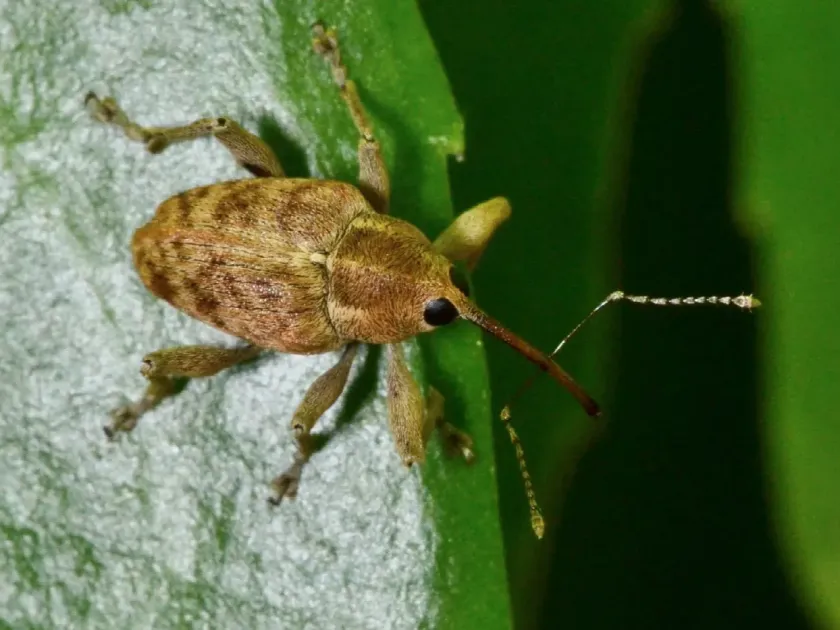
Description
How to identify
Curculio dentipes is a species of beetle belonging to the Curculionidae family, commonly known as true weevils. These insects are distinguished by their elongated, slender snout, which is specifically adapted for boring into plant tissues.
The adult beetle typically measures between 5 and 8 millimeters in length. Its body is covered with dense, scale-like structures that provide effective camouflage against the bark of host trees.
A key diagnostic feature of this species is the presence of prominent teeth on the femora of the mid and hind legs, which is the defining characteristic for its scientific name.
The larvae are legless, white-bodied, and possess a well-developed head capsule, designed for efficient feeding within the internal tissues of developing fruit.
The life cycle involves complete metamorphosis, with the larval stage being the most critical in terms of causing damage to the agricultural produce.
What it damages
This weevil primarily targets pome fruit trees, with a strong preference for apple and pear varieties. The adult female punctures the fruit to deposit eggs, which leads to the initial injury of the plant tissue.
As the larvae hatch and begin feeding on the internal pulp of the fruit, they create intricate tunnels. This activity significantly reduces the quality of the fruit and often causes it to drop prematurely.
Secondary infections, such as rot-causing fungi, often colonize the wounds made by the larvae, leading to total fruit decay and further economic loss for the grower.
Adults also feed on developing buds and young foliage early in the spring, which can hamper the tree's development and reduce its overall vitality during the growing season.
High infestation levels can lead to substantial crop failure, directly impacting both the quantity and quality of the marketable harvest in commercial orchards.
When it appears
The emergence of adult weevils from overwintering sites in the soil or under leaf litter occurs in early spring, triggered by the rise in ambient temperature.
The most critical period for infestation coincides with the budding and flowering stages of host trees, as this is when the females begin their egg-laying process.
Larval development takes place during the summer months, while the fruit is growing. The feeding phase is synchronized with the physiological development of the host crop.
Towards the end of the summer, mature larvae leave the fallen fruit and burrow into the soil to undergo pupation, ensuring their survival for the next season.
The timing of these life stages can vary based on local climatic conditions and the specific variety of the fruit trees being cultivated.
Signs of infestation
Early signs of an infestation include minute, dark punctures on the surface of young fruit, where the female weevil has inserted her ovipositor to lay eggs.
Premature fruit drop in early summer is a strong indicator of larval activity. Dissecting the fallen fruit usually reveals the presence of larvae or the damage trails left behind.
- Presence of adults on flowers or foliage in spring.
- Small, circular holes or ragged edges on new leaves.
- Darkening and rot appearing around puncture sites on the fruit skin.
During morning or evening hours, adult weevils may be spotted on the tree canopy. Using a beating sheet to shake branches can help monitor the population size.
The accumulation of frass (larval excrement) near the entry points of the tunnels is a clear sign that the larvae are active inside the fruit.
Control measures
Cultural control practices, such as the regular collection and disposal of fallen fruit, are essential to break the life cycle and prevent larvae from pupating in the soil.
Tilling the soil beneath the trees in autumn and spring can disturb overwintering larvae and pupae, exposing them to predators and harsh environmental conditions.
Chemical control should be limited to instances where the pest population exceeds the economic injury level. Treatments are best applied before or shortly after blooming.
It is crucial to use selective insecticides that do not harm beneficial pollinators, such as bees, which are active during the blossoming period.
Installation of sticky or mechanical traps around tree trunks can effectively reduce the number of climbing adults attempting to reach the upper canopy to feed.
Taxonomy
- Latin name
- Curculio dentipes
- Order
- Coleoptera (beetles)
- Family
- Curculionidae
- EPPO code
- CURCDE
Discussion
No discussions yet — be the first.