
Pecan weevil
Curculio caryae
Description
How to identify
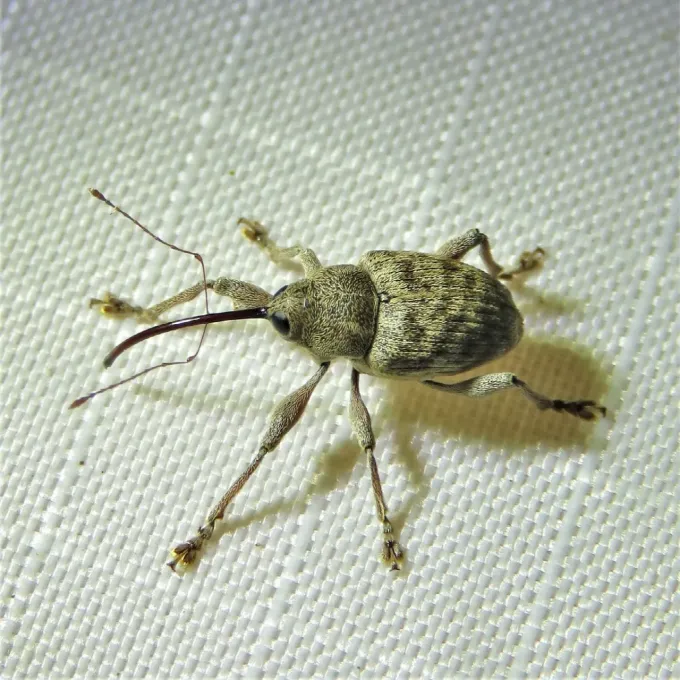
The pecan weevil (Curculio caryae) is a member of the Curculionidae family. It is a snout beetle typically measuring 6–10 mm in length. Its body is covered with grayish-brown hairs, creating a mottled camouflage pattern.
The most defining characteristic of this species is the disproportionately long snout (rostrum). In females, this snout can exceed the body length, enabling them to bore deep holes into the hard shells of developing pecans to deposit their eggs.
The larvae are legless, cream-colored grubs with a distinct brown head capsule. They develop exclusively inside the pecan nut, feeding on the kernel until they are ready to exit.
The insect undergoes complete metamorphosis with a long life cycle, typically spanning two to three years. This extended development often makes the weevil population difficult to manage with short-term strategies.
Adult weevils are capable of flight, allowing them to move between trees in the orchard, particularly when the nuts reach the dough stage and become attractive for feeding and egg-laying.
What it damages
The primary host for this pest is the pecan tree (Carya illinoinensis). While it occasionally affects other hickory species, it remains the most significant threat to commercial pecan orchards.
Direct damage is caused by both adults and larvae. Adults pierce the shell to feed on the kernel, while larvae consume the inside of the nut entirely, rendering the harvest unmarketable.
When infestation occurs early in the season, it frequently triggers premature fruit drop. This leads to substantial loss of yield before the nuts even reach maturity, impacting the orchard's overall profitability.
Infested nuts that remain on the tree are often prone to secondary infections. Mold and rot can spread through the entry holes, further degrading any remaining healthy parts of the nut kernel.
The presence of even a small population of pecan weevils can cause massive damage because a single female is capable of infesting dozens of nuts during her lifetime.
When it appears
Adult weevils typically emerge from the soil in mid-summer, usually in July or August. Their emergence is often triggered by rainfall, which softens the soil and allows them to dig their way out.
Once emerged, adults migrate to the trees and begin feeding. They specifically target nuts that have begun to harden, as this stage provides the necessary nutrients for the offspring.
Egg-laying continues for several weeks. Once the eggs hatch, the larvae feed on the kernel for about 3–5 weeks. After this period, they chew a small exit hole in the shell and emerge to drop to the ground.
The larvae then burrow deep into the soil to pupate. They remain in the soil for one to two years before emerging as adults, which explains the cyclical nature of pecan weevil outbreaks.
Monitoring the emergence period is critical for management. If the timing of pesticide application does not align with the adult emergence, the effectiveness of the control program is significantly reduced.
Signs of infestation
The most reliable sign of a pecan weevil infestation is the presence of small, perfectly round exit holes on the shell. These holes are created by mature larvae as they emerge to return to the soil.
Premature nut drop is another major warning sign. If nuts fall to the ground in mid-summer, they should be inspected for small entry or exit holes to confirm the presence of weevils.
On the tree, adults can be found on the shucks of the nuts. They are shy and often drop to the ground or play dead when disturbed, making them difficult to spot during routine inspections.
A hollow sound when shaking a nut or an unexpectedly lightweight feel often suggests that the inside of the nut has been destroyed by a larva.
- Round exit holes on the pecan shell.
- Premature fruit drop in late summer.
- Presence of white, legless grubs inside the kernel.
- Small, dark puncture marks on the pecan shucks.
Control measures
Chemical control is the most common management tactic. Growers typically use foliar insecticides during the peak of adult emergence to target the weevils before they can lay eggs.
Orchard sanitation is essential. Collecting and disposing of fallen nuts promptly prevents the larvae from exiting the shells and successfully burrowing into the soil to continue their life cycle.
Monitoring is conducted using trunk-mounted traps or by shaking branches over sheets to count the number of adult weevils present. This allows for precise timing of chemical sprays.
Cultural practices, such as maintaining healthy soil conditions and potentially using mechanical tillage under the canopy, may disrupt the larval development process in the soil.
Biological control methods are under active research, with entomopathogenic nematodes showing promise for attacking the larvae during their soil-dwelling stage, providing a sustainable alternative to chemical sprays.
Taxonomy
- Latin name
- Curculio caryae
- Order
- Coleoptera (beetles)
- Family
- Curculionidae
- EPPO code
- CURCCA
Discussion
No discussions yet — be the first.