
Crypturgus pusillus
Crypturgus pusillus
Description
How to identify
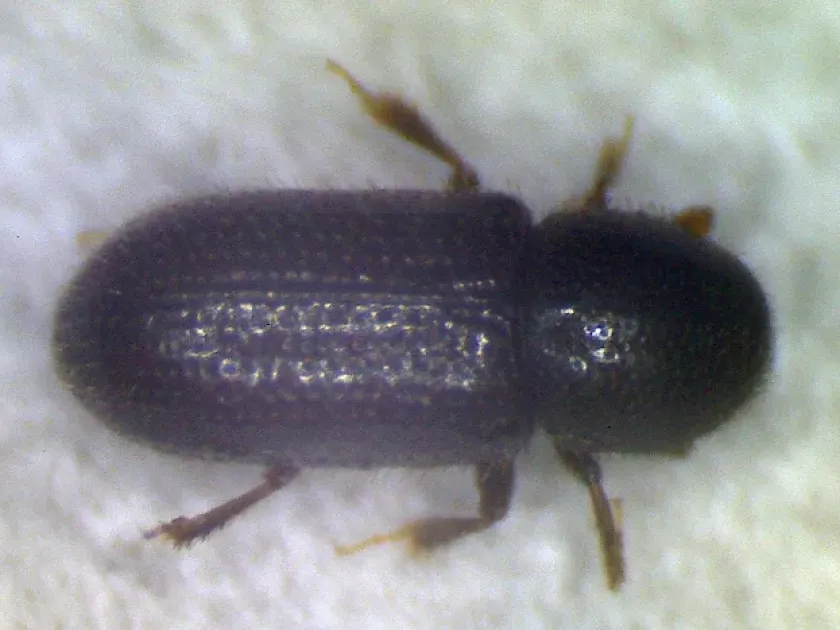
Crypturgus pusillus, commonly known as the small spruce bark beetle, is a minute member of the Curculionidae family, subfamily Scolytinae. Measuring only 1.1–1.6 mm in length, these beetles are dark brown to black in color.
The beetle possesses a cylindrical body covered with short, fine hairs. Its head is largely hidden by the pronotum, a common morphological trait among small bark beetles, making it difficult to identify without magnification.
Systematically, it is classified within the order Coleoptera. Despite its small size, it plays a significant role as a secondary pest in coniferous ecosystems, often associated with larger species of wood-boring insects.
The larvae are typically white, legless, and curved, with a prominent brown head capsule. They spend their entire developmental phase feeding within the inner bark, safe from most environmental stressors and predators.
Their ability to colonize small gaps in the bark makes them elusive inhabitants of forest stands, often going unnoticed until significant damage is already done to the host tree.
What it damages
The primary hosts for Crypturgus pusillus are Norway spruce, though it may occasionally colonize pines and firs. It generally prefers to settle in areas previously damaged by larger bark beetles like the spruce engraver.
The beetle does not usually attack healthy, vigorous trees due to their strong resin defense mechanism. However, in stressed stands or during outbreaks of other bark beetles, it acts as a secondary colonizer, further weakening the tree.
Damage is characterized by a dense network of maternal and larval galleries under the bark. These galleries intersect, severely disrupting the tree's phloem and cambium layer, which is vital for nutrient transport.
When present in high populations, these beetles accelerate the physiological decline of the host tree, leading to crown yellowing and eventual mortality of the infested section of the trunk.
Economically, this beetle contributes to timber degradation and is a concern in managed forests where tree health is prioritized to prevent wider outbreaks of wood-boring pests.
When it appears
The flight period for Crypturgus pusillus typically begins in spring, usually between April and May, depending on regional weather patterns. This is when overwintering adults emerge to seek suitable host trees.
Once a suitable host is found, beetles bore into the bark to mate and establish galleries. The developmental time for one generation varies significantly based on temperature, typically ranging from a few weeks to two months.
In warmer southern regions, the species can complete two generations in a single year, whereas in northern climates, development is usually restricted to a single generation per season.
New adults emerge late in the summer and autumn. These beetles then prepare to overwinter, staying beneath the bark of the host tree or moving to the forest floor litter for protection against winter conditions.
Temperature fluctuations directly influence the beetle's activity. A warm spring followed by a hot summer provides optimal conditions for rapid population growth and successful colonization of new host materials.
Signs of infestation
The most reliable sign of an infestation is the presence of numerous small entry holes in the bark, often occurring in clusters. These holes are noticeably smaller than those made by larger bark beetles.
Upon removing a section of the bark, one can observe the characteristic, intricate, and chaotic network of larval galleries. This "maze-like" pattern distinguishes it from the more structured galleries of primary bark beetle species.
Frass (boring dust) found on the bark surface or within bark crevices is a clear indicator of active tunneling. In addition, the yellowing or browning of needles in the crown is a symptom of advanced infestation.
Because the beetle is often a co-inhabitant with other pests, signs are frequently found alongside the larger galleries and entrance holes of primary wood-boring insects.
Management crews should inspect trees that show signs of stress or previous bark beetle attacks, as Crypturgus pusillus is likely to inhabit the same stressed environments.
Control measures
The primary strategy for controlling Crypturgus pusillus involves maintaining healthy forest stands and executing timely sanitary harvests to remove infested wood from the forest.
Trap trees can be deployed early in the season to attract and aggregate the population, allowing for the subsequent removal and destruction of the bark before the new generation emerges.
Pheromone traps are useful tools for monitoring beetle activity and population trends. They assist foresters in identifying the onset of flight and the relative density of the pest in specific areas.
Biological control methods include the preservation of natural predators and parasitoids, such as predatory beetles and wasps, which help keep the bark beetle population within manageable limits in natural ecosystems.
Chemical control is rarely effective or practical for bark beetles in large forest areas due to the insects' protected location under the bark, making preventative silvicultural practices the most reliable approach.
Taxonomy
- Latin name
- Crypturgus pusillus
- Order
- Coleoptera (beetles)
- Family
- Curculionidae
- EPPO code
- CRYUPU
Discussion
No discussions yet — be the first.