
Crypturgus hispidulus
Crypturgus hispidulus
Description
How to identify
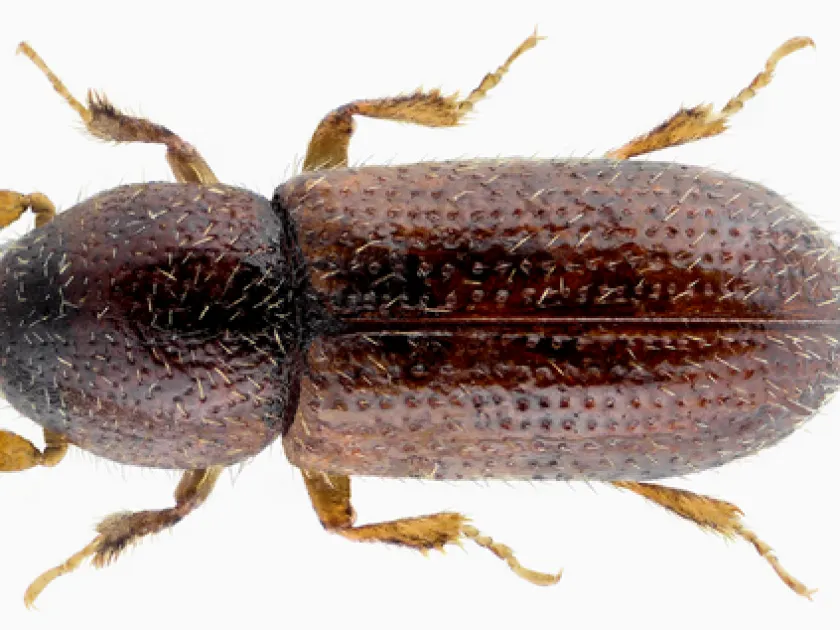
Crypturgus hispidulus is a minute bark beetle belonging to the family Curculionidae, subfamily Scolytinae. Adult beetles are typically very small, measuring about 1.0 to 1.5 mm in length.
The body shape is cylindrical, typical for many bark beetles. Their color ranges from dark brown to black, providing camouflage against the bark of host trees.
The elytra, or wing covers, are covered with fine, erect bristles, which is a key identification characteristic for this species and gives it its specific scientific name.
Larvae are small, legless, and white with a brown head capsule. They spend their entire developmental period beneath the bark, feeding on the inner tissues of the tree.
Field identification often requires the use of a magnifying lens to distinguish this species from other related bark beetles, focusing on specific morphological traits and gallery patterns.
What it damages
This beetle primarily attacks coniferous tree species, with a strong preference for Norway spruce. It may occasionally infest other conifers such as fir or pine trees under certain conditions.
The beetle typically selects the lower portion of the tree trunk where the bark is thinner. This allows the adults to initiate galleries and lay eggs more efficiently.
The larvae and adults damage the cambium layer and phloem. By feeding on these nutrient-transporting tissues, they disrupt the flow of sap and resources, which weakens the tree significantly.
Crypturgus hispidulus often acts as a secondary pest, colonizing trees that are already stressed by drought, windthrow, or attacks from primary, larger bark beetle species.
High infestation rates lead to the premature death of the tree. Even if the tree survives an initial attack, its physiological condition is compromised, making it susceptible to pathogens.
When it appears
The active flight and colonization period of Crypturgus hispidulus occurs during the warmer months of the year, typically starting in late spring.
Mass emergence of adult beetles usually coincides with the warming of the bark in May and June. During this time, they actively seek suitable host trees for reproduction.
After finding a suitable host, the beetles bore into the bark to construct nuptial chambers and galleries. The larval development continues throughout the summer months.
By late summer or early autumn, the new generation of adults completes development. They prepare for overwintering, often remaining under the bark or moving into the litter layer.
Periods of extreme heat or drought are known to trigger population explosions. Such environmental stressors make host trees more attractive to the beetles, leading to outbreaks.
Signs of infestation
Due to the beetle's minuscule size, signs of infestation are often overlooked in the early stages. The first visible symptoms may only appear once the tree health begins to decline.
Small entry holes on the bark are the most common sign. These holes are tiny and can easily be mistaken for natural irregularities in the bark texture.
Under the bark, one can find irregular, winding galleries. These tunnels do not follow a fixed geometric pattern and can be quite complex due to the density of the colony.
Fine boring dust, or frass, may accumulate in bark crevices. This material is very light and can be easily washed away by rain, making it an unreliable indicator for long-term monitoring.
Severe infestations cause the bark to crack or flake off. This is a clear indicator that the tree has been heavily damaged and is likely experiencing severe physiological decline.
Control measures
Effective management focuses on forest hygiene. Removing infested trees before the next generation of beetles emerges is the most critical step to prevent population spread.
Sanitation logging and the proper disposal of timber are essential practices in commercial forests to reduce the number of potential breeding sites for the beetles.
Pheromone traps are used for monitoring population levels. These tools help forest managers detect the arrival of the beetles and time their control measures accordingly.
In ornamental or nursery settings, targeted insecticide applications may be used, though these must be implemented carefully to avoid negative impacts on beneficial insects.
- Routine forest health inspections to detect early symptoms.
- Promoting forest biodiversity to support natural predators.
- Maintaining healthy tree stands through proper silvicultural practices.
Taxonomy
- Latin name
- Crypturgus hispidulus
- Order
- Coleoptera (beetles)
- Family
- Curculionidae
- EPPO code
- CRYUHI
Discussion
No discussions yet — be the first.