
Crypturgus cinereus
Crypturgus cinereus
Description
How to identify
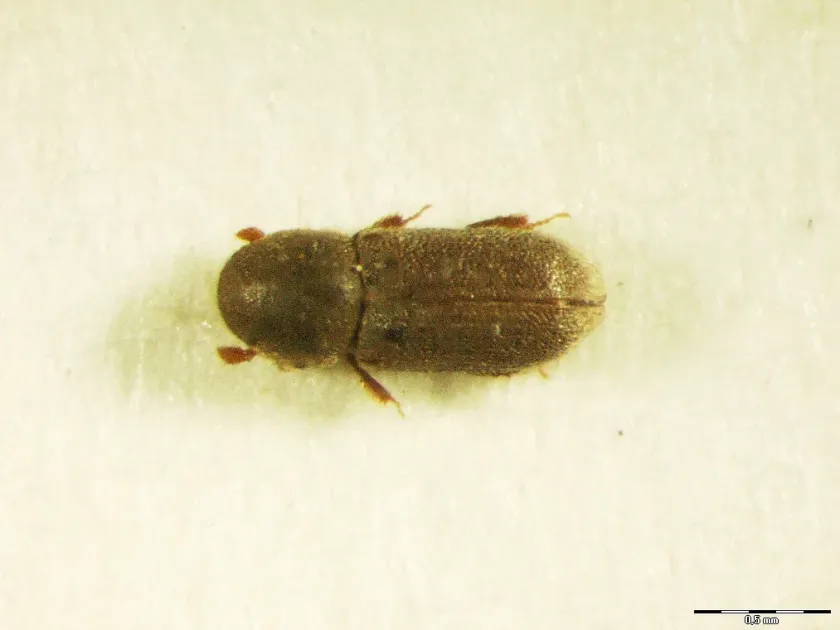
Crypturgus cinereus is a small beetle belonging to the Curculionidae family and the Scolytinae subfamily (bark beetles). It is extremely small, typically measuring only 1.0–1.5 mm in length.
The beetle has an elongated, cylindrical body that is dark brown or black. The elytra are covered with dense, short, grayish hairs, which serves as a key identifying feature for this specific species.
The head is largely retracted under the pronotum, making it difficult to see from above. Their antennae feature a characteristic club, which is often examined under high magnification for accurate taxonomic identification.
Larvae are legless and C-shaped, common for bark beetle species. They are equipped with robust mouthparts designed for feeding on the cambium and phloem of conifer trees.
Because of their small size, they often cohabitate with larger bark beetles, utilizing the existing entrance holes made by larger species to gain access to the inner bark layers.
What it damages
This beetle primarily affects conifer species, especially Norway spruce (Picea abies), though it can also infest pines and larches. It prefers weakened, dying, or recently fallen trees.
Damage is caused by both adults and larvae, which tunnel through the inner bark and cambium layer, effectively disrupting the tree's vascular system, including the transport of nutrients and water.
While an individual beetle causes little damage, their collective impact, especially in large populations, can accelerate the death of host trees already stressed by drought or other pathogens.
The presence of Crypturgus cinereus in logging debris or stumps creates a reservoir that can lead to outbreaks and the spread of infestations into nearby healthy forest stands.
By interfering with the healing process of the tree and facilitating the entry of fungi, this pest significantly contributes to the overall decline of infested timber.
When it appears
The flight period for adult beetles generally occurs in spring and early summer, often coinciding with the emergence of larger bark beetle species in forest ecosystems.
They overwinter as both adults and larvae within the bark of host trees, surviving cold winters due to the insulating properties of the wood and the beetle’s physiological adaptations.
Life cycle completion typically takes one season in temperate climates, though favorable weather conditions may occasionally allow for a partial second generation during a single year.
Beetle activity is highly dependent on environmental temperature and the physiological state of the host tree, which determines the attractiveness of the tree for colonization.
After reaching maturity, the new generation of beetles emerges from the bark, creating small exit holes, and migrates in search of new hosts to continue the reproductive cycle.
Signs of infestation
The most prominent sign of infestation is the presence of tiny, numerous entrance holes on the bark surface, which are often difficult to spot without close inspection.
Under the bark scales, you can find a network of narrow, intricate galleries. These galleries often overlap, indicating a high concentration of the pest within the wood.
External symptoms, such as the yellowing or browning of needles, may appear only after the infestation has reached a critical density, as the tree’s vascular system fails.
Fine wood dust, often called boring dust, can sometimes be found near cracks in the bark or at the base of the tree, signaling active tunneling and feeding by the beetles.
Peeling away a section of the bark in affected areas will reveal the characteristic larval galleries and, occasionally, the adult beetles themselves, confirming the diagnosis.
Control measures
Sanitation logging is the most effective control method. Removing infested trees from the forest before the next generation of beetles emerges is crucial to prevent further spread.
Proper forest management, including the removal of logging residues, stumps, and fallen timber, significantly reduces the breeding grounds available for the population.
In high-value areas or nurseries, preventive chemical treatments using insecticides may be applied to tree trunks to create a barrier against beetle penetration during flight.
- Regular monitoring of forest health and bark beetle activity.
- Maintaining healthy forest stands through thinning and density control.
- Utilizing pheromone monitoring traps to track population density.
Improving the resilience of forest stands against environmental stressors remains the best long-term strategy for managing the risk posed by this and other bark beetle species.
Taxonomy
- Latin name
- Crypturgus cinereus
- Order
- Coleoptera (beetles)
- Family
- Curculionidae
- EPPO code
- CRYUCI
Discussion
No discussions yet — be the first.