
Crypturgus borealis
Crypturgus borealis
Description
How to identify
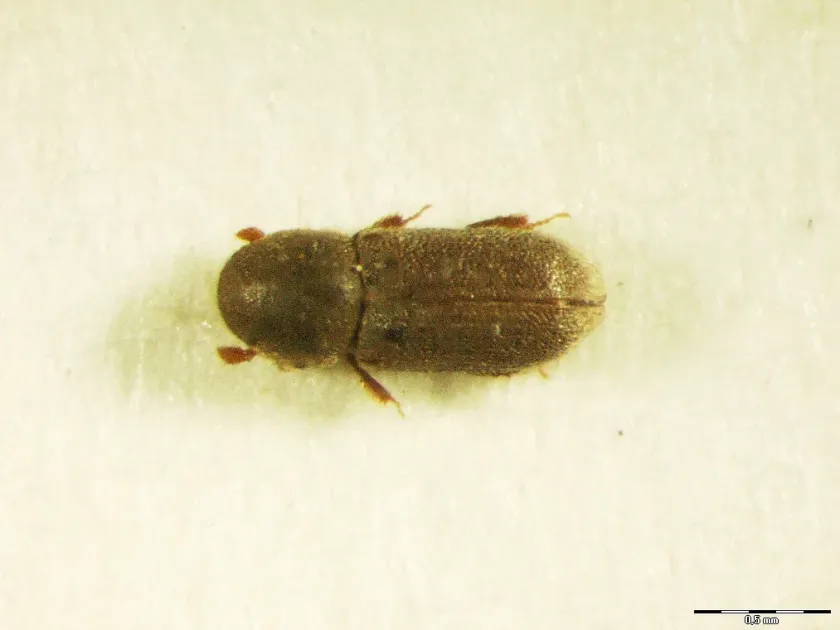
Crypturgus borealis is a minute bark beetle species within the Curculionidae family and Scolytinae subfamily. Measuring only 1.0 to 1.5 mm in length, it is among the smallest bark beetles.
The body is cylindrical and typically dark brown or blackish in color. The surface is covered with dense, short hairs, which give the insect a dull or matte appearance under magnification.
The head is almost entirely retracted into the thorax, which is a common morphological trait for bark beetles. This small size allows it to navigate easily within tight spaces under the bark.
This species is well-adapted to northern forest ecosystems. Its life history is closely tied to the bark of coniferous trees, particularly in boreal regions of the northern hemisphere.
Systematically, it is classified as a wood-boring insect that occupies the inner bark and cambium layer, functioning as a secondary colonizer within the forest habitat.
What it damages
The primary hosts of Crypturgus borealis are coniferous tree species, with spruce being the most common. It occasionally attacks pine and fir in stressed forest environments.
The damage is caused by the beetle creating elaborate, intertwined galleries in the inner bark. This activity disrupts the vascular tissues of the tree, significantly hindering nutrient flow.
As a secondary pest, it often colonizes trees that have been previously attacked by larger primary bark beetles. It fills in the unoccupied spaces of the bark, accelerating the decline of the tree.
While an individual beetle causes minimal damage, mass colonization by thousands of individuals can severely weaken the host tree, making it vulnerable to secondary fungal pathogens.
In forestry, this species is noted for its ability to increase the rate of tree mortality in already compromised stands, especially during favorable climatic conditions for the beetle.
When it appears
The flight period for adults typically occurs from late spring to early summer. During this time, beetles emerge to locate suitable host trees for mating and egg-laying.
Development is temperature-dependent, with most activity occurring when average daily temperatures remain above 10-12 degrees Celsius. The larval stages develop throughout the summer.
Overwintering occurs primarily in the adult stage under the bark of host trees or in the leaf litter at the base of the tree, which provides insulation against harsh winter temperatures.
The species usually completes one generation per year. However, variations in emergence and development times can occur based on regional microclimates and specific seasonal weather patterns.
The peak of larval feeding and gallery expansion generally occurs in mid-summer, coinciding with the period of highest thermal activity for the population.
Signs of infestation
The most prominent sign of infestation is the presence of tiny, pin-prick sized entrance holes on the surface of the bark. These holes are often difficult to spot without close inspection.
When the bark is peeled back, one can observe a complex network of branching tunnels. Unlike many other bark beetles, their galleries are often chaotic and intertwined.
Fine wood dust, or "frass," can sometimes be seen in the bark crevices or at the base of the tree. However, it is often subtle and can be easily washed away by rain.
The crown of the tree may not show immediate signs of discoloration, which makes early detection difficult. Often, the presence is only confirmed once the tree is already severely stressed.
- numerous tiny entrance holes approx. 1mm;
- complex, intertwined gallery patterns;
- presence of fine frass in bark crevices;
- gradual decline in tree health and vigor.
Control measures
The most effective control strategy involves the timely removal of infested or weakened trees from the forest stand. Sanitizing the area helps to reduce the beetle population.
Proper forest hygiene, including the removal of slash and logging residue, is crucial. These materials serve as breeding sites and should be disposed of before the beetles emerge.
Trap trees can be used to monitor population density and aggregate the beetles in a specific area. Once infested, these trees must be harvested and processed immediately.
Maintaining high overall tree vigor through proper silvicultural practices is the best long-term strategy for preventing large-scale infestations in coniferous forests.
Biological control methods, such as encouraging natural predators and parasitoids, provide a sustainable approach to managing bark beetle populations in managed forest lands.
Taxonomy
- Latin name
- Crypturgus borealis
- Order
- Coleoptera (beetles)
- Family
- Curculionidae
- EPPO code
- CRYUBO
Discussion
No discussions yet — be the first.