
Cryptoxyleborus
Cryptoxyleborus
Description
How to identify
Cryptoxyleborus belongs to the Curculionidae family and the Scolytinae subfamily. These are microscopic beetles that lead a hidden lifestyle inside wood.
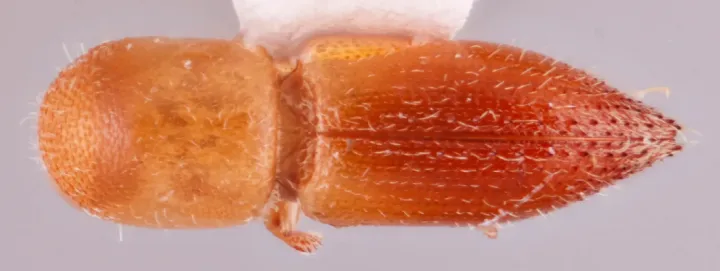
Externally, representatives of this genus have a cylindrical body typical of wood-borers, adapted for creating galleries in the hard tissues of the plant.
The coloration of the imago usually varies from dark brown to almost black, making them inconspicuous against the bark and wood background.
The size of the adult specimens is extremely small, which complicates their detection during the initial inspection of affected trunk areas or branches.
The life cycle is closely linked to symbiotic fungi that the beetles carry in special organs called mycangia, using them as food for their larvae.
What it damages
This pest primarily infests woody species in tropical and subtropical regions, often found on fruit tree plantations.
The primary hosts are weakened trees, but at high population densities, the pest can also attack perfectly healthy specimens.
The pest is dangerous to a wide range of deciduous tree species, disrupting their vascular system and causing general decline of the plant.
Significant economic damage is recorded in nurseries and young forest stands, where beetle activity leads to the premature death of seedlings.
The damage is critical as it creates entry points for secondary infections, including fungal diseases, which accelerate the wood decay process.
Signs of infestation
The main sign of the pest's presence is the appearance of tiny entry holes on the bark surface, through which the beetles penetrate inside.
Near the holes, there is often an accumulation of frass—fine sawdust ejected by the insects during the construction of internal galleries.
The internal galleries created by the beetles destroy the cambium and sapwood, leading to the disruption of nutrient and water transport.
Externally, the tree may react to the invasion by changing leaf color, wilting of individual branches, and a general decrease in annual growth rates.
When the bark is removed from infested areas, the branched systems of galleries are clearly visible, often colored dark due to fungal growth.
Control measures
The basis of control is strict sanitary management, which involves the timely removal and disposal of infested trees or their parts.
It is necessary to maintain a high level of agricultural technology, as strong trees have better immunity against infestation by wood-borers.
For monitoring the pest population, pheromone or attractant traps are used, installed near potential breeding sites.
In some cases, the use of insecticide treatments during the adult flight period is justified, although systemic preparations have limited penetration deep into the wood.
Preventive protection includes creating unfavorable conditions for the beetle, such as avoiding excessive planting density and ensuring proper irrigation.
Taxonomy
- Latin name
- Cryptoxyleborus
- Order
- Coleoptera (beetles)
- Family
- Curculionidae
- EPPO code
- CRPXSP
Discussion
No discussions yet — be the first.