
Mottled willow borer
Cryptorhynchus lapathi
Description
How to identify
The mottled willow borer (Cryptorhynchus lapathi) is a member of the Curculionidae family, widely known as a destructive stem borer for various hardwood trees.
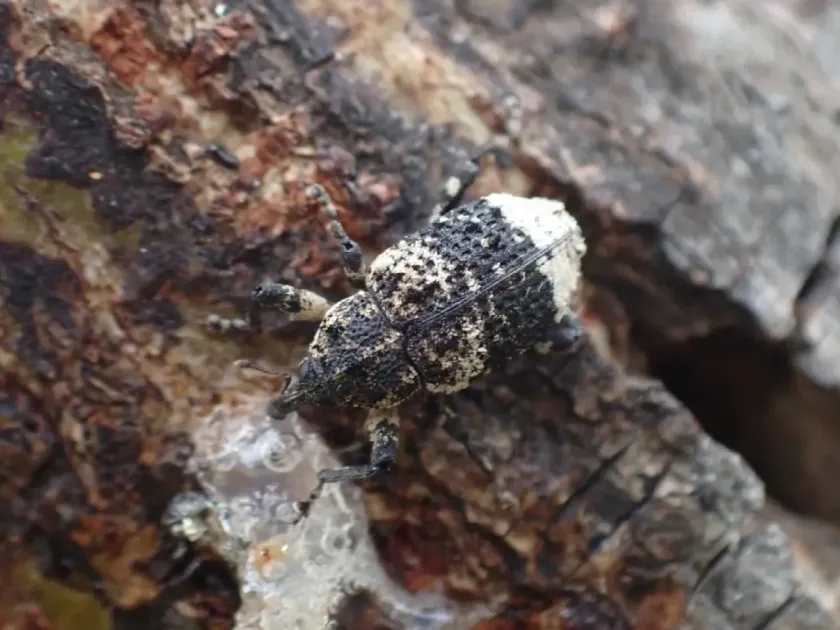
Adult weevils are 6–9 mm long, with a distinct snout and a mottled appearance created by dark and light scales. They possess strong legs and a hardened thorax.
The larvae are legless, C-shaped, and creamy white with a brownish head. They grow inside the woody tissue, effectively protected from many environmental hazards.
The pupal stage occurs inside a specialized chamber within the tree. This phase is crucial for the transformation into the adult beetle before emergence.
The life cycle typically spans one year. It starts with eggs laid in late summer and concludes with the emergence of new adults the following spring or early summer.
What it damages
The mottled willow borer primarily attacks species of Salicaceae and Betulaceae. Willow, poplar, alder, and birch are the main hosts for this pest.
Larval feeding creates extensive galleries in stems and branches, significantly disrupting the tree's vascular system and nutrient transport.
Young trees are often girdled by larval activity, which causes top dieback or complete tree death. In older trees, it causes severe structural weakness.
The presence of these galleries opens pathways for fungi and bacteria, leading to wood decay and further deteriorating the health of the host tree.
- Willow (Salix spp.)
- Poplar (Populus spp.)
- Birch (Betula spp.)
- Alder (Alnus spp.)
When it appears
Adult weevils emerge in late spring to mid-summer, typically starting in June. This is when they feed on young bark and seek mates for reproduction.
Females deposit eggs into bark crevices or branch forks shortly after mating. This timing is essential for the larvae to hatch before the cold season begins.
Larvae hatch in late summer and immediately begin boring into the inner bark. They continue their destructive growth throughout the autumn and winter months.
Overwintering occurs primarily at the larval stage within the tree trunk. The development resumes as temperatures rise and the sap flow increases in the host plant.
Pupation takes place inside the wood during the spring. This phase is relatively short and leads to the emergence of the next generation of adult beetles.
Signs of infestation
The most evident sign is the presence of small entry/exit holes on the bark, accompanied by sawdust-like frass (boring dust) accumulating at the base of the tree.
Deformed bark, swollen areas, or visible callous tissue often indicate where larvae have been actively tunneling through the wood.
Premature leaf yellowing, wilting, or branch dieback frequently occurs in specific sections of the tree canopy affected by the borer's galleries.
Dark fluid oozing from cracks in the bark is a common indicator of sap flow interruption caused by larval damage to the conductive tissues.
Increased branch breakage during windstorms is a common consequence of internal wood damage, signaling that the structural integrity of the tree is compromised.
Control measures
Sanitation practices such as pruning and destroying infested wood before adult emergence are the primary methods for managing localized populations.
Systemic insecticides applied during the peak flight season can kill adult weevils before they lay eggs, preventing new infestations.
Maintaining tree vigor through proper watering, fertilization, and avoiding physical injuries to the trunk helps trees resist infestation by the mottled willow borer.
Applying protective barriers or deterrents to the stems of young, high-value nursery trees can prevent females from successfully depositing eggs.
Encouraging insectivorous birds, like woodpeckers, can provide significant natural control by removing larvae from the bark in both forest and garden settings.
Taxonomy
- Latin name
- Cryptorhynchus lapathi
- Order
- Coleoptera (beetles)
- Family
- Curculionidae
- EPPO code
- CRYPLA
Discussion
No discussions yet — be the first.