
Fir bark beetle
Cryphalus piceae
Description
How to identify
The fir bark beetle (Cryphalus piceae) is a small wood-boring insect belonging to the Curculionidae family. Adult beetles are typically 1.5–1.8 mm long, cylindrical in shape, and dark brown to black in color.
The body is covered with fine, short, light-colored hairs. Larvae are legless, C-shaped, and creamy white with a distinct brown head, commonly found within the cambium layer.
These insects are primarily nocturnal, which makes their detection challenging. They prefer to overwinter in adult form beneath the bark of host trees or in specifically constructed galleries.
The life cycle is closely tied to environmental temperatures, with the emergence of adults usually occurring in spring once temperatures remain consistently above freezing.
Females bore through the outer bark to create egg galleries. Depending on the climate, the species may produce one or two generations per year.
What it damages
The primary host for this pest is the silver fir (Abies alba) and other related fir species. It may occasionally infest spruce if the trees are under significant stress.
Young trees and thin-barked branches of mature trees are the most susceptible. The damage is particularly severe in nurseries and young forest plantations.
Infestations are often triggered by external stress factors such as prolonged drought, wind damage, or recent frost events that weaken the tree's natural resin defense.
By feeding on the inner bark and cambium, both adults and larvae disrupt the flow of nutrients and water, eventually causing localized or systemic death of the host.
Once a tree is severely weakened, its ability to produce resin defense mechanisms drops, allowing for an exponential increase in the beetle population.
Signs of infestation
The presence of Cryphalus piceae is indicated by small, pin-hole-sized entry points on the bark. Around these holes, you can often see brown wood dust or "frass."
As the infestation progresses, needles begin to yellow and drop prematurely. The crown of the tree may start to die back, starting from the upper or outermost branches.
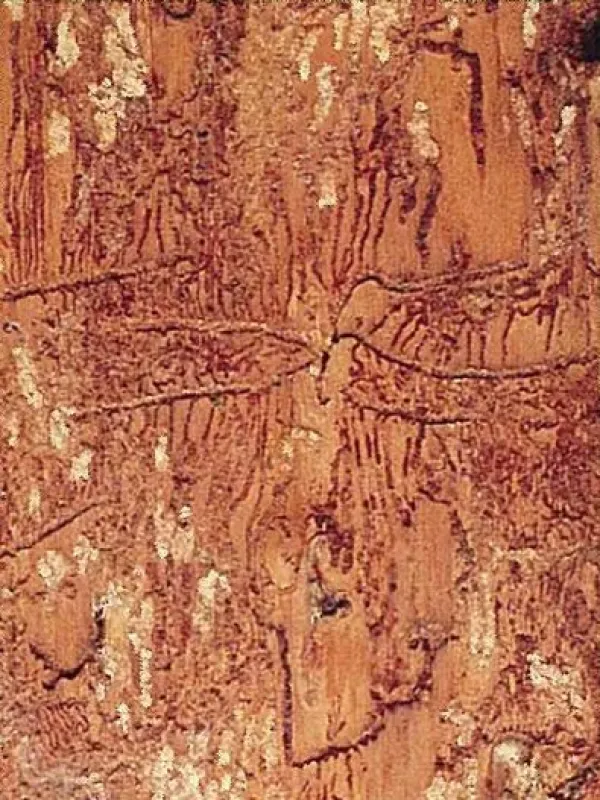
If a portion of the bark is peeled back, a maze-like pattern of egg and larval galleries becomes visible, often showing the extent of the damage to the cambium.
Visible resin flow may occur at the initial stages of the attack, but as the tree becomes overwhelmed, resin production ceases completely.
In the final stages, the bark becomes brittle and may start to detach from the wood, which is often accompanied by the presence of exit holes made by the next generation of adults.
Control measures
Sanitation is the primary management tool. All infested materials, including branches and weakened trees, should be removed and destroyed before the new generation emerges.
Monitoring using pheromone-baited traps is essential for tracking population levels and timing the application of chemical or biological control measures.
Maintaining tree vigor is the most effective preventative measure. Adequate irrigation and balanced soil nutrition help trees sustain the resin pressure needed to deter boring insects.
Systemic insecticides can be applied during the adult flight period. Proper coverage of the trunk and primary branches is critical for the treatment to be successful.
- Prompt removal of storm-damaged or stressed trees.
- Clearance of logging residues to reduce potential breeding sites.
- Application of specialized insecticides during the peak flight season in spring.
Taxonomy
- Latin name
- Cryphalus piceae
- Order
- Coleoptera (beetles)
- Family
- Curculionidae
- EPPO code
- CRYHPI
Discussion
No discussions yet — be the first.